
The Content
Crossover
Jump to Section
Forward
This AI content market outlook was written by Ted Murphy, Founder of COEY and Founder and former Chairman and CEO of IZEA (NASDAQ:IZEA). Ted is widely recognized as the father of influencer marketing, a pioneer who created an industry that transformed the relationship between brands and creators. With COEY, his focus is now on the intersection of artificial intelligence and content creation. Drawing from decades of experience building platforms that shaped how culture is made and shared, Ted offers a clear perspective on what lies ahead as generative tools redefine the landscape of marketing and media.
Of course, Ted did not write this alone. This paper was co-created with COEY’s suite of artificial intelligence tools, because we believe the future belongs to man plus machine. That collaboration is not just our process, it is our philosophy. The ideas that follow are a product of human insight sharpened by machine intelligence, a partnership that reflects the very world we are describing… one where people and algorithms combine to shape what we see, what we share, and what we value.

Introduction
By 2028, more than half of all new content online will be generated by artificial intelligence. This is our prediction at COEY, based on the research we have done and the trends we observe daily in the market. We call this moment the Content Crossover.
The crossover is not a decade away. It is three years from now. For enterprise brands, agencies, and marketers, that means the time to prepare is today.
The signals are unmistakable:
-
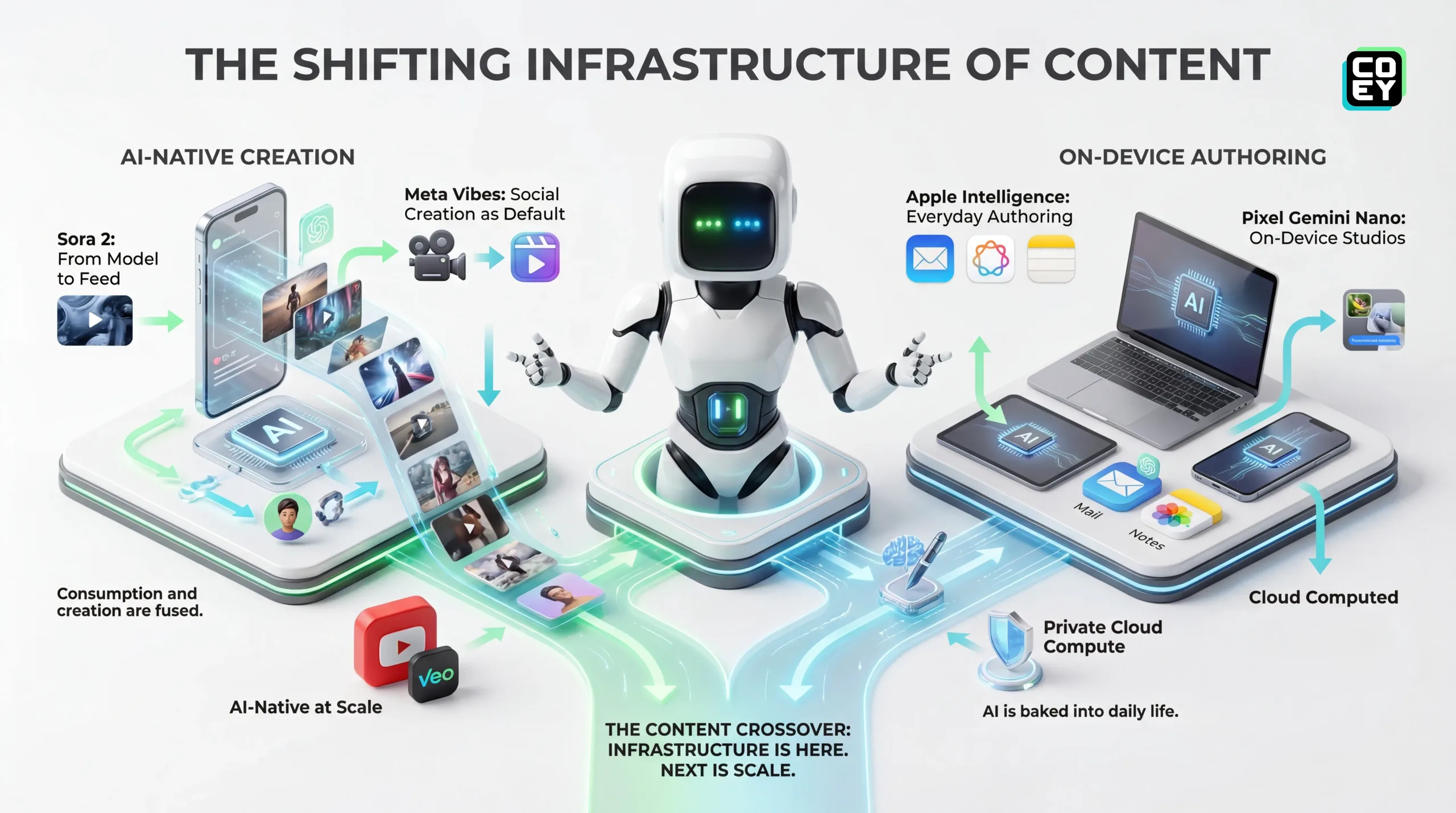
Infrastructure shift: OpenAI’s Sora 2, with its cinematic video engine and AI-generated feed, shows what happens when creation and consumption merge. Meta’s Vibes feed reframes social media as a remix-first playground. YouTube has embedded Veo tools for instant AI-powered editing and publishing. Apple Intelligence and Pixel Gemini Nano put AI creation directly inside billions of devices.
-
Consumer surge: In 2024, generative AI apps were downloaded 1.5 billion times worldwide, a 92 percent increase year over year. Consumer spending on these tools passed 1.3 billion dollars. ChatGPT, Gemini, and Sora consistently lead app store charts.
-
Cultural consequence: Algorithms are no longer just distribution systems. They have become tastemakers, curating not only what we watch but what we create.
Together, these shifts are driving an explosion of output. Content is about to hyperscale. The cost of production is collapsing, the speed of iteration is accelerating, and the competition for attention is governed by algorithms. In this world, the old strategy of investing in a few highly polished campaigns is not enough. Relevance will depend on throughput, variation, and the ability to produce more shots on goal.
As the founder of IZEA and someone who helped create the influencer marketing industry, I have seen firsthand how shifts in content creation redefine entire markets. The rise of AI is the next great shift. Its impact will be even larger and faster. The Content Crossover will not just change how content is made. It will change how brands, agencies, and marketers operate at every level.

THE SHIFTING INFRASTRUCTURE OF CONTENT
The Content Crossover is not powered by abstract theory. It is being built in plain sight, through the tools and platforms that billions of people already use. When we zoom out, we can see a clear infrastructure shift: content creation is moving from expensive, siloed, and human-limited workflows into native, integrated, AI-first systems. This is not a hypothetical future. It is happening now.

Sora 2: From Model to Feed
When OpenAI first launched Sora, it was easy to think of it as just another generative model. The outputs were cinematic and stunning, but the model still felt like a specialized tool. With Sora 2, that changed. Sora 2 is not just a model. It is an ecosystem. The app itself now includes an AI-generated feed. Every clip in that feed is synthetic, produced by the model, and designed for remix. Users scroll through AI-native video the same way they scroll through TikTok. The difference is that every piece of content can be regenerated, extended, or personalized instantly.
This matters because consumption and creation are fused. You no longer need separate workflows for inspiration and production. The same feed that entertains you also prompts your next creation. Every clip is a starting point, which means content is no longer fixed but fluid. Most importantly, algorithms drive creation. The feed suggests not only what to watch but what to make. This turns the platform itself into a creative director. For brands and agencies, Sora 2 is a glimpse into a future where creative briefs are replaced by algorithmic nudges. Imagine an AI feed that shows your team the trending narrative formats of the day, then generates branded variations on demand. The implications for speed, relevance, and cultural alignment are massive.
Meta Vibes: Social Creation as Default
Meta’s Vibes represents another milestone. While Sora is pushing video into new territory, Meta is reframing what a feed even is. Traditionally, social feeds have been about discovery and distribution. Vibes flips the script: the feed is no longer just a place to consume. It is a place to make. Every piece of content in Vibes is designed for remix and iteration. The social experience is not about posting a finished work, but about contributing to an ongoing chain of creation.
Remix becomes social currency. The act of creating with someone else’s prompt or clip is the new like or share. Brands will need to play natively. A polished ad dropped into Vibes will feel out of place. What works are quick iterations, playful riffs, and interactive formats that invite participation. Social is now a studio. Agencies that once treated social media as a distribution channel must now think of it as a collaborative production environment. For enterprise marketers, Vibes signals that future campaigns may need to launch not with a single hero asset, but with dozens of remix-ready building blocks that audiences can co-create with.
YouTube and Veo: AI-Native at Scale
YouTube remains the largest video platform in the world, and its decision to integrate Veo AI tools directly into the app is a clear signal that AI-native creation is not optional; it is the new baseline. Features include Edit with AI for rewriting and trimming, AI music generation for mood-based soundtracks, AI-powered Shorts creation, and SynthID watermarks to normalize provenance.
For creators, this means AI is embedded where audiences already are. There is no need to leave the platform for production. For enterprises, it demonstrates scale and legitimacy. When the largest video platform treats AI content as first-class, adoption accelerates across the industry. Watermarks will not slow the flood of AI content. They will make it safer for brands to embrace. Agencies must be prepared for creative operations to move inside platform ecosystems. The external production suite may give way to workflows embedded directly within YouTube, TikTok, or Meta.
Apple Intelligence: Everyday Authoring
Apple’s introduction of Apple Intelligence shows another angle of transformation. Unlike many AI rollouts, Apple’s approach is about baking AI into daily life. Writing and rewriting tools now live in Mail and Notes. Image generation produces contextual visuals. Personalized assistance runs through Private Cloud Compute to safeguard privacy.
Apple matters for three reasons. First, the reach: billions of devices instantly gain these tools. Second, the everyday nature: AI is not limited to projects but shows up in emails, texts, and reminders. Third, the trust factor: Apple has set expectations for privacy in enterprise workflows. For marketers, the message is clear. The devices people use every day are now content engines. Teams must rethink workflows that assume laptops and studios as the center of production.
Pixel Gemini Nano: On-Device Studios
Google has taken a different path with the Pixel 9, which ships with Gemini Nano for on-device creation. Key features include Pixel Studio for content generation, Call Notes for transcription and summarization, and intelligent screenshot workflows. Unlike Apple, which leans on ecosystem trust, Google leans on technical power.
On-device generation means creativity is no longer tethered to the cloud. Edge AI becomes real, reducing latency and making tools faster and more responsive. Platform competition between Apple and Google will accelerate adoption across demographics. For enterprise marketers, the implication is simple. Everyone with a modern phone now has a studio in their pocket. Campaigns will not just compete with other professional creators, but also with consumers producing AI-native content instantly.
THE DEMAND SIDE
The infrastructure of AI-first content creation is here, but infrastructure alone is not enough to drive transformation. The other half of the Content Crossover story is demand. Consumers are not passively waiting for AI to become mainstream – they are actively pulling it into their lives. The market signals from 2024 and 2025 are unmistakable, and they show why 2028 is not a distant horizon but an imminent tipping point for AI-driven content.
Explosive Growth in Generative AI Apps
In 2025, global downloads of generative AI apps likely surpassed 3 billion, roughly doubling from 1.5 billion in 2024 (SensorTower, Tribune). That 2024 figure itself was almost double the ~800 million downloads seen in 2023 (BusinessDay).
Consumer spending is following the same meteoric trajectory – in-app purchases in generative AI apps jumped from about $0.45 billion in 2023 to $1.3 billion in 2024 (BusinessDay). They are on track to reach an estimated $4 billion by the end of 2025 (over 3× year-over-year growth) (TechCrunch). These are not experimental hobbyist tools; they are mass-market utilities with real revenue engines.
Downloads matter because they show reach, and spending matters because it shows value. Together, these metrics demonstrate that generative AI has already broken through the adoption barrier that many new technologies struggle to cross. This is not like VR – which saw hype cycles but limited penetration – it’s closer to the smartphone moment, when a powerful tool went from niche to mainstream within a few short years.
Notably, this demand is global: apps with AI features were downloaded 17 billion times in 2024 (13% of all app downloads), with markets like India, the U.S., and Brazil each contributing over a billion AI app downloads (BusinessDay). In other words, consumers worldwide have “voted with their fingers” to make AI part of everyday mobile experience.
AI Apps Topping the Charts
Another signal comes from the app stores themselves. ChatGPT, Google Gemini, and OpenAI’s new Sora app are not buried in some niche category – they have repeatedly topped the overall charts on both the Apple App Store and Google Play.
For example, OpenAI’s Sora (a text-to-video creation app) shot to the No. 1 overall free app on the U.S. App Store within days of its late-2025 launch (TechCrunch), leapfrogging even incumbent social media and entertainment apps. Likewise, OpenAI’s ChatGPT hit the #1 spot on the App Store upon its debut (May 2023) and has remained a top-ranking app since, while Google’s Gemini app quickly climbed into the top downloads after release. This means AI apps are competing directly with gaming, streaming, and social apps — and winning.
By late 2025, AI apps even began to dominate revenue leaderboards: ChatGPT rose to the #2 spot globally for consumer app revenue (trailing only TikTok) and hit #1 in Turkey, Brazil, and Canada (Gamigion). Google’s Gemini reached #6 globally (Gamigion). The fact that AI-driven apps are displacing traditional entertainment and communication apps shows that AI is front and center in consumer life.
From Curiosity to Habit
Early adoption often skews toward curiosity: consumers try something new, experiment briefly, then churn. What we’re seeing with generative AI is different. Engagement data shows that people are returning to these apps and forming daily habits.
In the first half of 2025, users worldwide spent 15.6 billion hours in generative AI apps (over 426 billion sessions), up from 8.5 billion hours in the previous half-year (Tribune). Usage nearly doubled in six months.
OpenAI’s ChatGPT app is used on 12.1 days per month on average by its users — comparable to major platforms like Reddit or X — with only Google Search surpassing it (Tribune). People spent 16 minutes per day in the ChatGPT app in H1 2025, approaching the 18.2 minutes/day of search engine apps (Tribune).
Survey data in mid-2025 showed that 61% of American adults have used AI in the past six months, and nearly one in five use it daily (Menlo VC). Scaled globally, that implies over 1.7 billion people have tried AI tools, with 500–600 million daily users (Menlo VC). This is no longer experimentation — it is habit formation at unprecedented scale.
More than 15% of U.S. ChatGPT users access it on both web and mobile, a higher cross-platform rate than many major apps
Cultural Legitimacy
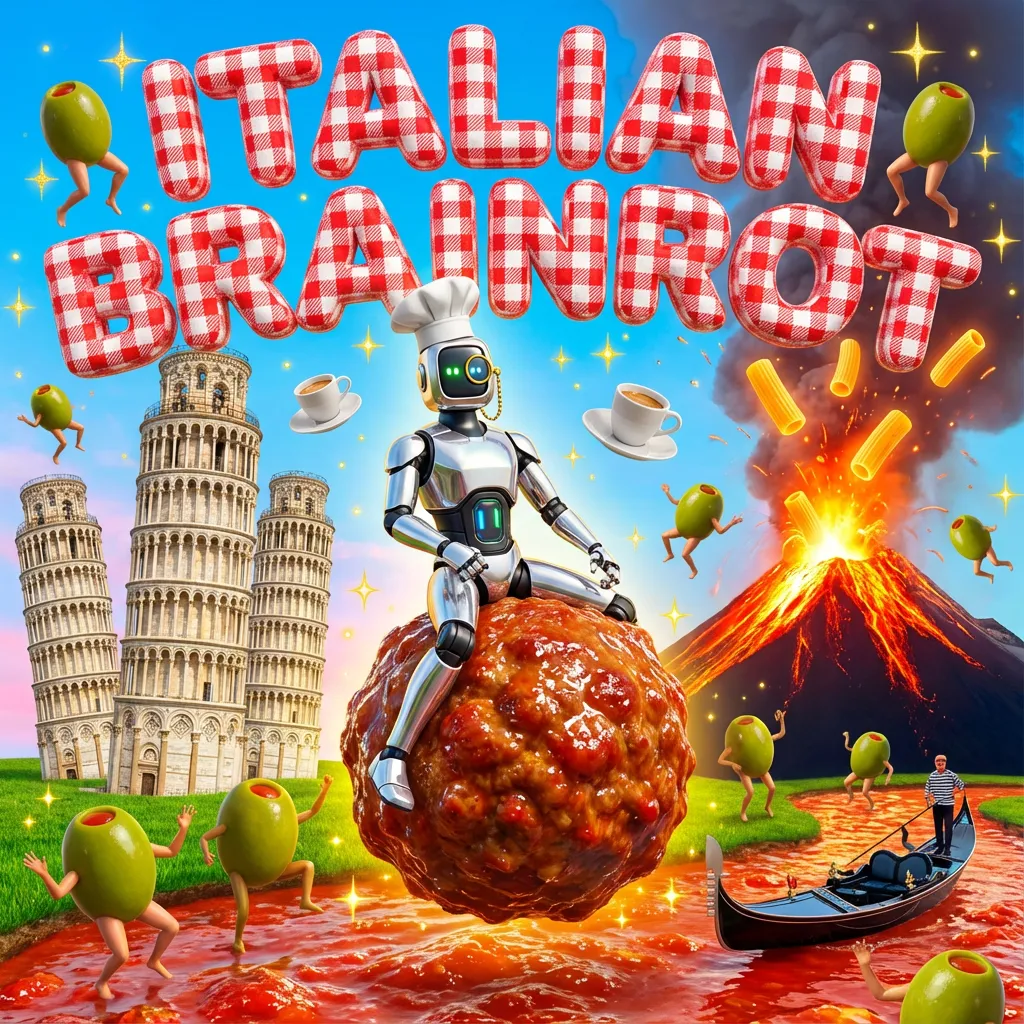
Consumer adoption is not only about numbers; it’s also about legitimacy. AI-generated content is now everywhere. TikTok feeds in 2025 have been filled with AI-generated memes, remixes, and effects that go viral alongside human-made content. One of the year’s biggest meme trends — the surreal Italian Brainrot format — was entirely AI-generated, yet became one of the most shared memes of 2025 (CSR Journal).
On YouTube and Instagram, creators routinely blend human and AI-generated footage in Shorts and Reels. Instagram’s latest filters and TikTok’s trending effects increasingly rely on generative AI, normalizing synthetic visuals as part of the creative palette.
The stigma around “fake” content is eroding.
Just as influencer marketing was once dismissed until it became normal, AI-generated content is shifting from suspicion to acceptance. A digitally altered AI image of global tech CEOs standing together — the fictional “$1 trillion squad” — spread widely in late 2025, sparking memes and discussion despite being fully synthetic (CSR Journal).
Consumers are not only comfortable with AI-made content — they are actively engaging with it, sharing it, and building culture around it. AI content now has cultural legitimacy. Brands that understand this demand pull will be well positioned as we approach the 2028 tipping point, when AI-driven creation becomes a mainstream expectation.
ALGORITHMS AS TASTEMAKERS
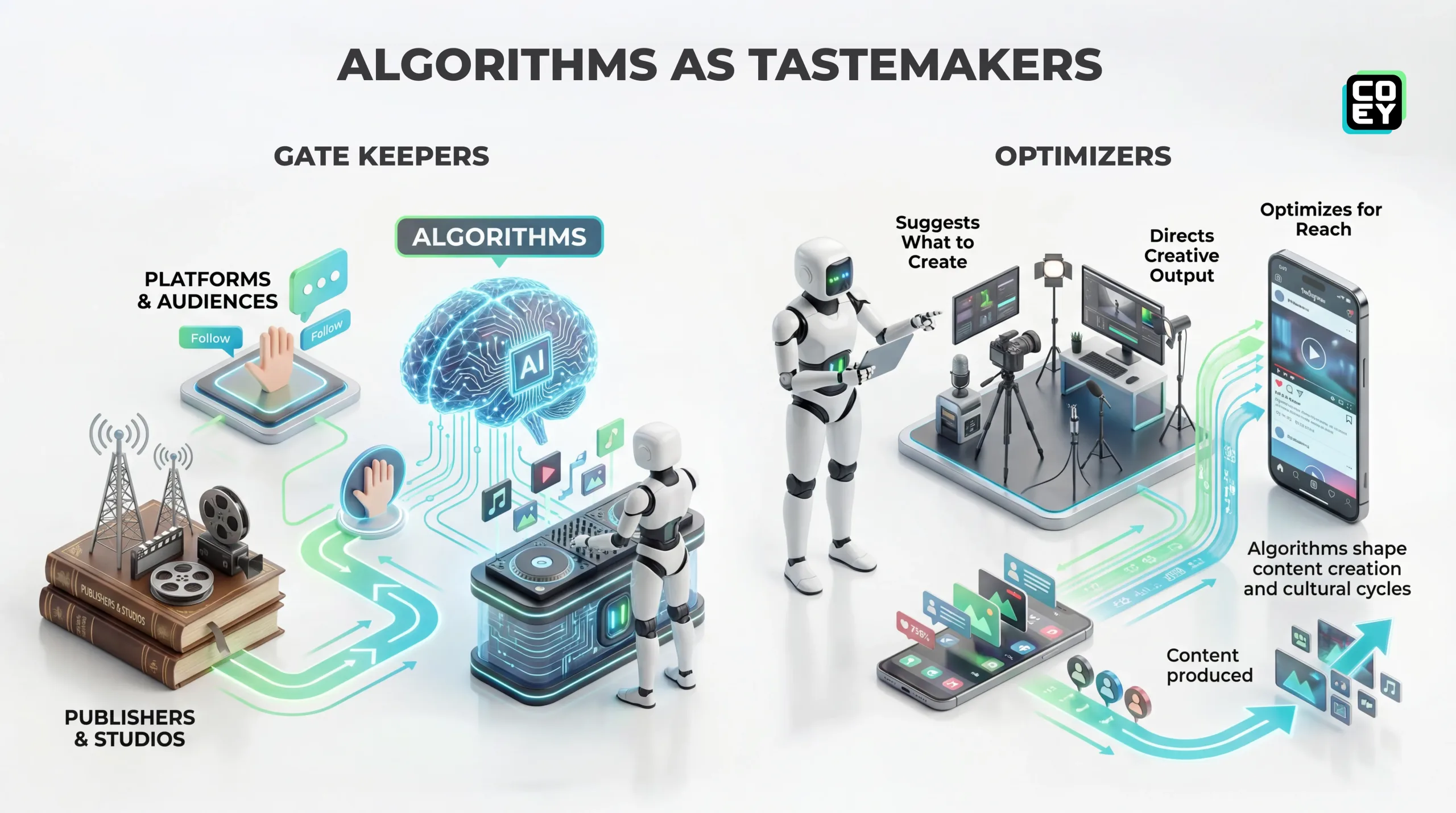
The Content Crossover is not only about tools and consumer adoption. The most profound shift lies in who decides what content gets seen. In the old media world, editors and executives determined which books were published, which songs hit the radio, and which commercials aired on television. In the first wave of digital media, the internet lowered the barrier to entry but left curation in the hands of humans — followers, fans, and subscribers. In the AI-first world, algorithms have fully taken over. They are no longer neutral distributors. They are tastemakers, shaping what we see, what we engage with, and increasingly, what we create.
The Evolution of Gatekeeping
Every generation of media has had its gatekeepers. Publishers and studios once controlled distribution through scarce access to printing presses and broadcast networks. The rise of the social web shifted that control to platforms, but the gatekeeping remained human at its core: creators needed to attract followers, and audiences decided what spread. With algorithmic feeds, that model changed. A single post could be pushed to millions of viewers overnight, regardless of follower count, based on engagement signals. TikTok’s For You Page, YouTube’s recommendation engine, and Instagram’s Explore feed set the standard. Algorithms became the deciding factor in attention.
From Distribution to Direction
What is different now is that algorithms are not only distributing content, they are directing its creation. Sora’s feed is designed to suggest not just what to watch, but what to generate next. Meta’s Vibes encourages users to remix and build on what is trending in real time. Even YouTube’s Veo integration quietly directs creative output through suggested edits, soundtracks, and Shorts formats optimized for the recommendation engine.
This matters for brands and agencies because it shifts the center of gravity in creative decision-making. Marketers are no longer competing for the attention of audiences alone. They are competing for the attention of algorithms that filter what audiences even see.
The algorithm becomes the first audience, the one that must be impressed in order to unlock reach.
Algorithms Reward Velocity and Volume
One reason algorithms have such influence is scale. No human could sift through the millions of videos, posts, and images uploaded each hour. Algorithms do this automatically, testing content in small batches, expanding the reach of what performs, and burying what does not. This creates a statistical logic of success. It is not enough to create one great piece of content. The odds are against it breaking through. The winning strategy is to produce enough volume and variation that the algorithm has something to latch onto. More shots on goal increase the probability of success.
The Feedback Loop of Creation
Once algorithms decide what gets surfaced, they also shape what gets made next. Creators imitate what works, audiences demand more of it, and algorithms amplify the cycle. With generative AI, this feedback loop accelerates. A trend can be identified, copied, remixed, and re-uploaded within hours, not weeks. The algorithm provides direction, and AI tools provide speed. For enterprise marketers, this means cultural cycles will move faster than ever before. A format that emerges in the morning may peak by afternoon and feel stale by the end of the week.
The Implications for Brands and Agencies
If algorithms are the new tastemakers, then creative strategy must adapt. Success will come from understanding how algorithms evaluate content and feeding them accordingly. That means producing at scale, testing relentlessly, and optimizing for early engagement signals. It also means being comfortable with iteration over perfection. The campaign built for a six-month arc will not survive in a world where the algorithm reshuffles attention daily. Brands and agencies must instead build systems that generate constant variation, measure performance in real time, and feed the next cycle of creation before it even begins.
The Content Crossover is not just about machines making content. It is about machines deciding what content matters. For marketers, this requires a fundamental mindset shift. The most important tastemaker is no longer an editor, a producer, or even a social influencer. It is an algorithm.
THE HYPERSCALING OF CONTENT
The infrastructure is in place. Consumers are adopting at scale. Algorithms have taken over as tastemakers. Put these forces together and the outcome is clear: content output is about to hyperscale. For enterprise brands and agencies, this is the most disruptive element of the Content Crossover. It changes the math of relevance.
The Collapse of Production Costs
In the traditional model, creating content required significant resources. Producing a 30-second television spot could cost hundreds of thousands of dollars and take weeks to complete. Even in the social media era, video production demanded cameras, crews, and editing time. AI is collapsing those costs and timeframes. A single marketer with access to Sora, Veo, or Gemini Nano can generate dozens of high-quality videos in a single day. The marginal cost of production is already pennies to dollars and approaching zero, and the marginal time investment is measured in seconds.
Generative image tools make art direction instantaneous. Music generation tools create custom tracks at no additional expense. What once took days of specialized labor now takes moments on a phone. For enterprise marketers, this is liberating and daunting at the same time. Budgets can stretch further, but the volume of competition increases exponentially.
Exponential Growth in Output
When production becomes cheap and instantaneous, content output multiplies almost without limit. A single creator can now generate hundreds of variations in the time it once took to perfect one piece. The result is an explosion of material hitting the internet each day – a true exponential growth curve in content creation. What began as a trickle of AI-generated posts and media has swelled into a flood. By 2025, generative AI was no longer a niche novelty but a significant slice of online content, and the curve is only getting steeper going into 2026.
The data from the past two years makes the trend clear.
In 2023, AI-generated content was a relatively small fraction of what was published online – roughly 5% of new material by some estimates. By 2024, that share had grown to high single digits, and 2025 marked a true inflection point. Researchers found evidence that AI was responsible for an ever-expanding portion of what’s on the web: one analysis even suggests that at least 30% of the text on active web pages in early 2025 was AI-generated, with the figure possibly closer to 40% (arXiv). The breadth of AI-created content also expanded. For example, the number of websites publishing entire news articles written by AI jumped from just 50 in mid-2023 to over 1,250 by early 2025, each churning out new copy daily (arXiv). This kind of prolific output would have been unthinkable a few years prior, but it’s the new reality when generative tools handle the heavy lifting.
Our updated projections show the steep curve continuing unabated. If generative content made up only a sliver of online media in the early 2020s, it is now on track to comprise a double-digit percentage of all new content. We estimate it crossed into the teens by the end of 2025 and will approach ~28% of new content in 2026, roughly 40% in 2027, and 50% or more by 2028, meaning half of all online content could be AI-generated within a few years. The inflection point is not gradual or distant; it is happening right now.
Attention Is Finite
While output grows exponentially, human attention remains finite. People cannot suddenly double the number of hours they spend consuming content. This creates an imbalance: exponential growth in supply meets linear growth in demand. The result is oversaturation. Every feed is flooded. Every scroll presents infinite choice. In this environment, algorithms become the necessary filters, deciding what rises and what disappears.
For marketers, this means the probability of any single piece of content breaking through decreases. The old model of investing heavily in a single campaign is no longer sustainable. Even the most beautifully crafted piece of work may vanish in the flood. The only way to compete is through scale. More shots on goal increase the odds of landing on target.
The Half-Life of Content Shrinks
Hyperscaling also changes the lifespan of content. In the past, a television ad could run for months. Even in the early days of social media, a strong campaign might trend for weeks. In the AI-driven environment, the half-life of content shrinks dramatically. A video that trends in the morning can feel stale by nightfall. Memes peak and die in hours. Cultural cycles spin faster because generative tools enable instant iteration and saturation.
For brands and agencies, this means planning long arcs around single assets is risky. Strategy must shift toward continuous iteration, real-time adaptation, and constant refresh. The winners will be those who can produce at velocity and pivot in response to algorithmic signals.
The Rise of Iteration Over Perfection
Hyperscaling favors iteration. Perfection is a liability when the cultural cycle moves faster than your production schedule. Brands that hold back content until it is flawless risk irrelevance. Instead, the focus must be on producing variations, testing them quickly, and doubling down on what works. The algorithm rewards those who play the numbers game. It does not matter if nine out of ten posts fail, as long as the tenth takes off.
This requires a mindset shift for enterprise organizations. Creative excellence is still important, but it emerges from volume, testing, and refinement rather than from long, polished production cycles. Agencies must adapt their workflows to deliver not just campaigns, but systems that generate continuous streams of content.
Hyperscaling means enterprise brands and agencies will need to rethink the fundamentals of creative strategy. Budgets must be allocated to throughput, not just craft. Metrics must evolve to measure velocity and variation, not just views or impressions. Teams must be structured for rapid iteration, with AI integrated into every stage of production. Most importantly, leaders must recognize that the Content Crossover is not about doing more of the same. It is about embracing a fundamentally different model where scale itself is the key to relevance.
WHY “MORE SHOTS ON GOAL” MATTERS
The Content Crossover forces enterprise brands and agencies to rethink everything about how they approach content. When half of all new content online is made by AI, the competition for visibility will not be won by a few carefully crafted campaigns. It will be won by those who can operate at scale, producing enough variations and iterations to feed the algorithms that now act as cultural tastemakers.
Relevance will belong to those who treat content as a volume game, not a perfection contest.
From Campaigns to Content Systems
For decades, enterprise marketing revolved around the campaign model. Agencies would spend months developing a single hero concept, crafting polished assets, and launching them in waves across television, print, digital, and social. This model made sense when production was expensive and distribution channels were limited. But in 2026, that logic no longer applies. Production is cheap, distribution is infinite, and attention is rationed by algorithms. Campaigns are too slow and too rigid to survive in a hyperscaled environment.
What replaces them are content systems. Instead of one hero ad, brands need modular creative architectures that generate dozens, hundreds, or even thousands of variants. These systems must be dynamic, responsive to cultural signals, and optimized for real-time performance. The new measure of creative excellence is not how perfectly a single campaign is executed, but how effectively a system can continuously generate and test variations until winners emerge.
The Old Model vs. The New Model
| Old Model | New Model |
|---|---|
| Craft one perfect ad spot | Generate one hundred variations instantly |
| Launch one campaign per quarter | Launch one campaign per day |
| Creative cycles driven by annual planning | Creative cycles driven by algorithmic signals |
| Measure success in views and impressions | Measure success in velocity, iteration, and remix rate |
| Depend on agencies for bottlenecked production | Depend on AI systems for continuous iteration |
| Audience feedback collected weeks after launch | Algorithmic feedback visible in hours or minutes |
| Perfection prioritized over speed | Speed prioritized, perfection emerging through iteration |
The Algorithm as the First Audience
In the Content Crossover era, algorithms are the first audience. They decide whether a piece of content will ever be seen by a human. They reward recency, engagement velocity, and variation. A polished video that fails to capture early engagement will sink quickly. A rough but timely variation that triggers interaction will be amplified. This is why volume and iteration matter more than perfection. If you only have one shot on goal, the odds of success are slim. If you have one hundred, the odds improve dramatically.
Brands must learn to impress the algorithm before they can impress the audience.
Agencies as System Builders
For agencies, this is both a challenge and an opportunity. In the old model, agencies were responsible for storytelling, design, and production. In the new model, they must also become system builders. Their task is not just to create campaigns, but to design frameworks that can produce endless iterations, measure results in real time, and feed the cycle of continuous adaptation. The agencies that master this transition will be indispensable. Those that cling to old models risk irrelevance.
New Metrics for Success
With more shots on goal as the guiding principle, success must be measured differently. Legacy metrics such as total views or impressions fail to capture the dynamics of an algorithm-driven environment. Instead, brands and agencies should focus on:
- Content velocity: How quickly can the team move from idea to publication?
- Variant volume: How many iterations can be produced per concept?
- Engagement half-life: How long does each asset sustain attention before fading?
- Remix rate: How often are consumers and creators building on top of brand-generated content?
- Algorithmic amplification: What percentage of assets earn extended reach through recommendation systems?
Organizational Implications
The shift to more shots on goal requires structural changes. Enterprise teams must break down silos between creative, media, and analytics. AI must be embedded across every stage of production, from ideation to editing to reporting. Leadership must accept that perfection cannot be the starting point. Instead, perfection emerges from iteration, guided by real-time feedback. Budgets must shift away from a few expensive campaigns toward systems designed for ongoing throughput. Agencies must reconfigure their business models to align with this reality, moving from project-based billing to value tied to iteration, testing, and performance.
The brands that thrive will not be those with the single best idea. They will be those with the most adaptive systems for producing ideas at scale.
Why This Matters Now
2028 is only two years away. In enterprise planning cycles, that is a single budgeting horizon. The time to adapt is now. Brands that wait until AI content is already the majority will be too late. Agencies that fail to reimagine their role as system builders will find themselves outpaced by competitors who can deliver scale. The Content Crossover is not just about technology. It is about a new creative economy where volume, velocity, and variation decide who stays relevant.
BEYOND THE CROSSOVER
The Content Crossover is the tipping point, not the end state. Once artificial intelligence creates more than half of all new content online, the rules of marketing, media, and culture will continue to evolve at rapid speed. For enterprise brands and agencies, it is essential to look beyond 2028 and anticipate the dynamics that will shape the next era of content creation and consumption.
Hyper Personalization at Scale
Today, personalization often means serving different audiences different ads based on demographics or behavior. After the Crossover, personalization will reach a new level. Artificial intelligence systems will be capable of producing fully customized assets for individuals in real time. Every person scrolling a feed could see a different variation of the same campaign, tuned to their preferences, behaviors, and context. This is not mass marketing, it is marketing of one executed at infinite scale.
After 2028, personalization will no longer be a strategy. It will be the baseline expectation.
The Rise of Synthetic Celebrities
Another outcome of the Content Crossover will be the emergence of synthetic influencers and brand personas. Artificial intelligence generated characters, voices, and personalities will gain audiences of millions. Unlike human influencers, they will not age, fatigue, or risk scandal. They will be consistent, scalable, and available at all times. For enterprise marketers, this opens opportunities to build proprietary brand owned personalities that can function as spokespersons, entertainers, and cultural icons. The challenge will be authenticity. Synthetic personas must feel real enough to connect emotionally with audiences, or they risk rejection as shallow and disposable.
The Battle Between Authenticity and Abundance
As synthetic content floods the digital world, authenticity will become more valuable. Consumers will crave human experiences, live events, and transparent storytelling as a counterweight to the endless stream of machine made material. This creates a paradox. The more synthetic content dominates, the more premium authenticity becomes. Brands that can balance both, delivering the efficiency of artificial intelligence driven scale while offering genuine human connection, will stand out.
Algorithmic Culture Cycles
Once machine generated output reaches majority share, cultural cycles will move faster than ever. Trends will emerge, peak, and fade in hours. Algorithms will not just surface trends, they will actively generate them by nudging what gets created next. For marketers, this means strategies must account for cycles so fast that traditional planning becomes irrelevant. The winners will be those who build always on systems that can respond within hours, not weeks.
Enterprise Marketing in a Post Crossover World
What does this mean for enterprise organizations? First, investment in artificial intelligence infrastructure will be table stakes. Second, the creative process will no longer be linear. Ideation, production, distribution, and feedback will merge into a continuous loop powered by machine intelligence. Third, brand safety and governance will become critical. As synthetic content proliferates, enterprises will need robust systems to ensure consistency, authenticity, and ethical responsibility across thousands of machine generated outputs.
Key Strategic Takeaways
- Prepare for infinite variation: Every consumer could see a unique version of your content.
- Develop synthetic intellectual property: Brand owned personas and characters will be assets as valuable as logos.
- Balance synthetic and human: Offer authentic experiences alongside scalable machine driven content.
- Invest in governance: Guardrails, policies, and oversight must scale with output.
- Adopt always on systems: Creative operations must function in real time, not on campaign calendars.
The Content Crossover is not the finish line. It is the beginning of a new creative economy defined by abundance, personalization, and speed.
For brands, agencies, and marketers, the lesson is clear. The next three years are about preparing for the tipping point. Beyond that, survival will depend on building systems that thrive in a world where content is infinite, algorithms are cultural architects, and authenticity is a rare and valuable currency.