COEY Cast Episode 2
CES 2026: Safer Agents, Spicier Audio, and the AI DJ Wars
CES 2026: Safer Agents, Spicier Audio, and the AI DJ Wars



Episode Overview
01/10/2026
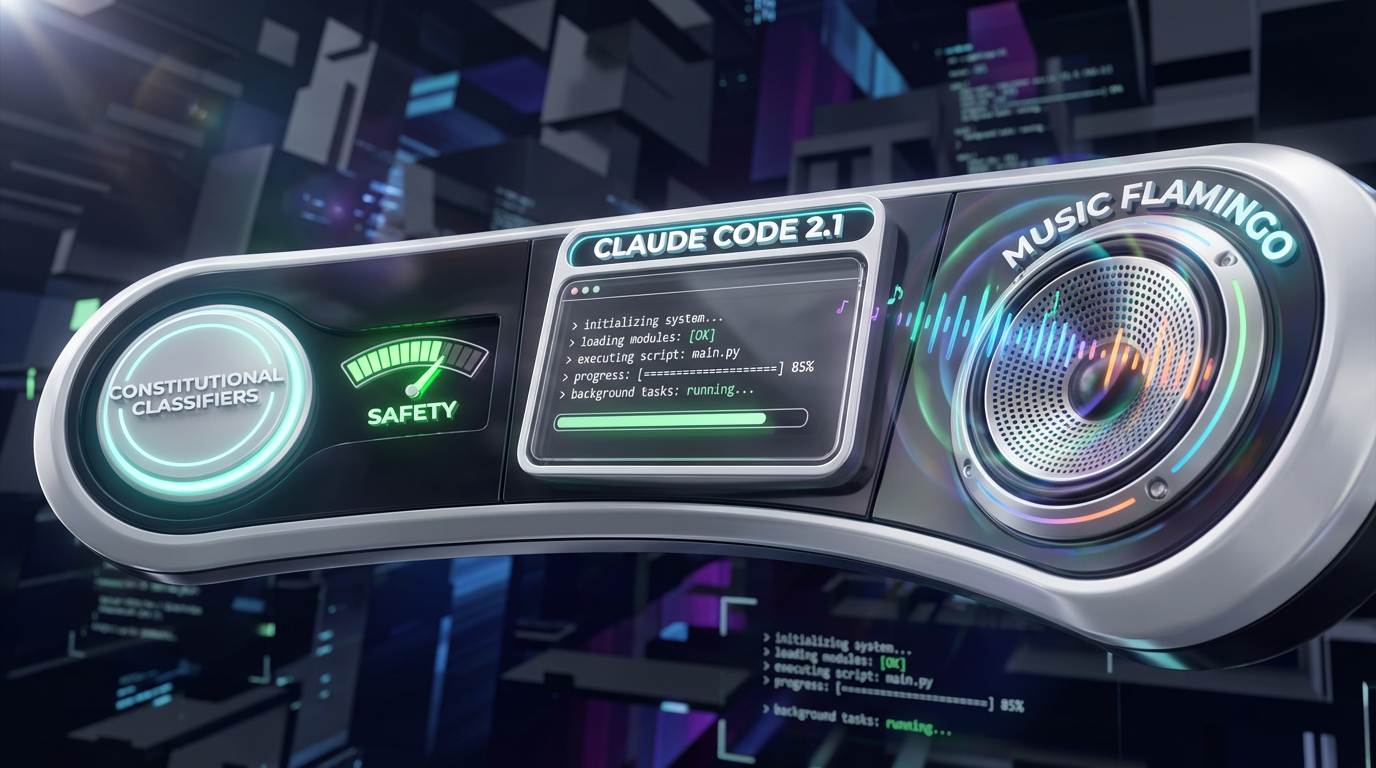
Anthropic’s next generation constitutional classifiers promise fewer jailbreaks and fewer bogus refusals by layering interpretability probes with smarter safety filters. Claude Code 2.1 pushes deeper into agent style background tasks inside developer and operator workflows, along with the reliability risks that come with autonomous CLIs. OpenAI’s upgraded speech stack improves transcription and speech to speech for creators while still needing human review for high stakes content. The emerging music AI arms race featuring tools like NVIDIA Music Flamingo and ElevenLabs music points to custom campaign soundtracks, new brand audio guidelines, and fresh legal headaches around provenance and licensing. Learn how to design workflows where agents help without wrecking production.

Episode Transcript
Hunter: It’s Saturday, January tenth, twenty twenty-six, and apparently it’s Cut Your Energy Costs Day… which is perfect because today’s episode is about AI systems trying to cut your cognitive energy costs… and sometimes accidentally cutting your will to live. This is COEY Cast. I’m Hunter.
Riley: And I’m Riley. Also, yes, this entire episode was assembled by robots. Like, genuinely. If a sentence lands weird, congratulations, you’ve just witnessed machine co-creation in the wild.
Hunter: We leave the smudges in. Today we’re digging into Anthropic’s “next-generation constitutional classifiers” research and the Claude Code two point one updates. And then we’re gonna detour into the audio world because OpenAI’s speech stack is getting spicy again, plus there’s this whole music generator arms race.
Riley: Okay Hunt, the Anthropic thing is fascinating because it’s basically like… “we made the bouncer smarter and also gave him a brain scanner.” And yet my feed is still full of people yelling, “Claude won’t answer my perfectly normal question!”
Hunter: Yeah. The promise is two things at once: fewer jailbreaks and fewer bogus refusals. The way they’re doing it is a layered approach. First layer is this interpretability probe that looks at internal activations, like a vibe check inside the model. If it smells danger, then it escalates to a heavier classifier that evaluates the exchange more deeply.
Riley: “Internal activations” is such a cursed phrase. Like, sir, why are you reading my neurons.
Hunter: Totally. But from a workflow angle, it matters. Because over-refusals are productivity taxes. If you’re a marketer trying to generate safe copy or a creator trying to rewrite a script, false refusals break flow. And jailbreaks are brand risk. So the thesis is: better safety, less friction.
Riley: But friction is still happening. So answer me this. If people are still posting “Claude blocked my harmless prompt” threads, what do you change first? The constitution, the classifier, or… the incentive structure?
Hunter: I’d start with incentive structure, honestly. Because the model provider is optimizing for “never be the screenshot” risk. So even if your classifier gets better, the safest move is still to sometimes say no. And then I’d tune the classifier thresholds per context. Like, if I’m in Claude Code inside my repo, I should get different tolerances than if I’m asking for, I don’t know, chemistry instructions in a blank chat.
Riley: Wait, so you’re saying we need “safety modes” that are basically… situational awareness?
Hunter: Yeah. And it can be operationalized without being creepy. Tie the policy to scopes. If the tool has access only to a codebase and a linter, and it can’t browse the web and it can’t export secrets, your risk surface is different. That should lower the refusal hair trigger.
Riley: Okay but the interpretability probe thing… is the industry gonna demand that in open-source models? Like, are we heading toward “if your model can’t explain itself, it can’t ship?”
Hunter: I think we’ll see a softer version. Not full mind-reading, but audit hooks. Like “here’s a safety confidence score,” or “here’s the classifier decision trace.” Open-source folks will implement parallel safety models that wrap a base model. The least creepy way is: keep it local, don’t store raw user prompts longer than needed, log only the decision metadata, and let orgs own the policy.
Riley: Mmm. And we’ll still find a way to make it creepy. Because humans.
Hunter: Because humans. Now, Claude Code two point one. This is where I get excited because they’re pushing background tasks and more agent-y workflows. The CLI is basically trying to become a little dev coworker that can run tests, start servers, monitor logs, and keep working while you do something else.
Riley: Which is cool until it becomes a shadow engineer that quietly rewires production while you’re making a sandwich.
Hunter: Exactly. This is where marketers and media operators should pay attention, because autonomous coding isn’t just for engineers anymore. People are using Claude Code to build little internal tools: attribution dashboards, content routers, UTM cleaners, creative QA scripts, even automations that push assets into a CMS.
Riley: And then a hotfix drops because background tasks were being weird.
Hunter: Yep. The chatter was basically: background tasks are amazing, but also, they can orphan processes, loop errors, and create these haunted-house situations where the agent thinks it fixed something, but the logs are still screaming. They shipped a quick patch to stabilize that.
Riley: So what’s your take: why do agentic CLIs feel more fragile than boring scripts? Because scripts are boring and don’t have opinions?
Hunter: Scripts are deterministic. Agents are probabilistic orchestration. They make judgment calls. They retry. They interpret partial failures. That’s powerful, but it’s also where reliability gaps show up. If your workflow is “generate thirty ad variants and schedule them,” an agent can save you hours. But if your workflow is “touch the tracking pipeline,” and you don’t have tests and rollback, you’re volunteering for a debugging internship.
Riley: Say it louder. Some automations are not worth it because the debugging becomes the full-time job.
Hunter: The guardrails I’d insist on if brand reputation is on the line are pretty simple. First, sandbox by default. No prod credentials. Second, version control everything it touches. Third, human confirmation for anything that publishes, deletes, or changes billing and analytics. And fourth, receipts. Like, if the agent edits a file, I want a diff and a reason.
Riley: And if it introduces a subtle attribution bug, who’s responsible? Because I feel like engineering will be like “marketing did it,” and marketing ops will be like “the model did it,” and the vendor will be like “skill issue.”
Hunter: That’s the triangle of doom. Real answer: the operator is responsible. If you run an agent against your stack, you own the outcome. Vendors will help, but they’re not signing your postmortem. That’s why you design workflows where the agent proposes, and humans approve, at least for anything that affects measurement.
Riley: That’s so unsexy but so correct. Okay, quick ecosystem check. Because this week has been chaos. We’re coming off that CES vibe where everything had an agent slapped on it.
Hunter: Totally. The trend line is: agents everywhere, but governance is lagging. We talked recently about agent app stores as this idea of a private catalog of approved automations, with policies, scopes, and kill switches. That becomes even more relevant when tools like Claude Code get more autonomous. You don’t want random “one cool prompt” automations running your business.
Riley: Meanwhile, audio is having its own glow-up. OpenAI speech-to-speech, better ASR, better text-to-speech… people are saying it’s more natural and handles garbage input audio better.
Hunter: For creators, that changes this quarter’s workflows in really practical ways. Cleaner transcription means faster editing. Better speech-to-speech means you can do performance conversion: same message, different energy, different language, without rerecording. And for customer support, it means voice agents that don’t crumble the second someone talks from a moving car.
Riley: But we’re still not at “set it and forget it,” right? Because I’ve heard enough hallucinated transcripts to last a lifetime.
Hunter: Yeah. The bottlenecks are still latency consistency and error tolerance. Like, when ASR is wrong, the whole chain is wrong. So you still need human-in-the-loop checks for anything that matters: legal claims, pricing, sensitive support issues. But for draft-level content, it’s a rocket.
Riley: Where do you think open-source catches up fastest? ASR, text-to-speech, or speech-to-speech?
Hunter: ASR usually gets “good enough” first because evaluation is more straightforward. Text-to-speech is catching up fast too. Speech-to-speech is trickier because it’s this full pipeline with timing and prosody and turn-taking. But once open stacks hit “sounds human enough and doesn’t break,” enterprises will absolutely avoid the premium API tax where they can.
Riley: Okay and then music generation is going turbo. Google MusicAI chatter, NVIDIA Music Flamingo as an open model for analyzing full songs, and ElevenLabs music showing up on fal.ai. We are so close to “every campaign gets a custom jingle.”
Hunter: We are. And that’s both exciting and terrifying. Exciting because licensing friction is a creativity killer for small teams. Terrifying because we might drown in the same-y mid-tempo corporate shimmer soundtrack.
Riley: The slop anthem era. Like, imagine scrolling and every ad has the same “uplifting future bass with gentle marimba.”
Hunter: The fix is taste and constraints. Brands need an audio style guide the same way they have a visual one. Instrument palettes, tempo ranges, cultural do’s and don’ts, and where you never want to accidentally sound like a specific genre tied to a specific community.
Riley: And Music Flamingo being music-theory-aware for analysis is interesting. Because you could use that to audit music, not generate it. Like, “does this sound triumphant or ominous,” “does it use gospel chord progressions,” “does it feel like a sports highlight reel.”
Hunter: Exactly. Use it as a vibe lint tool. But you have to be careful not to turn it into a lawsuit machine by training it on copyrighted catalogs in a way that makes it too good at “sounds like.” The safe play is analysis for descriptors and structure, not imitation.
Riley: And then Legal shows up like the final boss. “So where did this song come from?” And you’re like, “Uh… the vibes?”
Hunter: Which is why provenance matters. You want receipts: what model, what prompt, what training claims the vendor makes, what license terms, and how you store the outputs. You also want a policy that says: if it’s a flagship campaign, we do extra checks. If it’s a TikTok variant test, lower stakes, but still track it.
Riley: So if we had to meme this whole week: “AI got safer, AI got louder, and AI learned to DJ.”
Hunter: Perfect. Also: “background tasks are just haunted tasks with better branding.”
Riley: Stop, that’s too real.
Hunter: Alright, let’s land it. If you’re a creator or marketer listening: the takeaway is not “trust the agent more.” It’s “design the workflow so the agent can’t hurt you.” Safety layers like constitutional classifiers are great, but your internal guardrails are the real difference between speed and chaos.
Riley: And if you’re playing with new audio or music tools, be the director, not the passenger. Use them for drafts, variants, localization, mood exploration. Then put human taste back on top.
Hunter: That’s it. Thanks for hanging with us on COEY Cast.
Riley: Go cut your energy costs today by automating the boring parts, not by letting an agent rewrite your entire production environment.
Hunter: Facts. And for AI news and updates, check out COEY.com slash resources. Subscribe wherever you’re listening, and we’ll catch you next time.
Riley: Byeee.