COEY Cast Episode 144
Spud, Mythos, and the Rise of AI Campaign Operators
Spud, Mythos, and the Rise of AI Campaign Operators



Episode Overview
03/27/2026
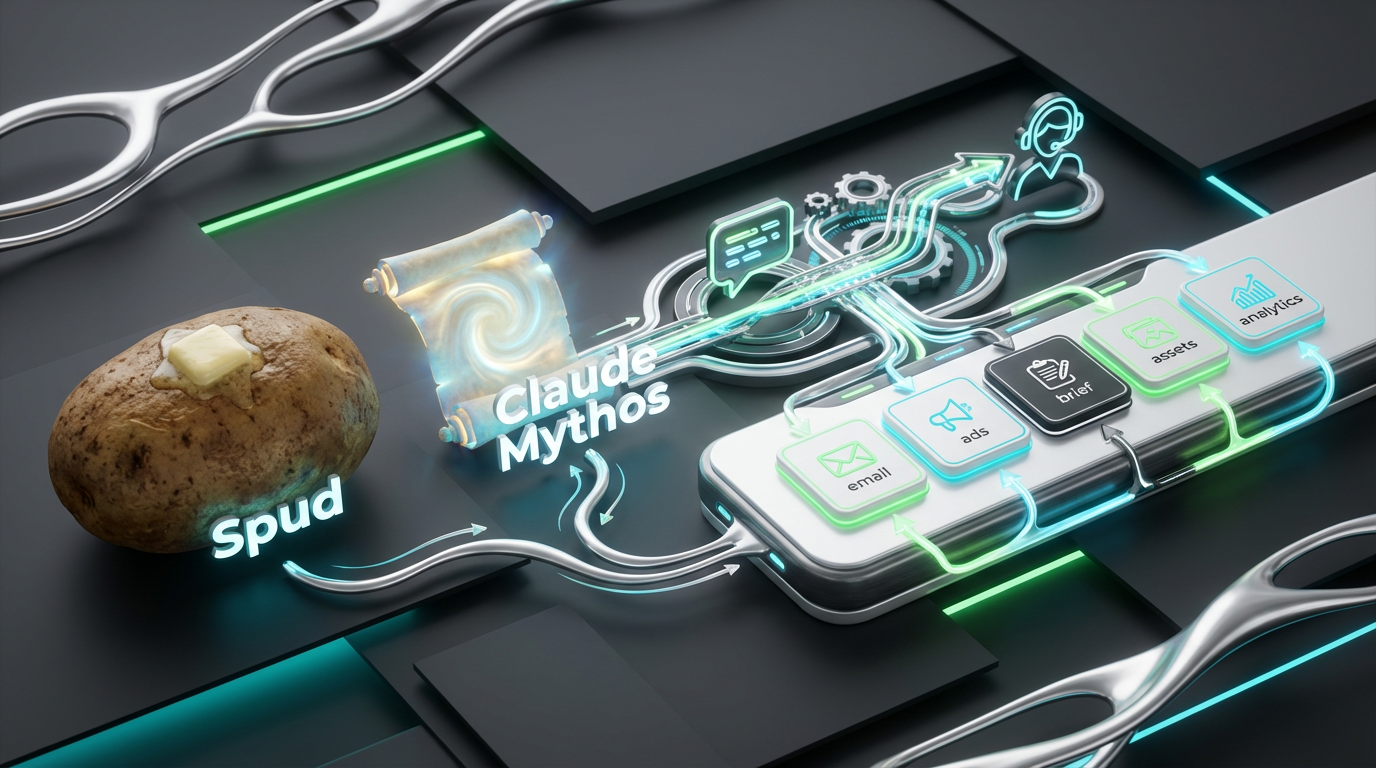
Leaked frontier model chatter is loud, but the bigger story is workflow. Anthropic's rumored Claude Mythos, also called Capybara in some corners, and OpenAI's rumored Spud show how fast the model race keeps shifting. The real takeaway for creators and marketers is not to rebuild around leaks or wait for the next flagship. It is to build model agnostic systems with evals, guardrails, and human review. Klaviyo Composer, Pomelli, and RogIQ show where things are heading as AI moves from chat assistant to campaign operator. That shift can remove the boring middle of briefs, asset versions, and reporting, but taste, judgment, and brand differentiation still need a human hand on the wheel.

Episode Transcript
Hunter: Happy Friday, March 27th, 2026, and welcome back to COEY Cast, the show that was stitched together by a small swarm of AI tools that definitely did their best and may or may not have developed opinions. I’m Hunter.
Riley: And I’m Riley. Also, apparently it is Spanish Paella Day, which feels right because today’s AI news is just a giant pan of leaked models, spicy marketing automation, and at least one ingredient that probably should not have been thrown in.
Hunter: Yeah, this week really said, what if the frontier labs gave us mystery boxes and the marketing stack started acting like an intern who suddenly learned project management. The big stories are Anthropic’s leaked Claude Mythos, also getting called Capybara in some posts, OpenAI’s rumored next flagship codenamed Spud, and then this very real shift where tools like Klaviyo Composer, Pomelli, and RogIQ are moving from chat helper to campaign operator.
Riley: Which is the part creators and marketers should not sleep on. The leaked supermodel drama gets all the likes, but the workflow story is the actual rent-paying story. Like, cool, your model can solve a hard reasoning puzzle. Can it also help me get a campaign brief into on-brand assets without my soul leaving my body?
Hunter: Exactly. Let’s start with Mythos, because X has been treating it like either the second coming or the start of cyberpocalypse. And my normal-company answer is honestly pretty boring in the best way. Do not rebuild your strategy around leaked vibes. If a rumored model is amazing at reasoning, coding, and vulnerability hunting, the move is not panic or worship. It’s tightening your evals, your access controls, and your workflow design.
Riley: Thank you. Because the internet hears “better at cyber” and immediately goes, ah yes, either this will save us or the machines are now little hoodie-wearing gremlins in a basement.
Hunter: Right. Better cybersecurity capability cuts both ways. If it helps your red team find weaknesses faster, amazing. If it helps bad actors automate recon and exploitation, not amazing. So the sane move is to assume stronger models will raise both defensive productivity and offensive risk. That means sandboxing, permissions, logging, approval gates, and not letting one shiny model straight-up free roam across production systems.
Riley: This is where the adult supervision question matters. Because every week people ask, what’s the moat? The model? The agent? The secret prompt sauce? And I’m like, honestly, half the moat is just having enough grown-up process to stop your agent from confidently setting the building on fire and then summarizing it in a very polished memo.
Hunter: That’s it. The winners are not the teams with the hottest leak. They’re the teams with structured workflows, clean data, and human review where it matters. We talked about this recently on the show with Claude moving from chatbot to operator. The fantasy is full autonomy. The reality is leverage through orchestration.
Riley: Wait, and that ties directly to Spud too. Because if OpenAI’s next flagship is “very strong” and supposedly coming within weeks, every company is tempted to freeze and go, should we just wait? And my answer is no. Build now. Build with swapability. Build ugly if you have to. But build.
Hunter: I’m with you. If you wait for the next flagship model, you’ll be waiting forever. The industry strategy right now is basically surprise, hype, rename, repeat. So your roadmap cannot depend on certainty from vendors. Your roadmap has to depend on model-agnostic workflow design.
Riley: Which is less sexy, but way more useful. Like, the stack may become obsolete before procurement even finishes the calendar invite, so stop marrying a model and start dating interfaces. Keep your prompts portable. Keep your logic outside the model when you can. Use routers. Use evals. Use fallbacks.
Hunter: Riley with the very practical relationship advice for enterprise AI.
Riley: I contain multitudes.
Hunter: But seriously, that’s why open models and open agent frameworks keep coming up. Not because open always wins on raw capability today, but because control matters. Privacy matters. Rule changes matter. If tools like OpenClaw keep improving, that middle path gets more attractive for teams that want local automation without handing their entire future to closed APIs.
Riley: Although, to be fair, open source comes with its own chaos package. More freedom, more knobs, more footguns. It’s like getting the keys to a race car and a toolbox and someone saying, have fun, don’t die.
Hunter: Totally. Open is not automatically easier. It’s a fit question. If you’ve got a real ops team, governance, and technical comfort, open frameworks can be powerful. If you don’t, a frontier API with guardrails may still be the smarter call. But either way, the durable value is not the model alone. It’s workflow design plus proprietary context plus judgment.
Riley: And brand taste. Please, dear lord, brand taste. Because let’s talk about the marketing tools. Klaviyo Composer, Pomelli, RogIQ, all these systems point to the same shift. AI is moving from “here’s a draft” to “I can draft the brief, generate the assets, and tee up the campaign.” Which sounds amazing until every brand becomes the same polished, statistically optimized beige smoothie.
Hunter: Yeah. That is the risk. When everyone uses the same brand-DNA automation layer, sameness creeps in fast. You get competent outputs, but not necessarily memorable ones. So where humans still matter most is intent, taste, selection, and strategic tension. The machine can give you ten plausible directions. The human has to know which one actually means something.
Riley: Or which one is weird enough to be interesting. Because the machine loves safe averages. Humans are still better at the sharp left turn that makes a campaign feel alive.
Hunter: Yes. And for marketers, the real win is not replacing the creative director. It’s compressing the boring middle. Research, first-pass briefing, versioning, asset adaptations, tagging, reporting scaffolds. That’s where these tools can save serious time.
Riley: Also, beginners versus advanced teams, that split matters. A solo creator can absolutely get value here if the tool is plug-and-play. But the deeper upside really shows up for teams with repeatable workflow pain. Email ops, content teams, paid social teams, lifecycle marketing. If you’re doing the same motions every week, this stuff starts to print time.
Hunter: And money, eventually, if you do it right. But only if the automation is reliable enough that humans are reviewing exceptions instead of redoing everything. Otherwise you just bought yourself a very expensive digital meeting.
Riley: Oof. Too real. We should also zoom out because the past week has been absurd in classic AI fashion. We’ve got leaked frontier models, campaign operators getting smarter, open-source agent chatter getting louder, and then this comedy bit where an AI conference got flooded with AI slop papers so badly that its own AI review system buckled.
Hunter: Which is the most on-the-nose story imaginable.
Riley: It’s incredible. The machines were like, wow, there is so much machine-made nonsense here that even we cannot parse the nonsense. Very Spider-Man-pointing-at-Spider-Man energy.
Hunter: And it actually matters. Because it reinforces the same thing we keep saying. Human in the loop is not some old-fashioned brake pedal. It’s quality control. It’s authenticity control. It’s trust.
Riley: Same with the Grok legal mess around explicit fake imagery. Same with that wild dog-cancer vaccine story where a pet owner used AI tools and bio models to design something promising without formal biology training. Those stories are totally different, but they rhyme. Capability is getting democratized faster than judgment is getting distributed.
Hunter: That’s a great way to put it. We’re absolutely getting closer to useful organizational intelligence, but we are also getting incredibly efficient at demoing confidence with better lighting. That’s why process matters. Not to kill the magic. To make the magic usable.
Riley: Mmm. Say that again for the people in the back building agent demos with no audit logs.
Hunter: The magic has to survive contact with operations. And that’s the lens I’d use on all three top stories. Mythos and Spud matter because frontier gains will keep making systems smarter. But for most teams listening, the immediate leverage is in campaign automation layers that turn that intelligence into repeatable work.
Riley: So if I’m a marketing lead listening right now, my move is not, “let me camp on X waiting for Spud leaks.” My move is, “where are my repetitive approvals, asset requests, briefs, reporting loops, and on-brand production bottlenecks?” Then automate that with humans still owning final taste.
Hunter: Exactly. Start with one workflow you already understand. Keep the model interchangeable. Put guardrails around publishing and customer-facing claims. Let the machine do the drafting and the grunt work. Let the humans decide what deserves to ship.
Riley: And if your team starts sounding like every other team because the AI found your “brand DNA,” maybe your brand DNA needs a little more personality and a little less corporate oatmeal.
Hunter: That might be the quote of the episode.
Riley: I do what I can.
Hunter: Alright, that’s our Friday check-in from the AI blender. Thanks for hanging with us on COEY Cast.
Riley: Thanks, friends. Go celebrate Spanish Paella Day by mixing bold ingredients responsibly, which is honestly also good advice for your AI stack.
Hunter: And make sure you check out COEY.com slash resources for AI news and updates.
Riley: And subscribe so you don’t miss the next one. Catch you later.