
Meta AI Chat Prompts Now Influence Your Ads
Meta AI chat prompts now influence your ads, a quiet targeting shift. What it means for AI marketing automation and the new intent signal landscape today.
17 December 2025Team COEY

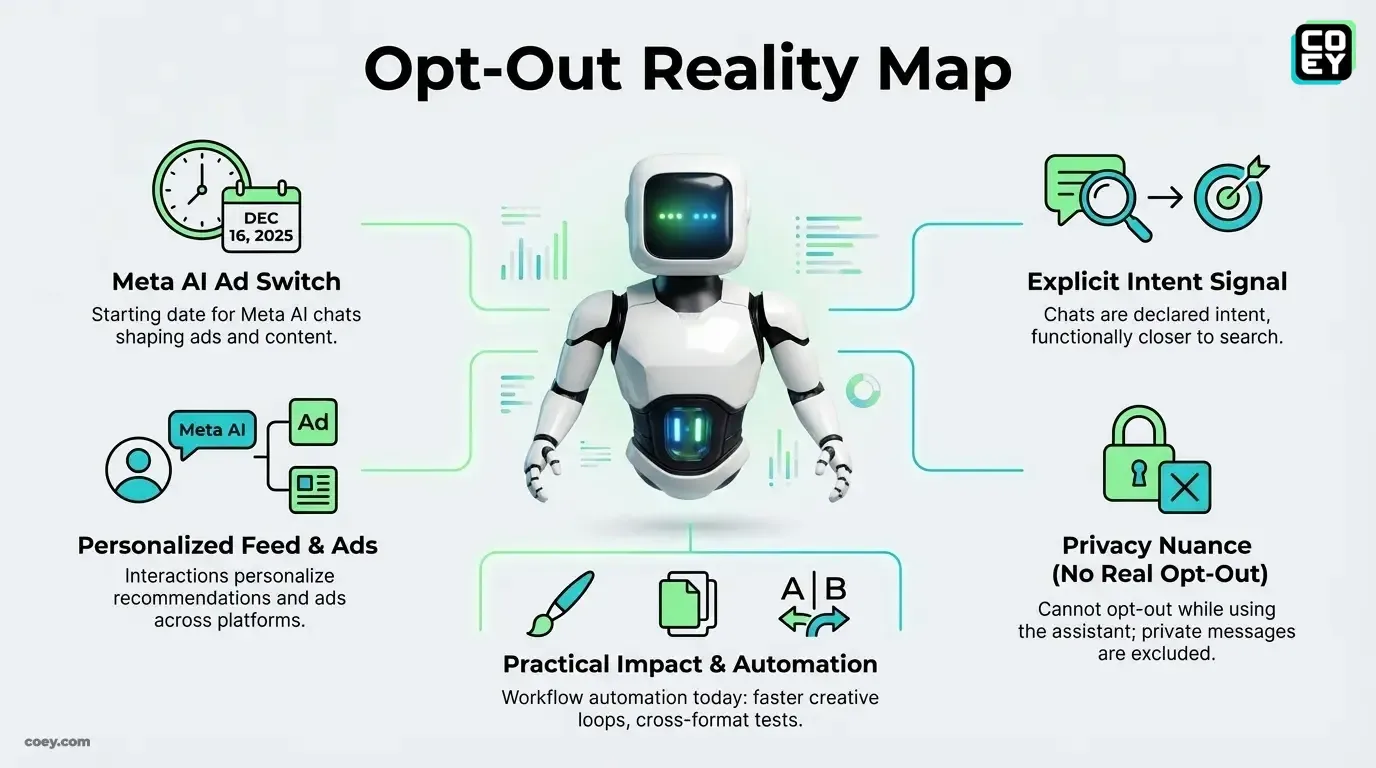
Meta just flipped a major switch: starting December 16, 2025, your interactions with Meta AI can be used to personalize both ads and recommended content across Facebook and Instagram, with expansion to Messenger and WhatsApp where Meta AI is available. The baseline reporting landed via Reuters, and the privacy and opt-out nuance is covered in more detail by Ars Technica.
If you’re a marketer, creator, or anyone building a content engine on Meta, this is the real story: prompts are becoming a first-class intent signal. Not “they watched three Reels about sneakers,” but “they literally asked the assistant which sneakers to buy.” That’s declared intent inside the biggest ad distribution machine on earth.
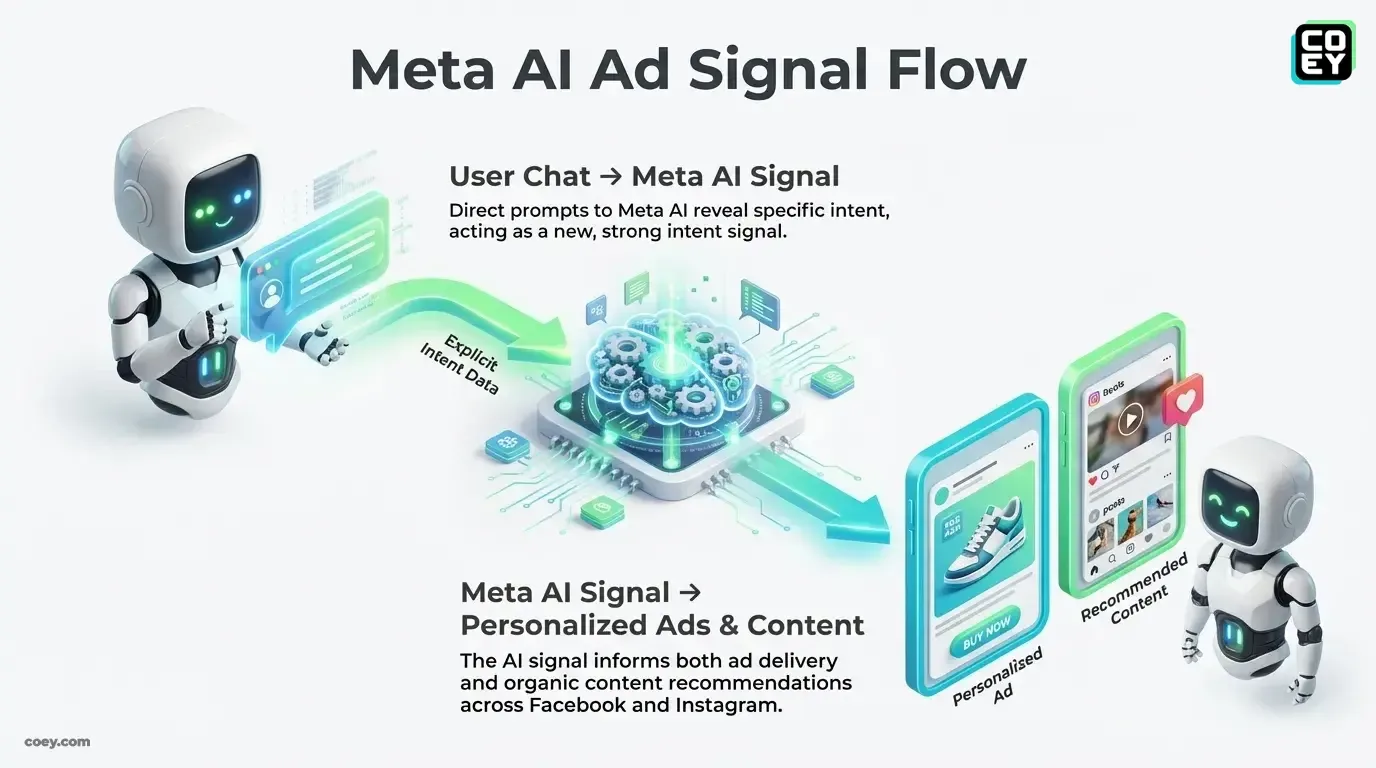
Translation: The feed is learning from the chat. Asking the assistant is now functionally closer to “searching,” except it’s happening inside the same app where the ads live. Convenient!
What changed on Dec 16
Meta says it will use interactions with Meta AI to personalize:
Recommended content (what shows up in feeds, Reels, etc.)
Advertising (what ads are delivered and to whom)
This applies across Facebook and Instagram, and expands to Messenger and WhatsApp in supported regions (availability varies by product and local regulation). Meta’s own framing on “improving recommendations” is outlined in its newsroom post: Improving Your Recommendations on Our Apps With AI at Meta.
The important carve-out: Meta continues to separate private person-to-person messaging from user-to-Meta-AI interactions. In WhatsApp and Messenger, end-to-end encrypted personal chats are not used for ad targeting. But messages you deliberately send to Meta AI? Different bucket.
Why marketers should care
Meta’s targeting machine has always been strong, but it has historically depended on inference: likes, follows, watch time, click trails, purchase pixels. Meta AI changes the input type from inference to explicit language.
That matters because AI prompts tend to be:
More specific (“best winter running shoe under $120”) than passive browsing
More immediate (asked minutes ago, not “interested in running” from last quarter)
More contextual (constraints, preferences, comparisons all in plain English)
In other words: this is Meta getting closer to “search intent” without needing Google. If you run ads for products with clear consideration cycles (fitness, beauty, travel, home, apps, courses), you should expect the platform to get better at finding buyers while also getting noisier for everyone who relies on broad interest targeting.
Privacy, opt-outs, and the “sensitive topics” line
Meta says it will exclude certain sensitive categories from ad targeting even if discussed with Meta AI. Reuters notes exclusions including things like religion, sexual orientation, political views, and health topics. (This is also the part regulators will interrogate first, and where real-world enforcement tends to get… messy.)
Opt-out is the other headline hiding in the footnotes. According to Ars Technica’s reporting, Meta does not offer a user control to opt out of targeted ads that use Meta AI chat data while still using Meta AI, meaning the most reliable opt-out is “don’t use the assistant.” That’s not a privacy control. It’s a product ultimatum.
Regionally, this rollout is not uniform. Early coverage indicates the policy may not apply, or may be delayed, in some jurisdictions due to local regulation and compliance requirements. Availability of Meta AI itself varies by country and product surface.
Automation lens: can this be automated?
Here’s where we separate “huge platform shift” from “pluggable workflow.”
Meta is using the signal internally. But as of this rollout, there is no public advertiser-facing API that lets you pull “Meta AI prompt topics” into your stack, build audiences directly from prompts, or trigger automations off those conversations.
| Automation question | Reality (today) | What would unlock it |
|---|---|---|
| Can I target “asked Meta AI about X”? | No explicit control surfaced | New targeting object or segment in Ads APIs |
| Can I export AI-intent signals to my CRM/CDP? | No direct export path | Aggregated intent endpoint or webhook events |
| Can I auto-adjust creative based on prompts? | Only indirectly (performance feedback loops) | Intent trend reporting + rules-based activation |
So yes, this can influence your campaigns today but it’s “automated” in the sense that Meta’s algorithm gets smarter, not in the sense that you can programmatically orchestrate it from your own systems.
What you can automate anyway (right now)
Even without an “intent API,” teams can still build workflow automation around the effects:
Creative refresh loops: faster iteration based on performance volatility that likely reflects fresh declared intent.
Format multiplication: one concept → turn it into text post, carousel, Reel, Story, and an audio read. More surfaces = more chances to catch the intent wave.
Testing systems: set tighter A/B cycles and rotate angles faster. Declared intent compresses the time between “interest” and “conversion.”
Reality check: This is workflow-automatable today. Signal-ingestion automatable later if Meta decides to expose it.
What it means across text, photo, video, audio
Meta AI is not strictly text-only in every region or surface. Meta AI experiences can include voice and image-based interactions in some products and markets, so the “prompt signal” can become cross-format by default because the user’s intent can arrive as text, voice, or an image-based question depending on the product experience and where it’s available.
Text
Specificity wins. If people are asking “best X for Y,” then content and ads that answer “best X for Y” will get algorithmic tailwinds. Vague brand poetry is about to feel even more like filler.
Photo
Clear product visuals beat vibes. If intent is “minimalist desk setup,” your dreamy abstract lifestyle shot loses to “here’s the setup, here’s the list, here’s the price.”
Video
Hook alignment gets ruthless. Declared intent collapses the funnel. If someone just asked Meta AI about winter skincare, your Reel better start with winter skincare, not a cinematic pan of your sink and a soft piano intro.
Audio
As assistants normalize voice queries, “audio-ready” brand packaging matters more: clean VO, short scripts, and one-sentence positioning that survives being spoken aloud (by humans or TTS later).
Practical impact for brands and creators
This shift rewards teams who can ship faster than they can overthink. When declared intent updates in real time, quarterly creative planning starts to look like a museum exhibit.
Performance marketers: expect more audience volatility and more sudden winners. Build systems that rotate creative weekly (or faster), not monthly.
Brand teams: assistant curiosity becomes a new middle layer. The content that seeds questions can shape downstream ad demand.
Creators: prompts quietly become trendsetters. If you make content that mirrors what people ask, you’re drafting behind the algorithm’s pace car.
What’s next: open signal or closed loop?
Today: Meta AI prompt data is a powerful internal signal that advertisers feel indirectly through delivery and performance changes.
Next (likely): new reporting views and “intent-like” categories inside Ads Manager, still mostly closed.
Future (the real unlock): aggregated intent trend endpoints, privacy-safe categories, and partner integrations that let external tools respond automatically without exposing raw conversations. That’s the only version that scales into real automation without detonating privacy law.
Meta’s message is clear: the conversation is now part of the ad machine. The winners won’t be the teams who panic. They’ll be the teams who build human plus AI creative systems that can adapt fast, because the platform just upgraded its understanding of intent, and it’s not waiting for your next quarterly brainstorm.