Zhipu AI’s GLM-4.7-Flash Is the “Run It Yourself” Speed Drop
Zhipu AI's GLM 4.7 Flash is the run it yourself speed drop. What it unlocks for AI marketing automation, on prem agents, and content workflows.
28 January 2026Team COEY

Zhipu AI has released GLM-4.7-Flash, a Mixture-of-Experts model built for fast inference on consumer-ish hardware, and that’s a bigger story than another leaderboard screenshot. The real signal: this is part of the ongoing shift from “AI as a website you visit” to AI as a component you run, wire into pipelines, and trust with repetitive work. You can try it through chat.z.ai, but the interesting part is what happens when the model leaves the chat window and shows up inside your creative and operational supply chain.
Local-first models are not a vibe. They’re a cost, privacy, and reliability strategy, especially for teams tired of cloud latency, rate limits, and “why did the API suddenly change?” surprises.
What actually shipped
GLM-4.7-Flash is positioned as a 30B parameter MoE model where only about ~3B parameters are active per token (commonly described as “30B-A3B”). That architecture choice is the core product decision: MoE is how you get more capability than a small dense model while keeping inference affordable enough to run on the machines people already own.
Release coverage emphasizes that it’s designed for efficient local deployment, particularly for coding, reasoning, and tool and agent workflows. MarkTechPost’s roundup is one of the clearer summaries of the model framing and benchmarks: MarkTechPost coverage of GLM-4.7-Flash.
One concrete spec that matters for workflow scale: the model is reported to support a 128K context window (128,000 tokens) in published coverage and in the model ecosystem. Long context isn’t just for “feed it a book.” It’s for letting the model operate with bigger work packets: campaign docs plus analytics exports plus brand constraints plus a backlog of tasks, without collapsing into amnesia halfway through.
Speed claims, translated for ops
Early writeups and community chatter have been heavy on throughput claims (because yes, tokens per second is the new horsepower flex). Independent posts show strong Apple Silicon performance in MLX-style setups (for example, reports of around 81 tokens per second on an M3 Ultra with 4-bit quantization). On the GPU side, community reports also show high throughput on consumer cards in quantized runtimes, but numbers vary heavily by context length, quantization, and serving stack.
Here’s the pragmatic take: speed matters, but only when it changes the shape of your workflow.
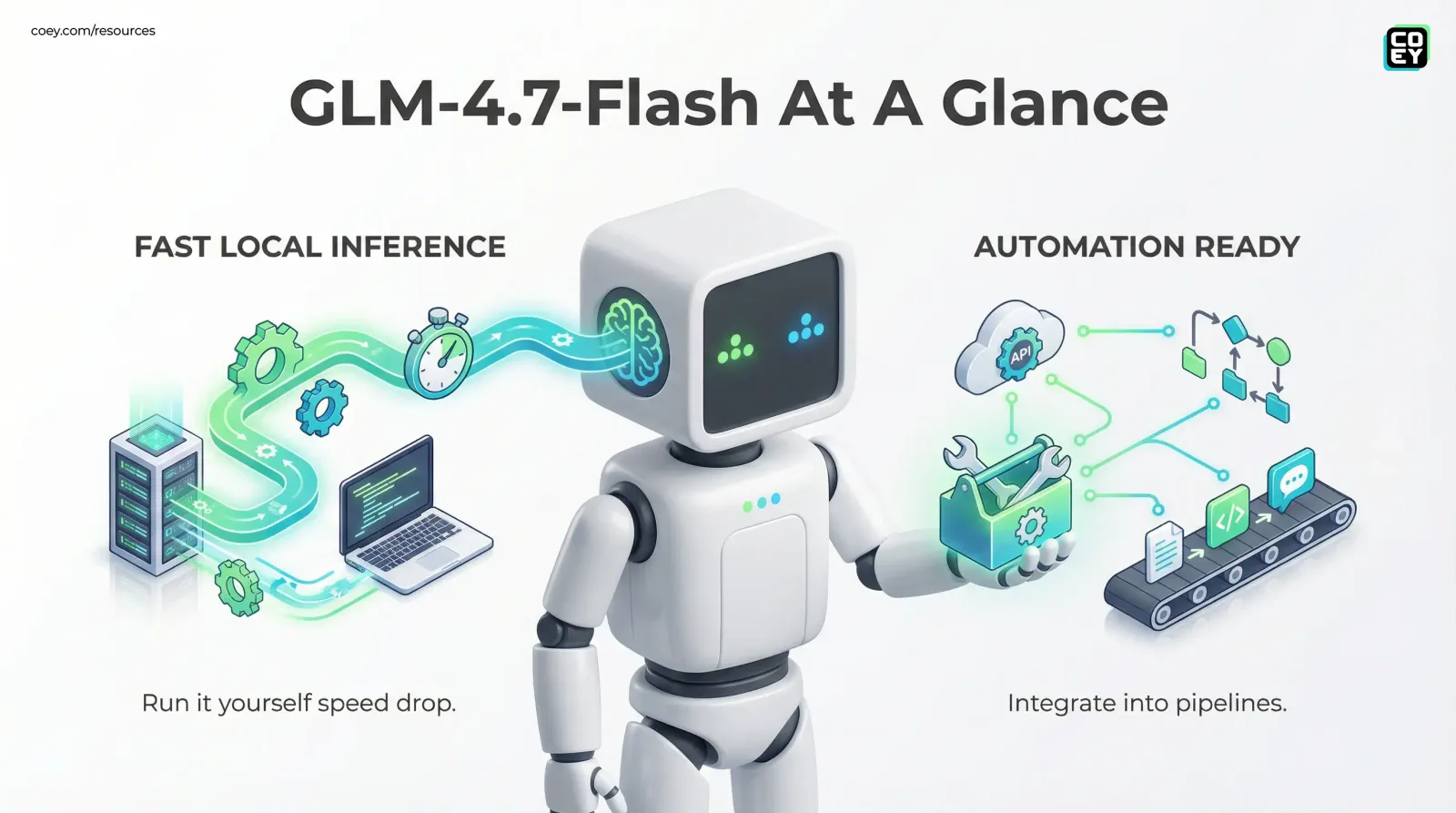
Fast local inference means you can run more iterations per hour, brief to draft to critique to rewrite, without the “waiting on the cloud” drag.
Fast plus cheap enough means you can move from “use AI sometimes” to “run AI continuously” (batch jobs overnight, background tagging, inbox triage, daily reporting).
Fast but unreliable is still a problem, because the moment you put a model in a loop (agents, tool calls, retries), your failure rate becomes your cost center.
Benchmarks: useful, but don’t get hypnotized
GLM-4.7-Flash is being marketed around coding and agent readiness, and third-party coverage highlights results on tests like SWE-bench Verified and tool-use evaluations. One widely repeated figure: 59.2% on SWE-bench Verified for GLM-4.7-Flash in the published benchmark set.
But here’s the part execs should care about:
Benchmarks don’t measure your permissions, your data mess, your edge cases, or your approvals process. They measure potential. Real readiness is “does it behave inside a workflow with consequences?”
If you’re evaluating this for production use, the model’s biggest advantage is not “it scored X.” It’s that MoE efficiency makes it realistic to run in more places, which makes automation design options open up.
API availability and automation potential
This release is notable because it supports multiple ways to operationalize, depending on how allergic you are to cloud dependencies.
1) Open-weight path (self-host)
GLM-4.7-Flash is described in public coverage as released under an MIT License and the weights are available for local deployment (commercially permissive, with the usual “read the actual license text” caveat). That means you can run it behind your firewall, close to your data, and build internal tooling around it without asking permission from a SaaS dashboard.
Operationally, “open-weight” translates into:
Automation-ready: you can wrap the model in your own REST API and call it from anything (n8n, Make, Zapier via webhook, internal services).
Privacy control: sensitive creative, unreleased campaigns, customer transcripts can stay local.
Cost control: you pay compute, not per-token margin forever.
2) Hosted API path (move fast)
Public coverage and community posts also indicate Zhipu offers a free API tier for GLM-4.7-Flash with a concurrency limit of 1, plus a higher-throughput paid option, GLM-4.7-FlashX (commonly cited at 3 concurrency). Community-shared pricing for FlashX is often quoted around $0.07 per million input tokens and $0.40 per million output tokens, though teams should verify current pricing in official docs before budgeting.
For non-technical teams, the important question is simple: is it callable? If yes, it can be orchestrated. If it can be orchestrated, it can become part of a repeatable creative machine.
Practical integration surfaces
GLM-4.7-Flash has documented support for common serving and inference ecosystems like vLLM and SGLang, plus standard experimentation through Hugging Face Transformers. These aren’t “marketing features,” they’re deployment accelerators, because your team (or partner) can stand up an endpoint without inventing a custom runtime from scratch.
| Automation question | Answer | Real-world meaning |
|---|---|---|
| Can we run it inside our environment? | Yes | On-prem plus privacy plus predictable latency |
| Can we call it from workflows? | Yes | Wrap as an endpoint; trigger from automations |
| Is it “plug-and-play” for nontechnical teams? | Not by default | You’ll want a wrapper UI, internal service, or partner |
Where this is real for creators and marketers
GLM-4.7-Flash is most interesting in the “high-volume, medium-stakes” zone, work that burns time, not brand trust. Think of it as a throughput engine that still benefits from human intent and review.
Deployable wins (low drama)
Content ops at scale: rewrite variants, localization drafts, metadata generation, bulk formatting.
Analytics narration: turn dashboards and exports into plain-English summaries with consistent structure.
Internal knowledge helpers: long-context Q&A over docs, briefs, and campaign history, especially when the alternative is “ask the one person who knows.”
Coding and glue work: scripts, small utilities, batch transformations, where speed matters and mistakes are reversible.
Still needs guardrails (don’t be a hero)
Auto-publishing directly to customer channels without critics, approvals, and receipts.
Anything compliance-heavy where a “close enough” phrasing can become an expensive screenshot.
Unbounded agents that can take actions across tools without strict permissions.
The model is not the workflow. If you don’t have routing, validation, and logging, you don’t have automation, you have faster chaos.
What this signals about the market
GLM-4.7-Flash is another data point in a pattern that’s getting hard to ignore: local deployment is graduating from hobbyist to strategy. The winners won’t be teams that chase every new model. They’ll be teams that turn models into systems, repeatable pipelines where humans set direction and machines carry the load.
If you want the earlier milestone in this line, see our previous coverage here: GLM-4.7: Open Model Built for Agent Workflows.
If you’ve been waiting for “AI you can actually run” to stop being a science project, MoE speed-focused releases like this are the clearest sign yet: the laptop is becoming an AI workstation again, and creative throughput is starting to compound locally, not just in someone else’s cloud.
Scale Your Content With AI Agents That Deliver
COEY helps brands and agencies automate content creation, marketing ops, and campaign execution using n8n, Claude Cowork, OpenClaw, and custom integrations. See how our agentic automation works across every marketing channel, or request a proposal.