Midjourney V7 Makes Image Gen Feel Less Like Gambling
Midjourney V7 makes image generation feel less like gambling. What it unlocks for AI marketing automation and more reliable ad creative pipelines.
8 February 2026Team COEY
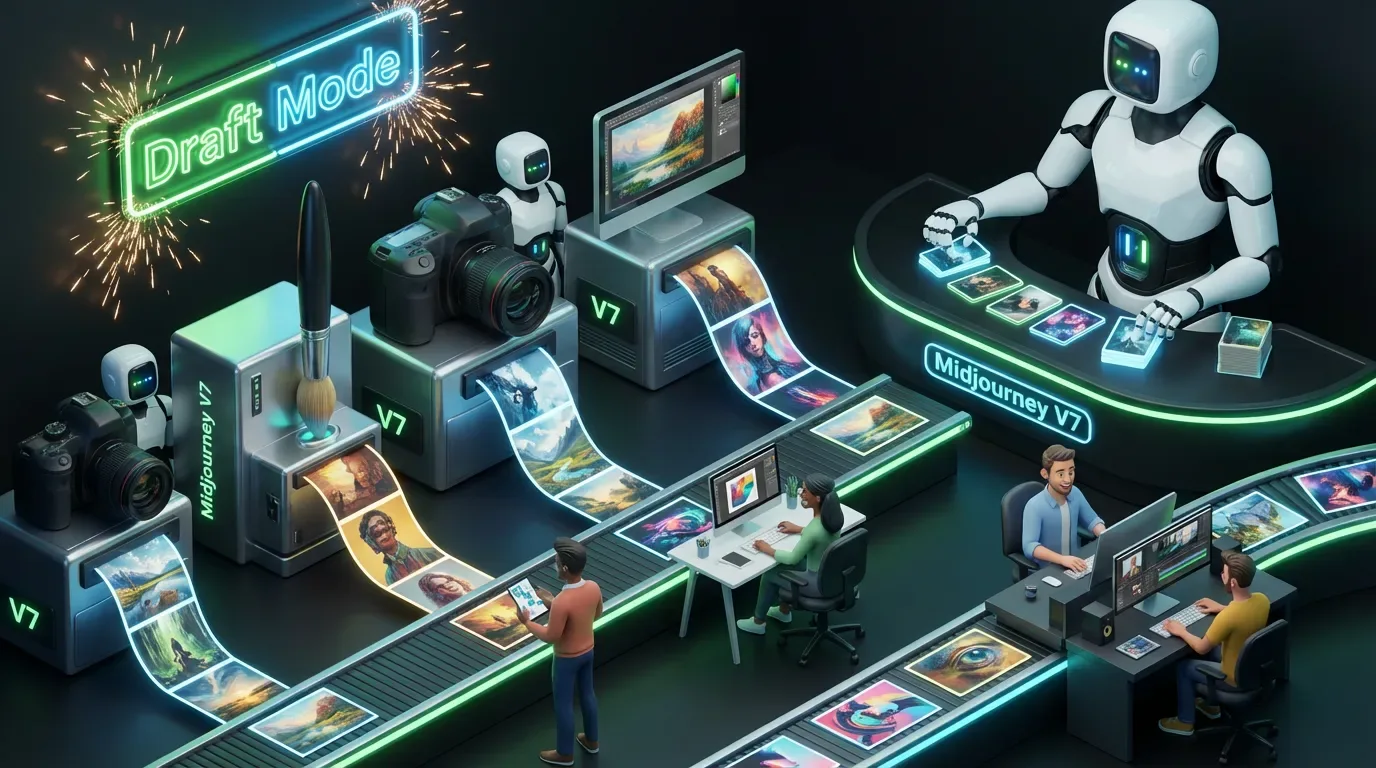
Midjourney’s V7 is live (originally released as an alpha model), and it’s the first upgrade in a while that actually hits where production teams feel pain: consistency, coherence, and speed. The official release notes position V7 as a new model architecture and introduce a fast “Draft Mode” designed for ideation at scale (Midjourney V7 Alpha announcement).
For marketers and creative ops folks, the headline isn’t “prettier pictures.” It’s that the reroll tax (time, cost, and sanity spent brute-forcing usable outputs) gets materially lower. And when that tax drops, automation suddenly stops being a cute experiment and starts looking like an actual pipeline component.
What actually shipped in V7
V7 isn’t a cosmetic tweak. Midjourney describes it as a “totally different architecture,” with major gains in image quality, textures, and overall coherence, especially in the usual failure zones like bodies, hands, and objects. TechCrunch’s coverage echoes the same theme: fewer weird artifacts and better realism, which is exactly what makes outputs more “drop-in ready” for real work (TechCrunch on Midjourney V7).
Here are the changes that matter operationally (not just aesthetically):
Higher fidelity + better coherence: More believable surfaces, lighting, and anatomy means less time doing damage control in Photoshop.
Better prompt interpretation: You can write “normal human creative direction” and get closer to what you meant, without turning every prompt into a legal contract.
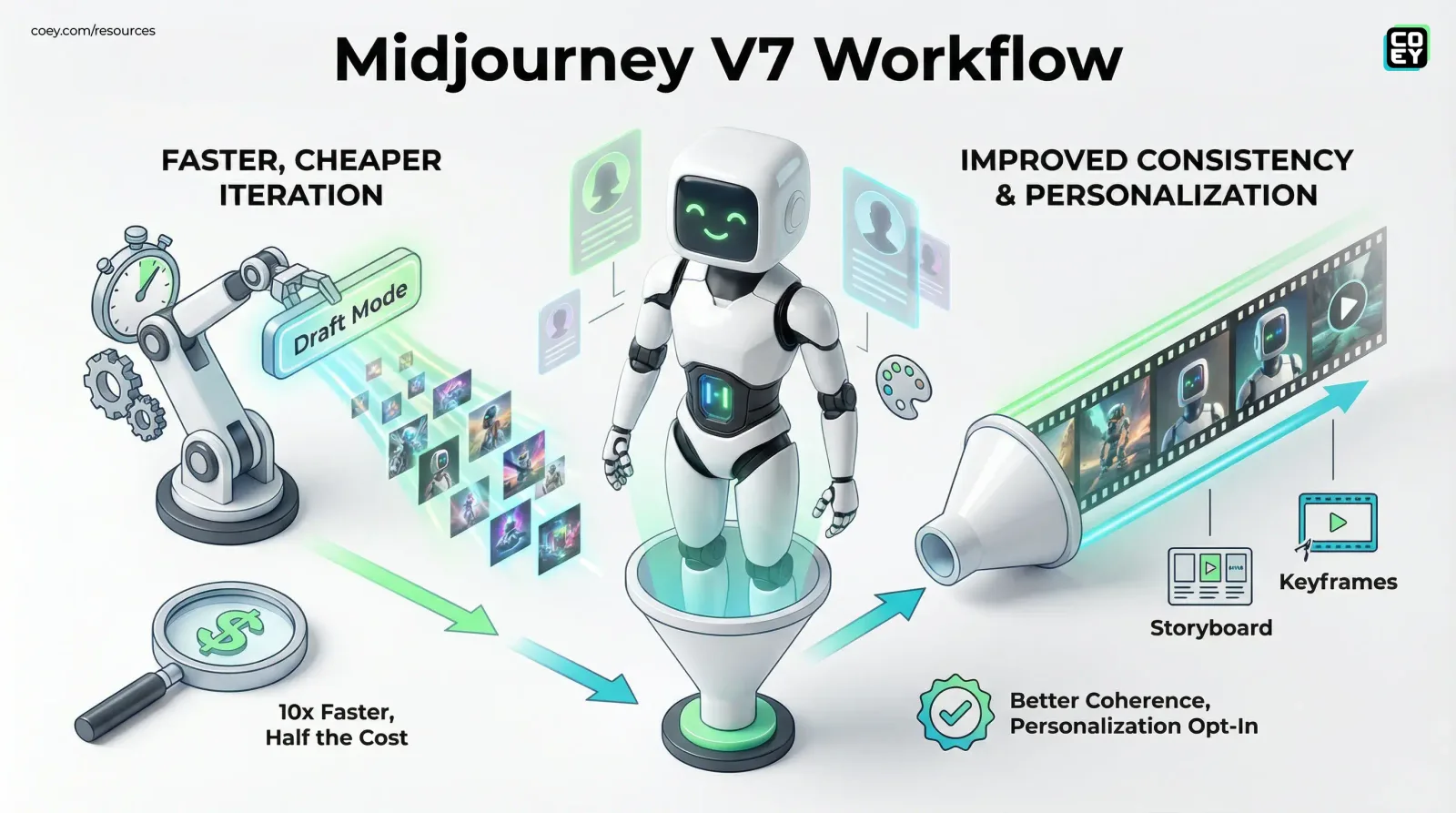
Personalization is available (opt-in): V7 supports personalization via Midjourney’s profiling and ranking flow, but it is not automatically applied unless you enable it (for example, by using the appropriate personalization parameter or setting).
Draft Mode: A speed and cost lever designed for rapid iteration. It’s built for exploring options fast, then promoting the winners to higher-quality renders.
Translation: V7 is less “AI art slot machine,” more “creative collaborator that can stay on brief.” Not perfect. Just finally predictable enough to matter.
Draft Mode is a workflow feature, not a gimmick
Draft Mode is one of those features that sounds like a footnote until you map it to how creative teams actually work. Midjourney says Draft renders are 10x faster and half the cost than standard generation, optimized for brainstorming and iteration (V7 Alpha notes).
That’s important because the bottleneck in most AI image workflows isn’t generation. It’s selection and alignment. Draft Mode effectively encourages a two-stage process:
Stage 1: Generate lots of cheap “thinking images” to explore composition, wardrobe, set design, and vibe.
Stage 2: Commit to a direction, then render fewer “final-ish” images with more compute.
In automation terms, this is the difference between “one expensive call per asset” and a funnel: cheap exploration, automated filtering, high-quality finalization. And funnels scale.
Personalization changes team dynamics (even when it is opt-in)
V7 supports Midjourney’s personalization system, which is built by rating images to create a preference profile (Midjourney Personalization documentation). That’s a big deal for consistency if you embrace it strategically.
For solo creators, that’s great. For teams, it’s complicated in a useful way.
If your brand depends on a consistent look, personalization can be either:
A multiplier: If your team aligns on a shared aesthetic and builds profiles intentionally.
A fragmentation risk: If each operator’s taste profile drifts, and suddenly your campaign looks like five different brands cosplaying as one.
The practical implication: creative ops teams may want to designate “generation operators” (or shared accounts and workspaces where allowed) so the personalization profile becomes a controlled asset, like a LUT pack or a brand font file.
How to access V7 (and what’s missing)
V7 is available through Midjourney’s existing product surfaces, primarily the Discord workflow, and it can be invoked with the version parameter. Midjourney’s docs show V7 selection via the version controls and the --v 7 parameter (Midjourney models and version controls).
That said, V7 launched as an alpha rollout with some gaps versus the full feature stack. At release, several features commonly used in production workflows were not available in V7 itself (including some upscaling and editing-related tools), and Midjourney indicated users may need to fall back to older versions for certain tasks until the V7 toolchain is fully wired (V7 Alpha notes).
Real-world readiness scorecard: the core generation quality is improving fast, but if your workflow depends on a very specific end-to-end feature set (upscale behaviors, exact edit modes), expect some transitional weirdness while they finish wiring the whole product stack to V7.
Automation reality: still no official public API
Here’s the part that matters for executives trying to operationalize this: Midjourney still isn’t API-first.
As of 2026-02-08, there’s no widely supported, official public Midjourney API comparable to what you get with OpenAI, Adobe, or many open-model providers. The typical access path remains Discord (and Midjourney’s web app). Yes, people automate Discord with bots, scripts, and workflow tools, but that’s not the same as an enterprise-ready API with predictable auth, rate limits, SLAs, and clean webhooks.
Want the broader operating model for scaling AI output safely inside a business? See Outrun Rivals With AI Competitive Loops.
So what’s actually automatable today?
| Workflow need | Midjourney V7 status | What it means in practice |
|---|---|---|
| Programmatic generation | Unofficial and Discord-based | Possible, but brittle; best for internal experimentation vs mission-critical pipelines |
| Batch ideation | Strong (Draft Mode) | Cheaper, faster exploration, especially useful when paired with human review |
| Brand consistency | Improved (personalization) | Consistency rises if you manage profiles intentionally; chaos if you don’t |
| Production asset delivery | Better, still not deterministic | Higher hit rate reduces rerolls, but you still need QA gates for brand and legal |
The pragmatic take: V7 makes Midjourney more viable as a creative engine, but it remains more like a high-end studio tool than a programmable infrastructure layer. If your roadmap depends on fully automated creative generation inside your stack, Midjourney is still the “amazing output, awkward wiring” option.
Where V7 is most ready: campaign systems
Even without a clean API, V7 can still plug into real workflows, especially where humans are already “in the loop” approving assets. The biggest gains show up when you run Midjourney as a high-throughput concept and variant factory:
Paid social creative: Generate faster variations of scenes, compositions, and product storytelling angles, then send selects into your normal ad build process.
Landing page visuals: Produce multiple hero-image directions quickly to test messaging plus vibe alignment before a designer polishes.
Brand worlds: Create consistent environments and references that downstream designers and video teams can reuse as visual anchors.
The key difference with V7 is that the “usable on first pass” rate climbs, so teams can confidently plan around AI-assisted throughput instead of treating it like a side quest.
Upstream fuel for video workflows
V7’s coherence improvements also matter because images are now upstream inputs for everything else: storyboards, keyframes, and reference packs for generative video tools. If your frames don’t match from shot to shot, your video workflow becomes a patchwork of fixes.
With more consistent composition and style, Midjourney outputs become more reliable as:
Storyboard sequences: pitch decks and previsualization that stakeholders can actually approve
Keyframe anchors: reference stills that guide motion tools or editors toward a consistent look
Thumbnail factories: fast iteration on packaging visuals (the most underrated growth lever on the internet)
If your content engine is “LLM writes → image model visualizes → video tool animates,” V7 makes the middle step less of a quality cliff.
Bottom line: V7 lowers friction, not responsibility
Midjourney V7 is a meaningful quality and usability jump, especially with Draft Mode and better prompt interpretation reducing iteration waste. It’s closer to “production collaborator” than “toy,” which is exactly what creative teams need if they’re trying to scale output without scaling burnout.
But the operational truth remains: Midjourney is still not a clean API product. Automation is possible, yet not enterprise-smooth, so the smartest way to use V7 today is in workflows where human review is already expected and where speed-to-variation creates real advantage.
In other words: V7 won’t fully run your creative machine by itself. But it will absolutely make your creative machine faster, especially when you treat it like what it is: a powerful collaborator that thrives with clear intent, tight feedback, and a workflow that knows how to pick winners.