
Mistral’s Voxtral Transcribe 2 Turns Speech Into a Real Automation Layer
Mistral Voxtral Transcribe 2 turns speech into a real automation layer. What it unlocks for agency and brand voice content automation.
9 February 2026Team COEY
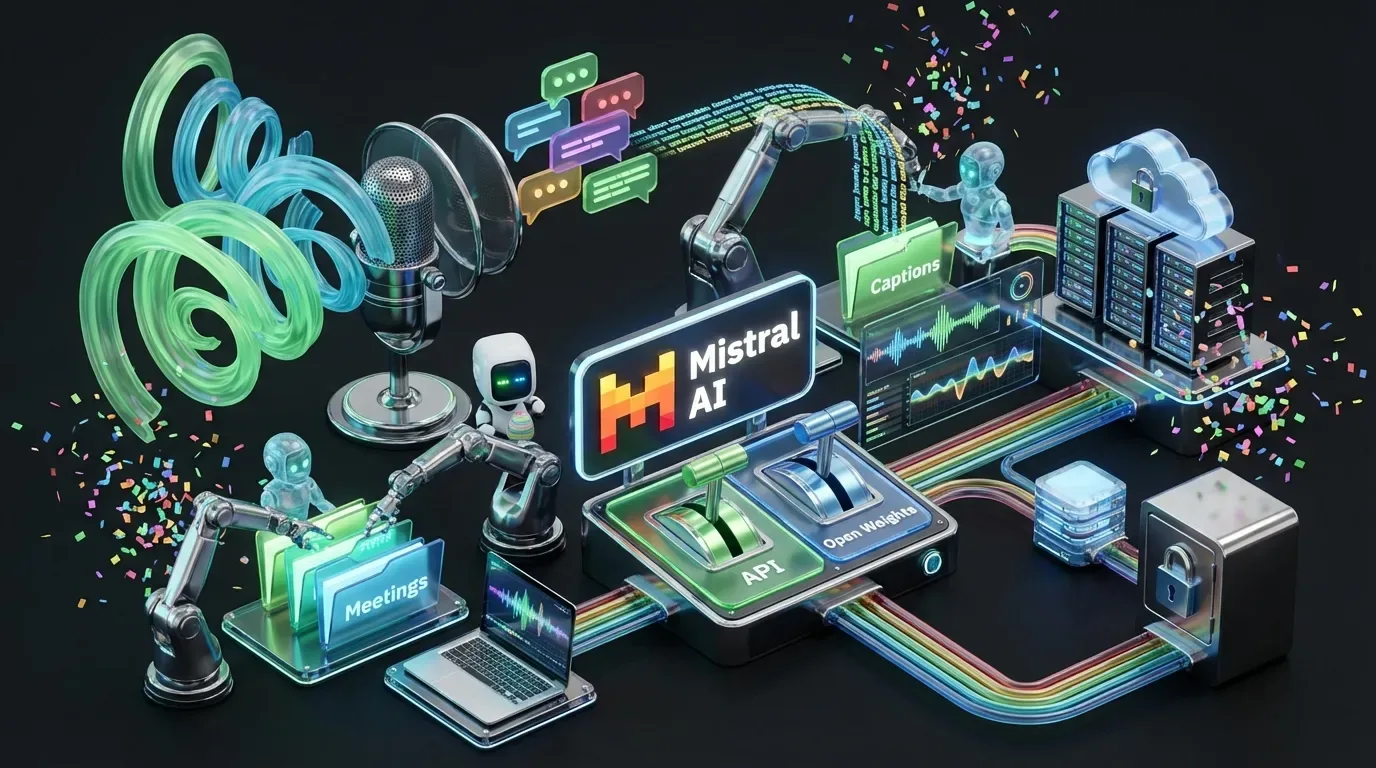
Mistral just made a very specific and very useful move: Voxtral Transcribe 2 is a refreshed speech to text lineup built for both high volume transcription and low latency streaming, with Voxtral Realtime released as open weights under Apache 2.0. In a world where “AI audio” often means “upload your file to a SaaS textbox and pray,” this release is a stronger signal: speech is becoming programmable infrastructure.
For creators, marketers, and execs trying to scale output, this isn’t about novelty. It’s about whether speech can finally behave like a reliable pipeline stage, capturing meetings, generating captions, feeding content repurposing engines, powering voice agents, without turning your data into a vendor hostage situation.
The real upgrade isn’t “better transcription.” It’s the combination of streaming , open deployment , and API access , the three ingredients that decide if something can plug into workflows or just demo well.
What Mistral actually shipped
Voxtral Transcribe 2 is split into two main offerings, each aimed at a different operational reality:
Voxtral Mini Transcribe V2 (batch)
Use case: uploaded or recorded audio and video (podcasts, webinars, calls, meetings).
Notable features: speaker diarization, word level timestamps , and context biasing (up to 100 words or phrases to nudge spelling for names, brands, jargon).
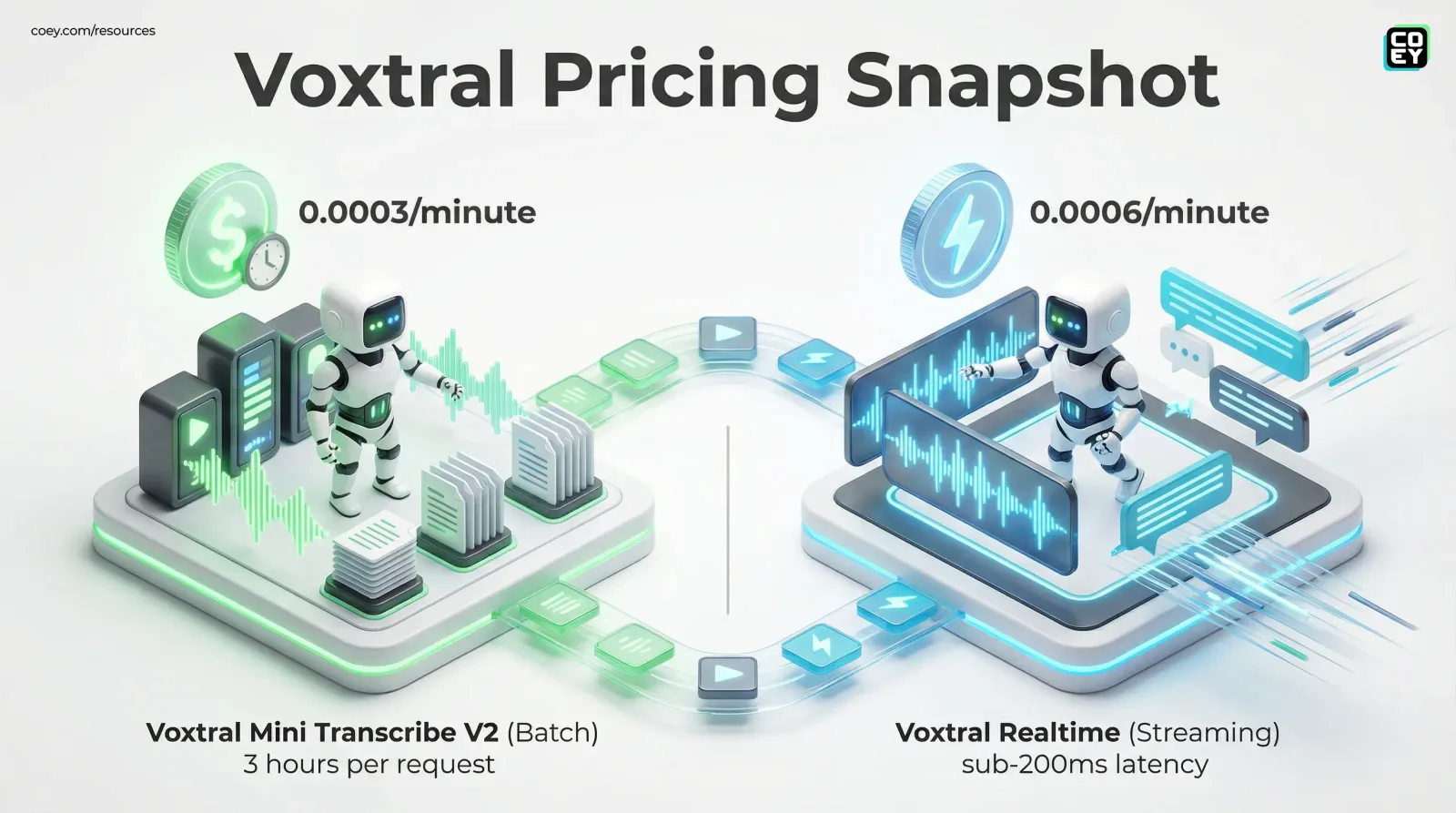
Long form posture: Mistral positions it for sessions up to roughly 3 hours per request .
Cost signal: Mistral lists the API price at $0.003 per minute .
Voxtral Realtime (streaming)
Use case: live captions, live note taking, voice agents, real time call intelligence.
Latency posture: configurable streaming delay down to sub 200ms in supported setups.
Big headline: open weights under Apache 2.0 , meaning you can self host commercially with minimal license friction.
Both models support 13 languages (English, Chinese, Hindi, Spanish, Arabic, French, Portuguese, Russian, German, Japanese, Korean, Italian, Dutch) and are framed for real production deployments, not just “research checkpoint, good luck.” The official announcement is on Mistral’s site: Voxtral Transcribe 2.
Why this matters for marketing ops
Speech is one of the most under automated inputs in modern marketing. Teams run highly automated workflows for:
copy drafting
creative generation
asset resizing
publishing and scheduling
Then audio shows up and suddenly everything slows down. Transcription becomes manual. Captions become “someone’s afternoon.” Meeting notes are “where did that doc go?” Voxtral’s value is simple: it lowers the friction to turn speech into structured text at scale, which means the rest of your automation stack can actually use it.
When speech becomes reliably machine readable, it becomes reusable. That’s how you turn conversations into content, and content into compounding output.
API availability: hosted convenience vs open control
Voxtral is shipping with two paths, which is exactly what grown up teams want:
Hosted API (fastest integration): if you want transcription inside your app or workflow this week , call the endpoint and move on.
Open weights (maximum control): if you need privacy, predictable costs, or custom deployments, Voxtral Realtime being Apache 2.0 is the “no one can rug pull your roadmap” option.
Mistral’s audio documentation starts here: Audio and Transcription (Mistral Docs). For non technical leaders, the translation is straightforward: if there’s an API, you can automate it; if there are open weights, you can run it inside your own walls.
Pricing signals (what’s real)
Mistral lists:
Voxtral Mini Transcribe V2: $0.003 per minute
Voxtral Realtime: $0.006 per minute
Pricing alone doesn’t make something workflow ready, but it sets expectations: you can afford to wire this into always on systems (caption factories, podcast back catalog processing, call transcription at volume) without acting like every meeting is a luxury purchase.
Automation potential: where this plugs in
The most useful way to think about Voxtral is as a speech ingestion layer. Once audio becomes text with timestamps plus diarization, you can chain it into the systems you already run:
Content repurposing: transcript to chapters to shorts script to social copy to newsletter draft
Accessibility: auto generate subtitles and captions at scale
Sales plus support intelligence: calls to diarized transcript to summaries to CRM updates
Voice agents: streaming ASR to reasoning model to tool calls to action
And yes, this is where tools like n8n and Make become relevant, but only if your ASR layer is callable and stable. Voxtral checks that box via API, and Voxtral Realtime adds the self host lever when you need it.
Automation readiness snapshot
| Question | Voxtral Transcribe 2 answer | What it means in practice |
|---|---|---|
| Can we automate transcription? | Yes (hosted API) | Trigger on new uploads, meetings, calls |
| Can we keep audio private? | Yes (Realtime open weights) | Self host for compliance or sensitive data |
| Is it real time capable? | Yes (sub 200ms posture) | Live captions, live agents, live notes |
| Will it reduce manual editing? | Partially | Still need human QC on key assets |
What’s genuinely ready vs “demo energy”
Ready now (high confidence lanes)
Captions and subtitles for short form and long form content (timestamps are the cheat code).
Podcast plus webinar backlogs where speed and cost matter more than perfection.
Meeting transcripts plus searchable notes (especially with diarization).
Call transcription feeding summaries, tags, and training workflows.
Still needs adult supervision
Live captioning for high stakes events (brand risk is real, you still want a fallback plan).
Industry specific jargon without customization (context biasing helps, but don’t assume perfection).
Voice agent stacks that need truly end to end reliability (ASR is necessary, not sufficient).
The model is not the workflow. Workflow readiness comes from retries, confidence thresholds, escalation rules, and human approval when accuracy actually matters.
The strategic signal: open streaming ASR is leverage
Mistral open sourcing Voxtral Realtime under Apache 2.0 is more than a developer friendly headline. It shifts leverage:
Cost leverage: you can move from per minute vendor pricing to compute economics.
Data leverage: keep sensitive audio inside your environment.
Roadmap leverage: you can ship on your schedule, not a SaaS feature queue.
For executives: this is the difference between “we adopted a tool” and “we installed a capability.” For marketing ops: it’s the difference between “we transcribed one podcast” and “we built a transcription assembly line.”
If you want a broader look at why open and edge deployable components are becoming the winning automation strategy, see: Edge Automation Unplugged: Decentralized Workflows for Speed and Sanity.
Bottom line
Voxtral Transcribe 2 is a practical speech automation release because it ships in the two formats that matter: a hosted API for immediate integration and open weights for long term control. The batch model’s pricing makes high volume transcription feasible, and the streaming model’s latency posture plus Apache 2.0 licensing makes real time speech systems more deployable without vendor lock in.
If your team is serious about scaling creativity with human plus machine collaboration, this is a clean building block: machines handle capture and structure; humans handle narrative, taste, and the final call on what ships.
AI Marketing That Goes Beyond the Hype
COEY builds the marketing automation systems that agencies and brands actually need: n8n workflows, Claude Cowork agents, OpenClaw models, all connected and delivering. See our automation capabilities, explore our channel work, or request a proposal.
For senior marketing leaders evaluating the broader shift, our Executive AI Accelerator is a confidential top-to-top engagement. For a structured blueprint, read How to Build an AI Content System.