ByteDance’s Seedream 5.0 Lands in Dreamina + CapCut Web, Fast, Photoreal, and Mostly Not Yet Automatable
ByteDance Seedream 5.0 lands in Dreamina and CapCut Web fast and photoreal, but mostly not yet automatable. What that means for AI ad creative ops.
12 February 2026Team COEY
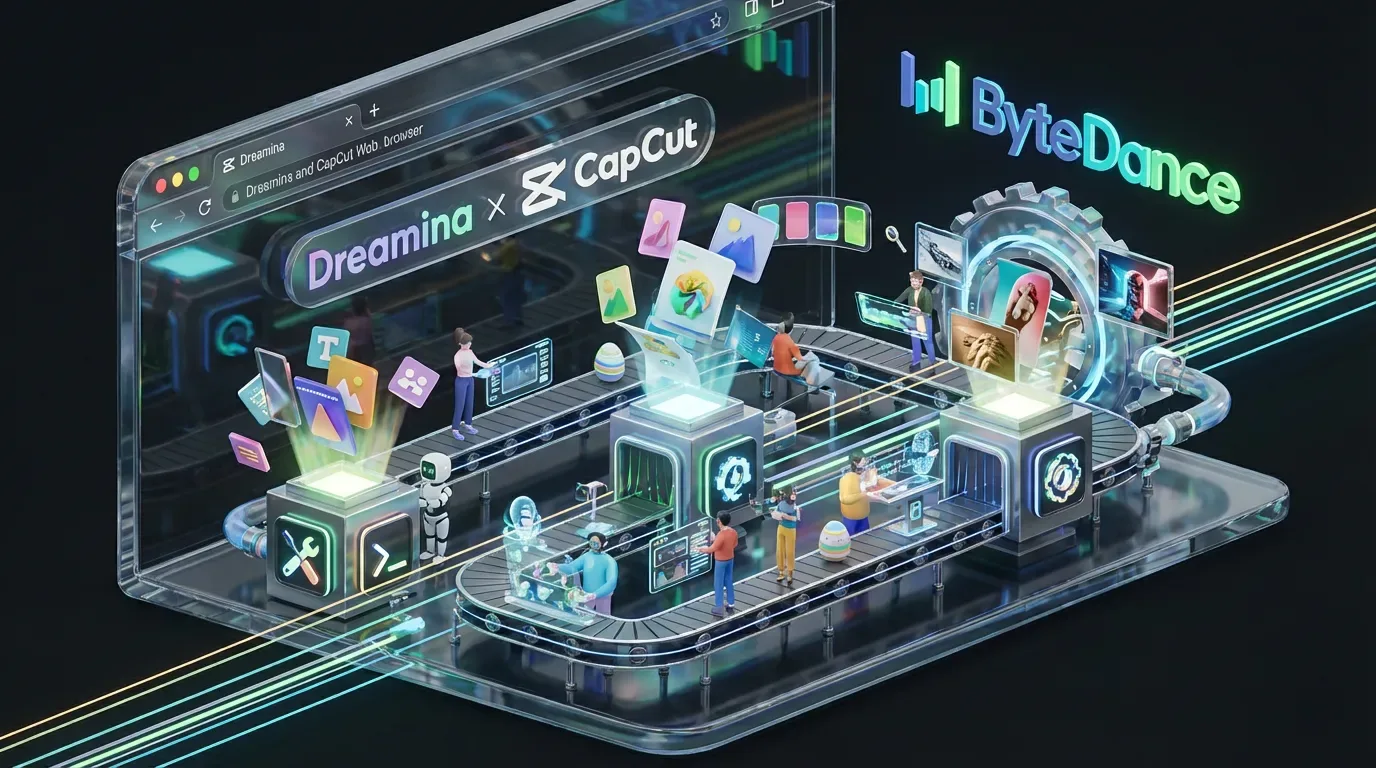
ByteDance just shipped Seedream 5.0, its newest image generation engine, directly inside Dreamina and CapCut Web, meaning the “make the visual” step is now sitting right next to the “ship the content” step. The most concrete public surface right now is CapCut’s Seedream 5.0 tool page (capcut.com/tools/seedream-5-0), which positions Seedream as a high-fidelity, marketing-grade image generator rather than an artsy sandbox you visit once and forget.
This is less about a new model name and more about distribution: ByteDance is embedding generative image creation where creators already do the work. That’s how AI stops being “cool” and starts being operational.
What actually shipped (and where)
Seedream 5.0 is now presented as a native capability across ByteDance’s creation surfaces, most visibly through CapCut Web and Dreamina. Dreamina also maintains a Seedream 5.0 prompt resource page (dreamina.capcut.com/resource/seedream-5-0-prompt) that signals the intended use: rapid prompting, fast iteration, and creator-friendly controls.
Availability note: based on current rollout signals, Seedream 5.0 is accessible inside CapCut’s product surfaces (including web) but appears to be region-limited in some markets (notably, it is not broadly available in the US at the time of writing).
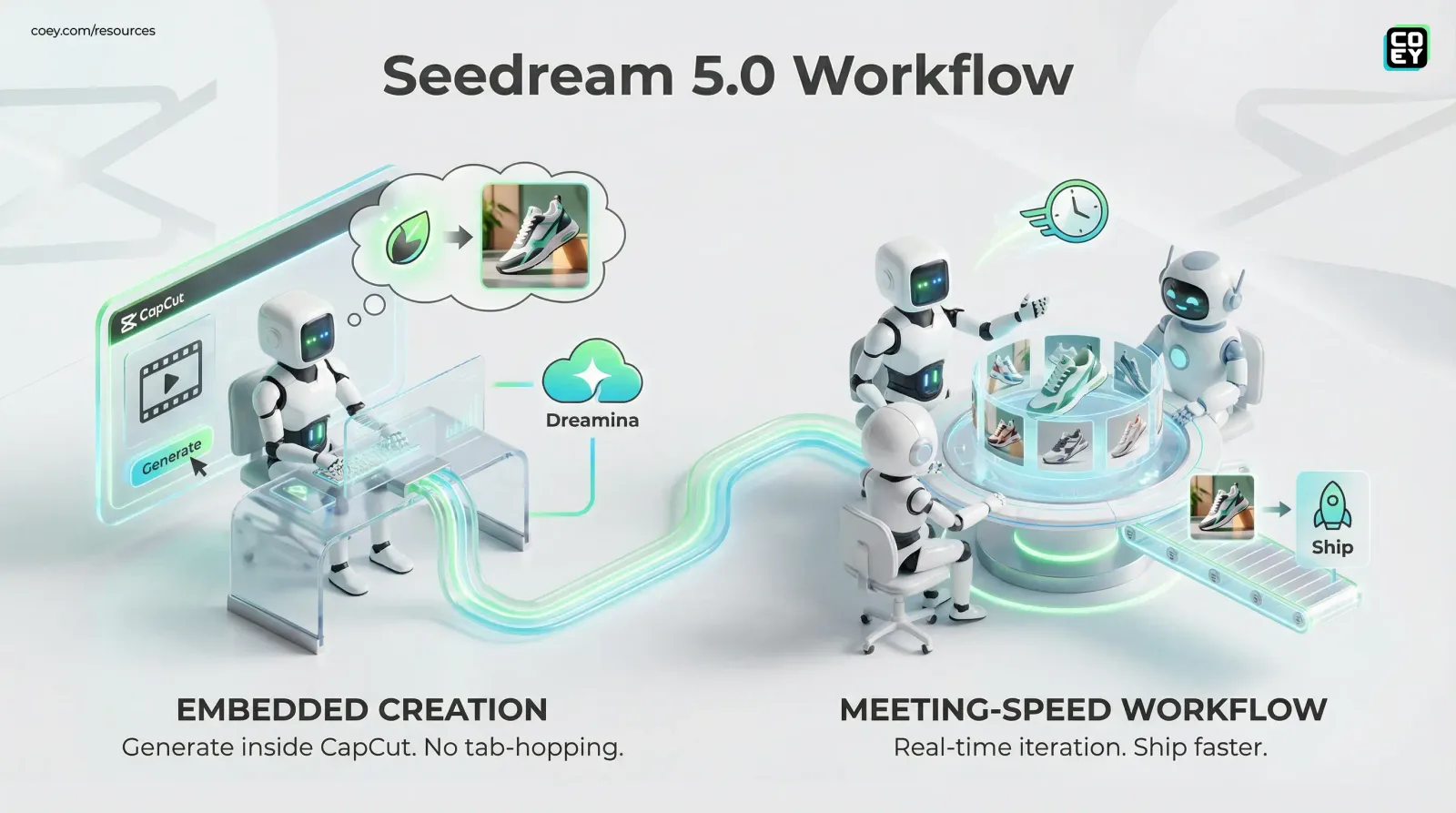
ByteDance’s core bet is familiar: if you can generate inside the editor, you eliminate the tab-hopping, exporting, reformatting, and “who has the latest version?” chaos that kills speed in real marketing teams.
Big picture: standalone generators win demos. Embedded generators win workflows.
Speed is the feature, not the flex
Most image models can produce something pretty. The real competitive edge is whether they can do it fast enough to support the way modern teams work: live brainstorms, on-the-fly creative direction changes, and variant testing that happens this afternoon, not next sprint.
Seedream 5.0 is being framed as ultra-fast and high-fidelity, designed for “generate a bunch of options, pick the winner, ship it” momentum. When the generation loop is measured in seconds, the creative process changes. You stop treating images like precious assets and start treating them like modular components.
What changes when generation gets “meeting-speed”
Creative direction becomes interactive: teams can respond to feedback in real time rather than capturing notes and disappearing for a day.
Variant output becomes default: you don’t “make an image.” You make 12 and let performance (or humans) choose.
Campaign timelines compress: the messy middle, concept-to-first-draft, gets dramatically shorter.
Quality upgrades that matter to marketers
CapCut’s positioning leans into high-fidelity visuals and “professional” outputs (translation: less weirdness, fewer artifacts, more usable first passes). The marketing implication is straightforward: if outputs are cleaner by default, teams spend less time doing manual patchwork in Photoshop, or worse, scrapping the idea entirely.
Seedream 5.0 is presented as strong on realism and instruction-following (including layout and design-oriented outputs like posters and slides). Dreamina’s Seedream resources also push creators toward practical prompt structure and iterative workflows for keeping a look coherent across a set.
The practical “is it usable?” checklist
| Need | Why marketers care | Seedream 5.0 signal |
|---|---|---|
| Fast iteration | More shots on goal, faster approvals | Embedded in CapCut Web for rapid loops |
| Photoreal outputs | Less “AI vibe,” more conversion-friendly creatives | Positioned as high-fidelity, pro quality |
| Consistency across variants | Campaigns need repeatable style, not one-off luck | Dreamina materials emphasize coherence workflows |
Real-world readiness: where it shines today
Seedream 5.0’s biggest readiness indicator isn’t a benchmark score, it’s that it lives inside CapCut, a tool already used for high-volume social production. That makes it immediately relevant for teams who operate on weekly output targets and performance-driven creative cycles.
Use cases that are “right now” viable
Ad concepting and rapid mocks: generate product-in-context scenes, lifestyle frames, or background plates to test angles fast.
UGC-style packaging: quick supporting visuals for overlays, cut-ins, thumbnail frames, and punchy social assets.
Ecomm experimentation: faster generation of seasonal backdrops, colorway contexts, and campaign visuals that would otherwise require a shoot.
Pitch + pre-production: mood boards and concept frames that help align stakeholders before spending real budget.
The key is “first-pass usable.” If you can reliably get to something that’s 80% there, your humans can do what humans do best: decide what matters, refine intent, and enforce brand taste.
Automation and API reality check
Here’s the part executives actually need: embedded does not automatically mean automatable. CapCut Web is a product surface. Automation requires developer surfaces: APIs, webhooks, job queues, batch endpoints, asset retrieval, metadata, permissions, and audit trails.
On the public-facing side, Seedream 5.0 is currently presented as a UI-first feature inside CapCut and Dreamina. As of today, there isn’t a broadly available, clearly advertised first-party “Seedream 5.0 API” for teams that want to plug generation into a content pipeline (think: generate 500 localized images overnight, route into a DAM, trigger review, publish variants).
There are indications that an official Seedream 5.0 API launch is planned for February 24, 2026, but until that is publicly live with docs, terms, and stable endpoints, it’s not something teams should treat as available infrastructure.
Worth noting: third-party “model hub” providers sometimes advertise access to earlier Seedream versions via aggregator APIs (for example, CometAPI references Seedream 4.5 as an API-accessible model: cometapi.com/seedream-4-5-api). That can be useful for experimentation, but it’s not the same as ByteDance offering a first-party commercial API with clear governance, SLAs, and rights built for brands.
Automation readiness, in plain English
| Tier | What you can do | What’s missing |
|---|---|---|
| Workflow-ready | Generate inside CapCut, iterate, export fast | Programmatic control + batch routing |
| Ops-ready | Standardize prompts, build internal templates | Governance logs, approvals automation |
| Pipeline-ready | Connect to your stack end-to-end | Official API endpoints + webhooks |
Translation: Seedream 5.0 looks immediately useful for humans shipping content in CapCut. It’s not yet a “creative factory” you can orchestrate from Make, n8n, or your internal tooling unless and until ByteDance opens official developer hooks.
What to be skeptical about (because you have to)
Even with better realism and faster iteration, image generation in marketing still has three recurring landmines:
Brand fidelity: logos, packaging, and exact product details can still drift. Great for concepts; risky for regulated or high-precision product shots without review.
Rights + usage clarity: teams need to confirm commercial terms inside the product experience before pushing assets into paid media.
Consistency at scale: one gorgeous output is easy. A hundred consistent outputs across markets is the real test.
So yes, this is a meaningful jump toward “AI that works like a teammate.” But no, nobody should treat it like a fully autonomous brand studio. Not yet.
Why this matters: the CapCut gravity effect
ByteDance keeps winning the same way: by making creation behaviors feel normal through the tools people already use. When Seedream 5.0 is one click away from templates, resizing, captions, and exports, it stops being “AI art” and becomes another lever in the production machine.
For creative ops, the long-term implication is bigger than images: CapCut is turning into a multimodal creation hub where generating, editing, and publishing collapse into one continuous loop. That’s the infrastructure play. And if ByteDance eventually exposes stronger programmatic access, this shifts again, from “fast creative tool” to “automated creative pipeline component.”
If you want the closest parallel inside CapCut’s ecosystem on COEY, see ByteDance Rolls Out Seedance 2.0 AI Video in CapCut.
Bottom line
Seedream 5.0’s real headline is not just better images, it’s placement. By embedding high-fidelity image generation into Dreamina and CapCut Web, ByteDance is shrinking the distance between idea and output, which is exactly how you scale creativity without scaling headcount.
Today, it’s best understood as a workflow accelerator: faster iteration, more variants, quicker shipping inside the tools teams already use. The next milestone to watch is straightforward: official API availability that turns Seedream from “fast in the UI” into “repeatable in the system.”
Scale Your Content With AI Agents That Deliver
COEY helps brands and agencies automate content creation, marketing ops, and campaign execution using n8n, Claude Cowork, OpenClaw, and custom integrations. See how our agentic automation works across every marketing channel, or request a proposal.