
HyperNova 60B Isn’t Just “Open Weight.” It’s On-Prem Agent Fuel.
HyperNova 60B is not just open weight, it is on prem agent fuel. What it unlocks for AI marketing automation and enterprise agent deployments.
26 February 2026Team COEY

Multiverse Computing has opened full access to HyperNova 60B 2602 on Hugging Face, and this is one of those releases where the boring detail is the headline: they are taking a frontier class base (OpenAI’s open weight gpt-oss-120B) and compressing it hard enough that a “serious” model suddenly fits into infrastructure more companies can actually run.
If you are an exec or marketing ops lead who is tired of the cloud token meter turning every automation idea into a finance meeting, HyperNova is a signal: the self hosted LLM era is not coming. It is already here. The question is whether your org can operationalize it without turning “we want privacy and control” into “we now run a small GPU data center.”
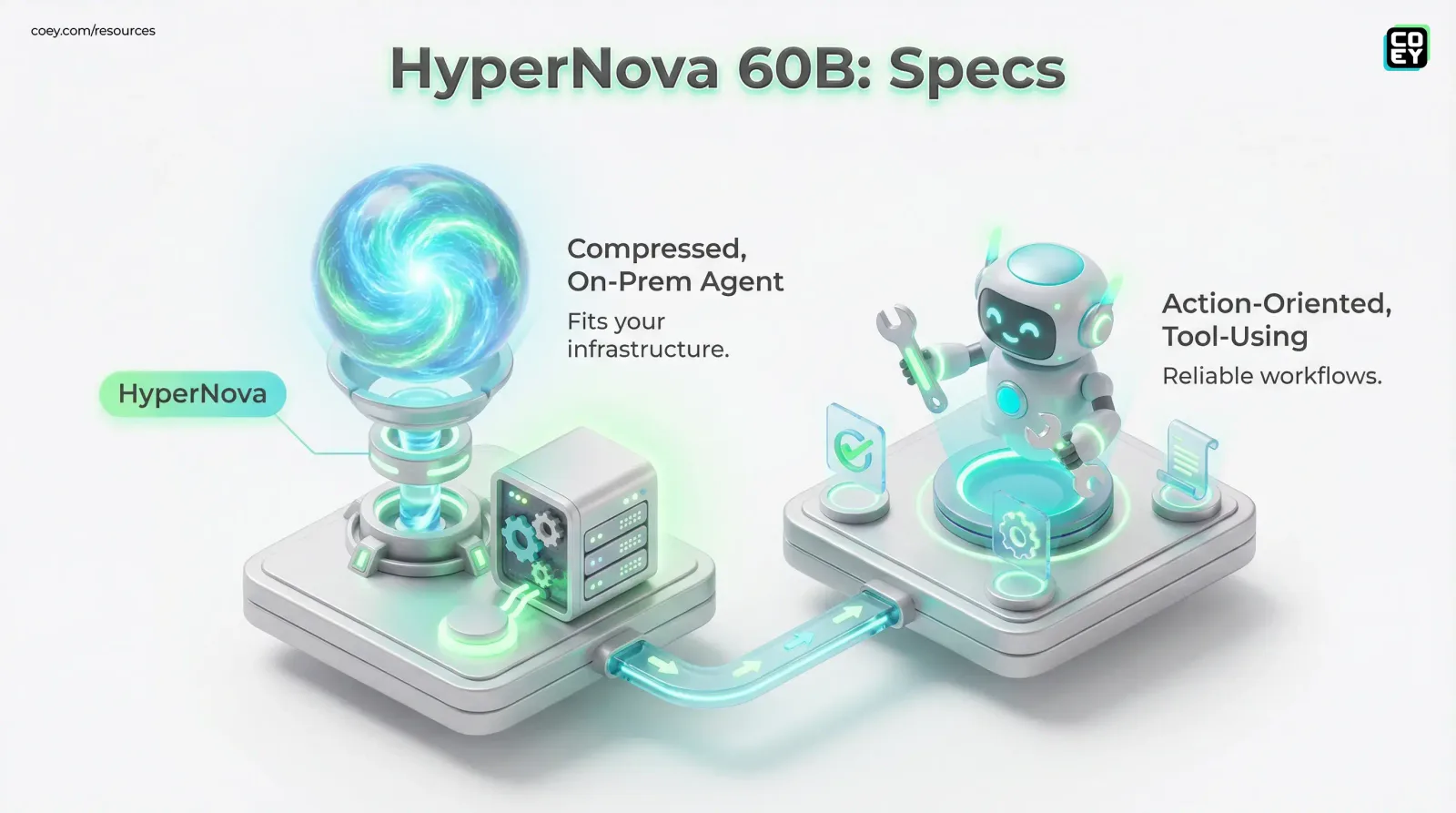
Open weights are only half the story. The real unlock is when open weights become deployable , meaning memory footprint, latency, and tool calling reliability are good enough to plug into workflows without constant babysitting.
What Multiverse actually shipped
HyperNova 60B 2602 is a compressed, instruction tuned LLM distributed under Apache 2.0 (commercially permissive). Multiverse positions it as a 50% compressed version of gpt-oss-120B, reducing the model file footprint from roughly about 61GB down to about 32GB while targeting near parity on the behaviors that matter for automation: reasoning, tool use, and function calling.
The release materials describe an architecture profile of roughly about 59B parameters and about 4.8B active parameters, and note use of MXFP4 precision. They also describe configurable “reasoning effort” modes (low, medium, high). Translation: this is not just “smaller.” It is trying to be tunable for different workloads and latency budgets.
| Spec | HyperNova 60B 2602 | Operational meaning |
|---|---|---|
| Distribution | Open weights (Hugging Face) | Run it where your data lives |
| License | Apache 2.0 | Commercial use plus customization without legal gymnastics |
| Memory target | About 32GB model file footprint (compressed) | Single node becomes realistic for more teams |
CompactifAI: compression as a strategy
Multiverse’s proprietary angle is CompactifAI, which they describe as quantum inspired compression that restructures networks to shrink them while keeping accuracy loss small. In their own materials, they also claim this approach can reduce model size by up to 95% in some settings while keeping precision loss to a small margin (they cite about 2 to 3% in their write ups). In practice here, they are using it to move frontier-ish behavior into a hardware band that does not require an 8x H100 altar.
Here is why this matters to creative and marketing operations: model compression changes the economics of iteration. Once inference is cheap enough, you stop treating the model like a scarce resource and start treating it like a background service:
Always on QA: run critics and validators continuously (tone, claims, formatting, policy rules).
Batch transformations: rewrite, localize, summarize, tag, and structure content overnight.
Agent loops: plan then tool call then revise then retry becomes feasible without a token cost jump scare.
Compression is not just cost cutting. It is what turns “AI we sometimes use” into “AI that runs continuously inside the workflow.”
The real flex: agent benchmarks plus tool calling
Multiverse is not marketing HyperNova as a vibes model. They are pushing agentic performance improvements, aka the difference between “LLM that talks” and “LLM that can reliably execute structured steps.” Their release materials cite:
About 5x gain on Tau2-Bench (agentic tool use)
About 2x gain on Terminal Bench Hard (agentic coding and terminal tasks)
About 1.5x gain on BFCL v4 (function calling)
Those numbers do not guarantee your agent will not do something cursed at 2 AM. But they do point at a deliberate optimization target: function calling reliability. If you want automation, you need the model to produce structured outputs and valid tool invocations consistently, because your workflow platform does not care that the prose was beautiful when the JSON did not parse.
API availability: yes, you can automate it
HyperNova ships as downloadable weights, not a hosted SaaS API. That is a feature if you want control, and a chore if you want instant plug and play. The good news: open weight models are inherently API capable. You wrap them behind an inference server and your stack calls it like any other endpoint.
Most teams productionizing HyperNova will choose one of these patterns:
1) Internal endpoint (recommended for on prem)
Stand up an inference server (common stacks include Hugging Face TGI and vLLM).
Expose an HTTPS endpoint inside your network.
Call it from orchestration tools (n8n, Make, Airflow) via webhooks.
2) OpenAI compatible interface (fast adoption)
If you present the model behind an OpenAI style API surface, you reduce integration friction. Your existing LLM calls (tools, routing, structured outputs) can often be swapped to a new base URL and model name. That is how you pilot without rewriting your entire automation layer.
| Question | Answer | What it means for teams |
|---|---|---|
| Can we call it programmatically? | Yes | Self hosted endpoint equals workflow ready |
| Is there a turnkey hosted API? | No (by default) | You will need infra or a managed GPU partner |
| Can non technical teams use it easily? | Not immediately | Best paired with an internal AI gateway or tool wrapper |
Where it is production ready today
HyperNova is most “ready” in workflows that are high volume, repeatable, and bounded, where human review remains the final gate, but the machine does 80% of the grind.
Marketing ops and content supply chains
Localization drafts with strict formatting requirements
Brief to variant generation for ads, emails, landing pages
Content repurposing (blog to newsletter to LinkedIn thread to script)
Metadata automation for CMS and DAM (tags, summaries, alt text)
Internal agents that touch real tools
Report builders (pull metrics then narrate then format then post to Slack)
Support triage (classify then draft response then create ticket fields)
Workflow glue (generate scripts, validate payloads, transform data)
Best use case framing: treat HyperNova like a work engine behind your systems, not a chat toy. The ROI shows up when it runs in batch and on schedule , not when someone prompts it once.
Where the hype ends (aka the stuff you still own)
Open plus compressed plus agent optimized is a strong combo, but it does not magically delete operational reality:
Serving is a product. You will need auth, rate limits, logging, monitoring, and cost controls.
Tool access expands risk. Function calling is powerful, but it is also a permissioning problem. Least privilege or enjoy your future incident report.
Benchmarks are not your workflow. Validate on your content types, your schemas, your edge cases, and your legal will screenshot this risk profile.
Bottom line
HyperNova 60B 2602 is a meaningful step toward on prem, automation grade LLM infrastructure because it is not just open, it is sized and tuned for real deployment and tool using agents. The Apache 2.0 license makes it commercially clean, the compression makes it hardware feasible for more orgs, and the agent and function calling posture makes it relevant to modern creative and marketing automation.
It will not replace human taste, intent, or governance. But it can absolutely replace a huge chunk of the repetitive labor that slows creative teams down. That is the mission aligned win: humans set direction, machines keep the pipeline moving.
Turn AI News Into Marketing Advantage
COEY turns the latest AI developments into real marketing firepower. We deploy n8n workflows, Claude Cowork agents, and OpenClaw pipelines that keep your channels running and your team focused on strategy. See our automation approach or request a proposal.