DeepSeek V4 Teases a 1M Token, Multimodal All in One Model. Here is What is Actually Operational
DeepSeek V4 teases a 1M token multimodal model. What is actually operational today for agency and brand AI content automation.
1 March 2026Team COEY
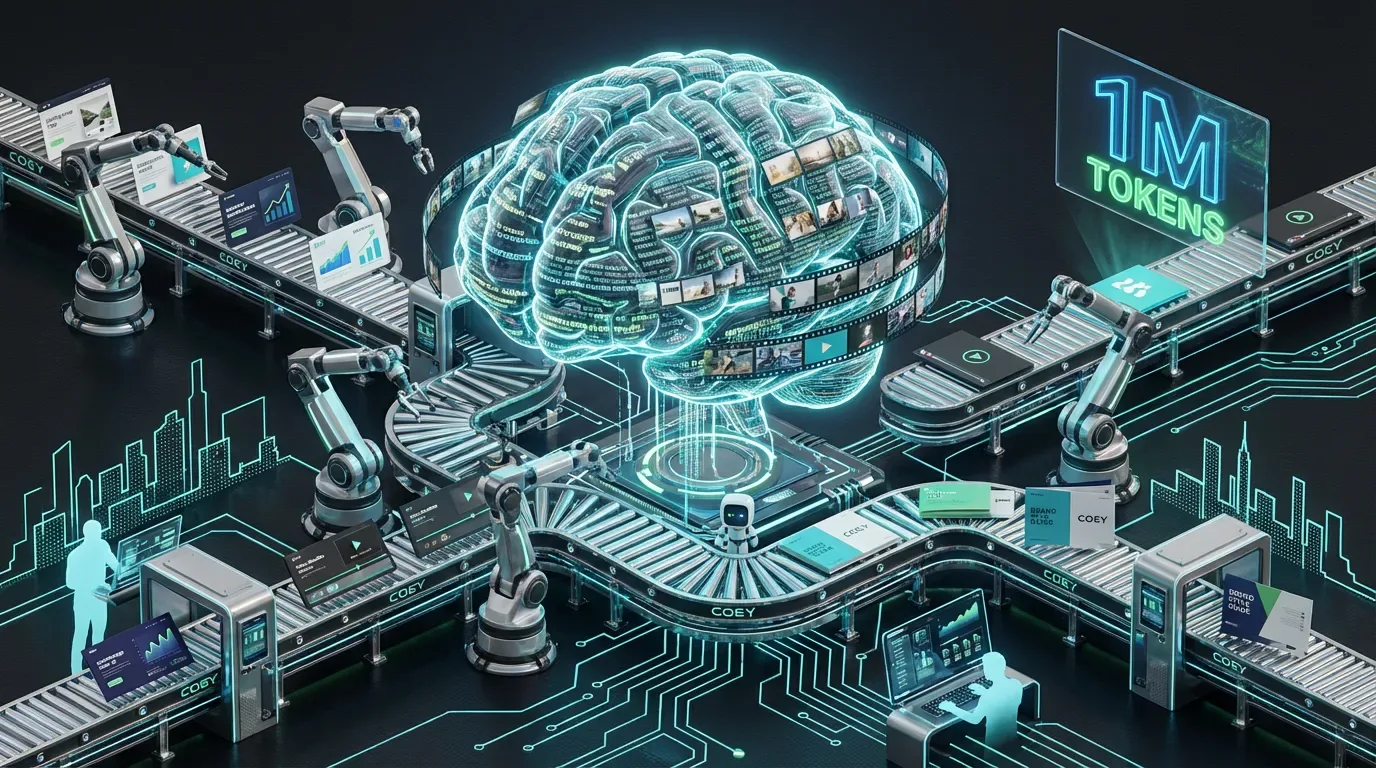
DeepSeek is teasing its next flagship, DeepSeek V4, as a multimodal foundation model with an attention grabbing 1M token context window. If the claims hold up, V4 lands right on the line COEY cares about: not cool demo, but can this become creative infrastructure? Because context plus multimodality plus cost is the combo that turns AI from a writing toy into a workflow engine.
Translation: V4 is not being pitched as a chatbot that can also see. It is being positioned as a single model that can keep an entire campaign brain in one place, text and images, and possibly video depending on what ships, without duct taping together five tools and a prayer.
What DeepSeek is claiming with V4
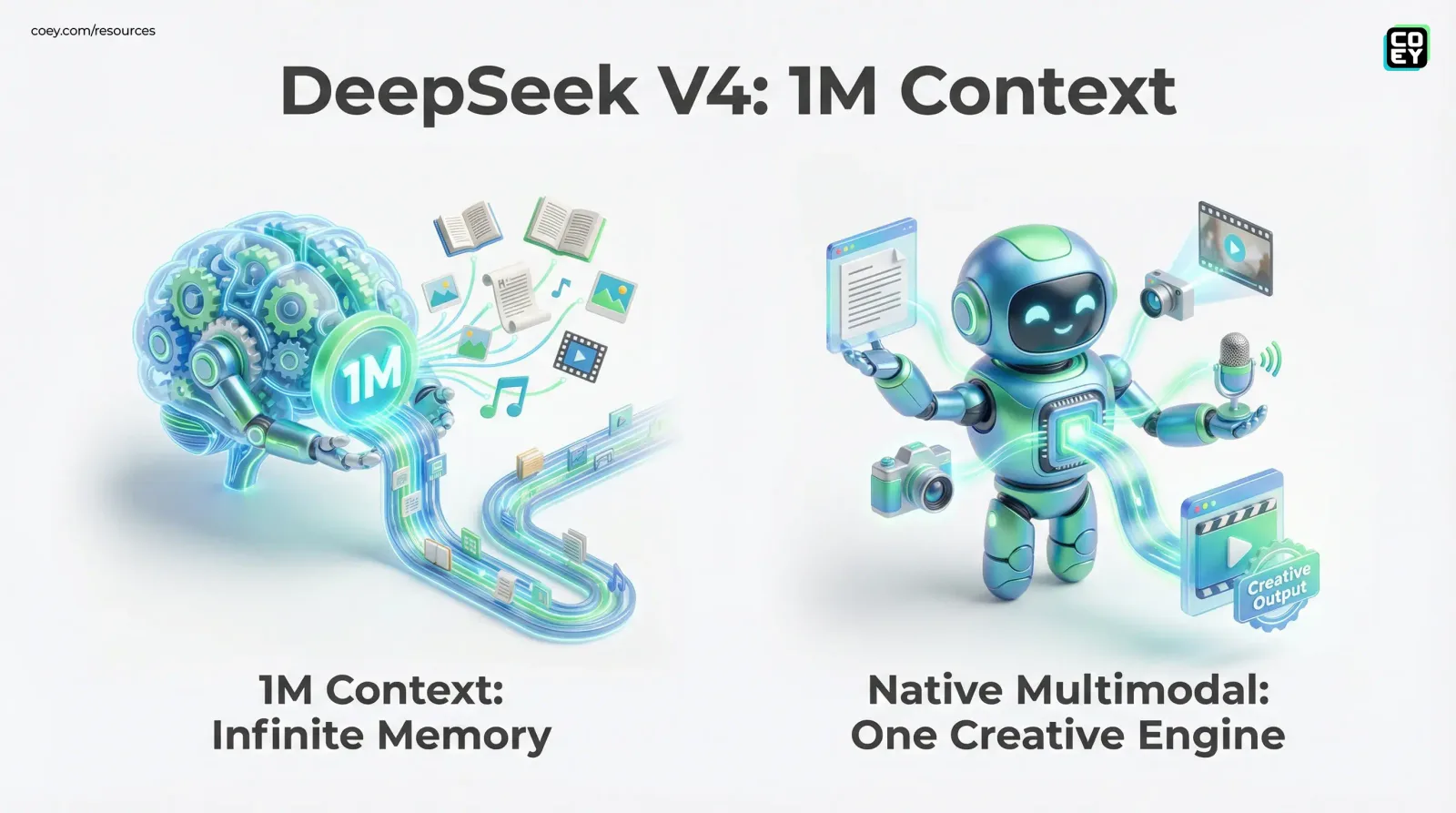
DeepSeek V4 messaging is basically: one model, multiple media types, massive memory, and lower inference cost. That is the whole pitch. And it is aimed at the exact people who are sick of stitching together separate systems for copy, visuals, clips, and QA.
Native multimodal, not plugin multimodal
DeepSeek is framing V4 as multimodal at the model level, meaning text and images are treated as first class citizens in one context. Some reporting and social chatter also describes video support, but DeepSeek has not clearly documented as of today whether that means video understanding, video generation, or both.
Fewer handoffs: no generate copy, then re brief image model, then re brief video model loop.
Better continuity: the same context governs what you say and what you show.
Cleaner automation: fewer brittle glue steps between tools.
1M token context: the real story
A million tokens is not a flex for social posts. It is a workflow unlock. In practice, it means you can plausibly keep a large truth set in one run: brand guidelines, product docs, prior campaign assets, competitive notes, legal disclaimers, and performance learnings.
That changes how teams build automation because it reduces the biggest hidden tax in AI workflows: context management. The classic stack today looks like: chunk docs, summarize chunks, summarize summaries, then hope your final output is not missing the one line Legal cares about.
Long context does not guarantee truth. It guarantees availability. You still need validation and approvals, but you get fewer it forgot the brief failures.
What is new vs DeepSeek prior releases
DeepSeek already has a reputation for shipping models that are cheap enough to run in volume and accessible enough to integrate. V4 teased shifts are about consolidating capability into one engine while pushing the ceiling on long context work.
The shift: consolidation plus economics
Consolidation: one model spanning multiple modalities reduces orchestration complexity.
Long context maturity: 1M tokens is designed for project scale work, not prompt scale work.
Cost pressure: DeepSeek continues to position itself as aggressive on inference economics, relevant because agentic workflows do not call models once, they loop.
API availability: can you automate it or not?
This is the dividing line between news and infrastructure. DeepSeek already operates a developer platform with public API documentation and an API shape that is designed to be familiar to teams who have built around OpenAI style patterns.
What exists today (confirmed)
DeepSeek current API docs indicate:
Standard HTTPS API access meaning callable from any stack that can POST JSON
OpenAI compatible conventions including the documented base URL https://api.deepseek.com
Developer first endpoints intended for programmatic use, not only UI access
What is still a question for V4 specifically
Until V4 model specific docs are live, the real automation questions are:
Is the 1M context available via API or only in limited preview surfaces?
How are multimodal inputs represented file upload, URLs, base64 blobs, or job based media processing?
Is video support understanding only analyze frames, or true generation render usable clips?
| Automation need | What we can infer | Why it matters |
|---|---|---|
| Batch plus orchestration | Likely (DeepSeek is API forward) | Lets you run overnight content pipelines, not just ad hoc prompts |
| Multimodal I O via API | Partially confirmed (text is confirmed; image and video details remain model specific) | Determines whether this plugs into Make and n8n workflows cleanly |
| Long context access tiers | Unknown (often gated) | Decides if 1M tokens is real for you or real for screenshots |
Where V4 could hit hardest for marketing teams
Most marketing orgs are not blocked by creativity. They are blocked by throughput and coherence: making lots of assets that do not contradict each other, do not drift off brand, and do not accidentally invent claims.
Cross channel campaign assembly
If V4 can truly hold a campaign full working set in context, it becomes feasible to generate:
launch narrative plus landing page sections plus email series plus ad variants
visual prompts and or first pass images aligned to the same brief
short form video scripts and storyboards that match the offer details
All without re briefing the model every step like you are onboarding a new freelancer 12 times a day.
Content repurposing at library scale
Long context is especially valuable for repurposing because the input is big and messy: transcripts, decks, long PDFs, performance exports, prior approved copy. With a 1M window, the promise is fewer chunking pipelines and fewer summary drift artifacts.
Creative QA (the underrated multimodal use)
Multimodal is not only about generating assets. It is also about checking them:
Does the visual match the copy claim?
Is the disclaimer present?
Are we using an outdated product name?
That is where human plus machine collaboration scales cleanly: the machine flags issues, humans approve what ships.
Hardware and geopolitics: the subtext that matters
DeepSeek has been signaling optimization for domestic China made accelerators, part performance posture, part supply chain strategy. This matters for enterprises thinking about:
availability: what hardware you can actually procure
cost: where inference can be cheaper at scale
deployment posture: cloud vs on prem vs in region requirements
It also matters competitively. If DeepSeek pairs frontier-ish capability with materially lower inference costs, it pressures Western providers where it hurts most: not in demos, but in budgets.
Reality check: what is hype vs what is ready
DeepSeek V4 is being teased as a big deal, and it might be. But production teams should separate the headline from the install.
Feels operational
API first DNA: DeepSeek already behaves like a platform, not just a chat app.
Long context as a workflow feature: reduces re briefing and chunking overhead.
Cost focus: critical if you are running agent loops or high volume content factories.
Needs validation
Multimodal quality: supports video can mean anything from understands frames to generates usable clips.
Latency plus quotas: long context and multimodal jobs can be slow or gated.
Governance: the more you automate, the more you need logs, approvals, and rollback paths.
If it is callable, it is composable. If it is composable, it can become a collaborator inside your systems, not just a shiny tab your team forgets exists.
Bottom line
DeepSeek V4 tease matters because it is aimed at the workflow AI phase: one model spanning modalities, a 1M token context window for project scale coherence, and economics that could make always on creative collaboration financially realistic. The open question is not whether it is impressive. The question is whether the multimodal plus long context features ship in a way that is API accessible, automatable, and stable enough for real pipelines.
If DeepSeek delivers V4 as an API ready, multimodal, long context workhorse, this becomes less about a new model launch and more about a new baseline for creative operations: humans set intent and taste, machines manufacture breadth and structure, and the org finally stops paying the format tax for every asset type.
Related on COEY: If you want the broader context on how DeepSeek has been fitting into real workflows, see LLM Powerhouses: GPT-5.2, Gemini, DeepSeek Transform Workflows.
For senior marketing leaders evaluating the broader shift, our Executive AI Accelerator is a confidential top-to-top engagement. For a structured blueprint, read How to Build an AI Content System.