
Grok Imagine Goes Video-First and xAI’s Automation Story Gets Real
Grok Imagine goes video first and xAI's AI marketing automation story gets real. What it unlocks for agency and brand video pipelines.
2 March 2026Team COEY
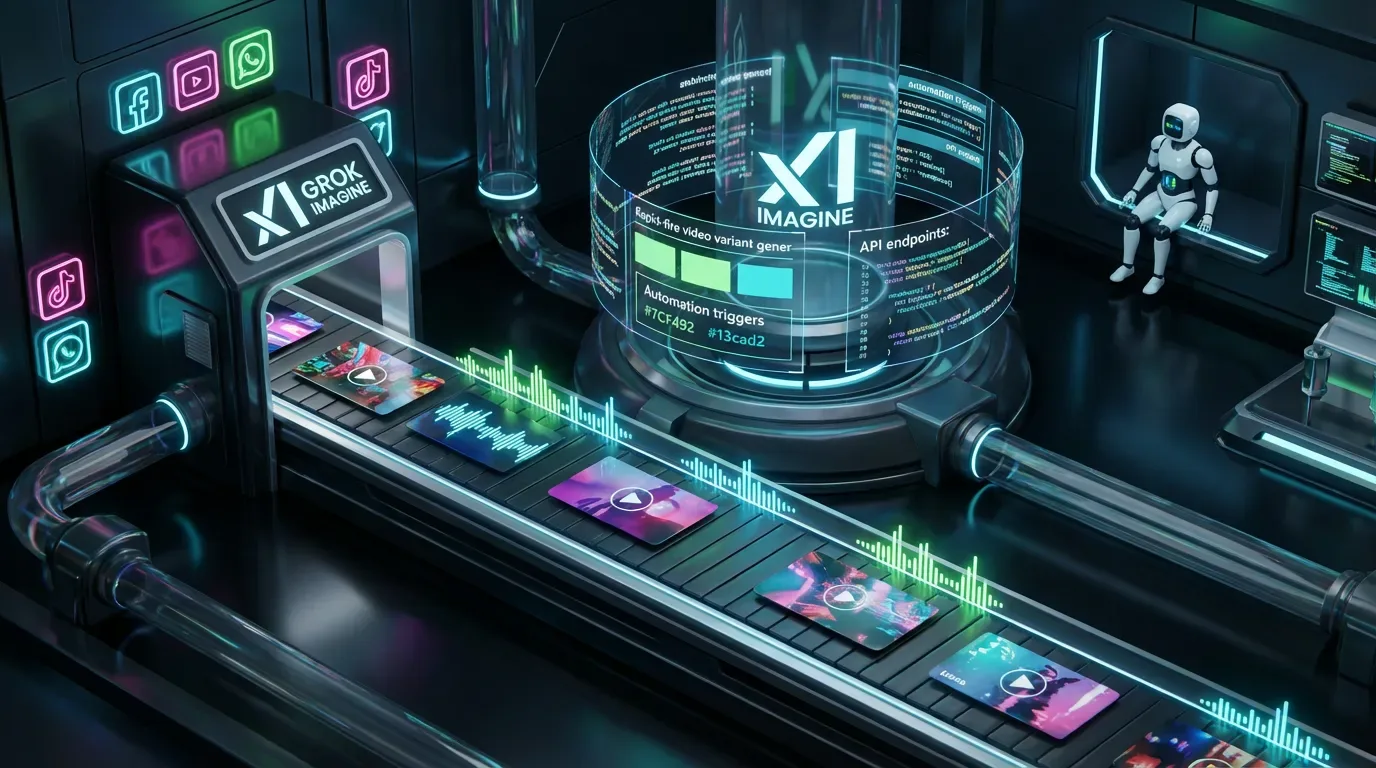
xAI is pushing Grok beyond “chat with a personality” into something closer to a programmable media engine, and the clearest signal is Grok Imagine’s jump into text-to-video alongside ongoing upgrades across the Grok model family.
The front door for what’s officially callable (and therefore automatable) remains the xAI developer platform at https://x.ai/api/. As of early 2026, Grok Imagine’s video is no longer just a product surface. xAI has also published an official Grok Imagine API announcement at https://x.ai/news/grok-imagine-api.
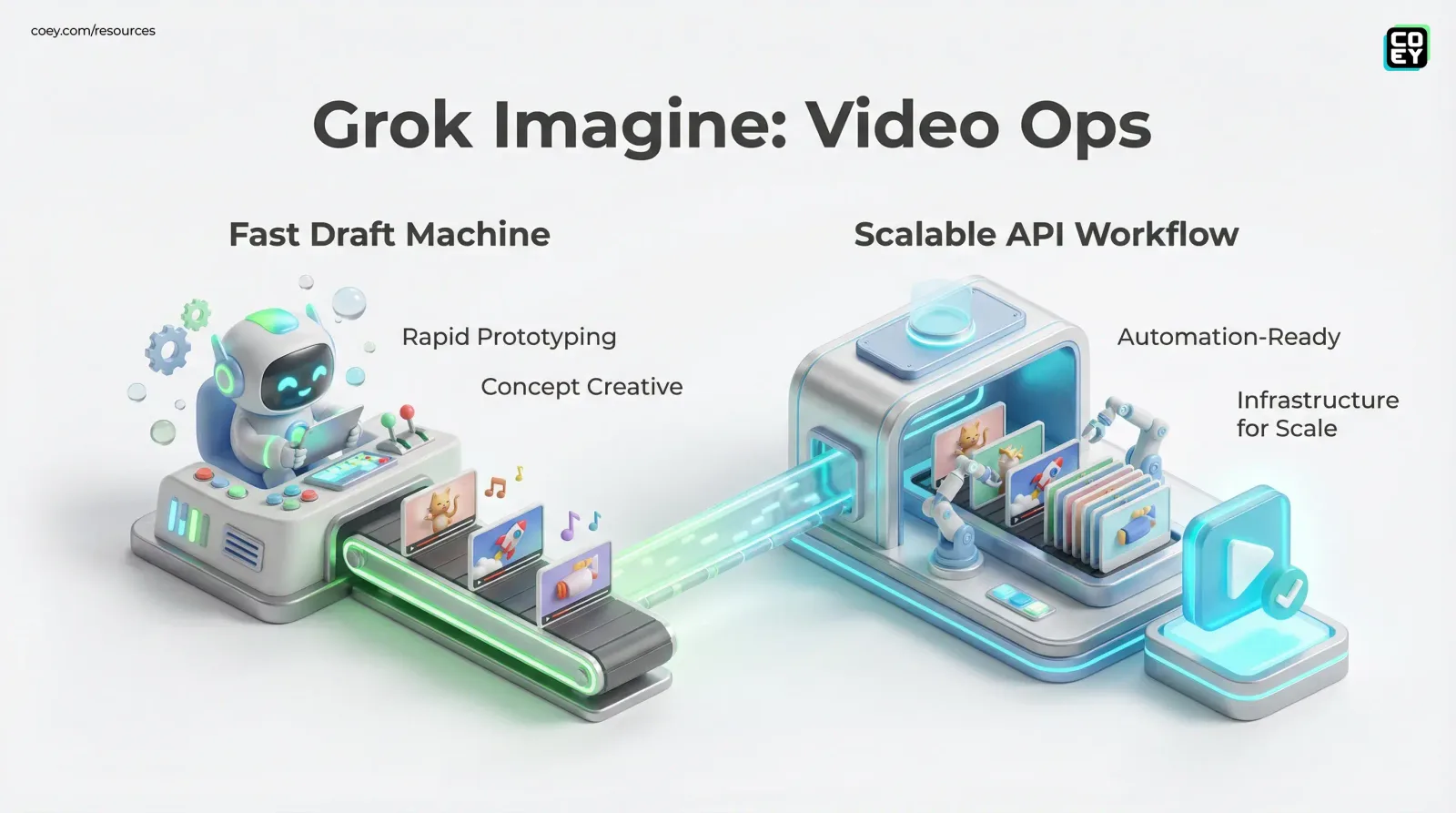
That distinction still matters. Creators love shiny features. Operators love repeatability. The gap between those two is where most “AI video tools” go to die.
The real question isn’t “can it generate video?” It’s “can we generate 200 variants overnight, route them for review, and ship the winners without a human playing download and upload babysitter?”
What actually shipped (without the fog)
The practical claim is straightforward: Grok Imagine can generate short video clips from text prompts, and Grok Imagine is widely reported to output short clips suitable for social placements, with the notable addition of native audio in the product experience.
On the API side, xAI’s developer docs now include a video generation capability page, with stated options that include 480p and 720p and durations up to 15 seconds depending on mode and settings: https://docs.x.ai/developers/model-capabilities/video/generation.
The operationally important piece is not the duration. It’s the direction: xAI is building a media stack where generation is native to the same ecosystem where distribution and audience already exist.
If you want the earlier UI-first moment that signaled the shift, COEY covered the initial rollout here: https://coey.com/resources/blog/2026/01/23/grok-imagine-adds-10-second-video-with-audio/.
The multimodal “physical AI” angle: separate hype from shipping
It’s easy to find ambitious language online about embodied or spatial reasoning for robotics. But as of what’s cleanly documentable in public product terms, the most reliable workflow signals are the ones with endpoints, schemas, and docs.
What is real: xAI continues to expand Grok’s core capabilities through its platform and releases like Grok 4.1, with official updates here: https://x.ai/news/grok-4-1/.
If there’s no endpoint, no schema, and no integration story, it’s not a workflow primitive. It’s a direction. Directions are nice. Workflows pay salaries.
Why Grok Imagine going video-first matters
Text-to-video is now table stakes in AI-land, but Grok Imagine’s relevance to marketing teams isn’t “we can make movies now.” It’s that it compresses the most expensive step in content: first-draft production.
Ten seconds is basically the internet’s native unit of persuasion:
hooks for paid social
story ads
product bumpers
explainer openers
quick concept creative for stakeholder alignment
The win is not cinematic perfection. It’s throughput. If your team can generate enough decent options quickly, humans can do what humans do best: pick the angle, refine the story, and decide what’s on-brand.
Audio is the sleeper feature
A lot of AI video demos look great muted. Grok Imagine’s reported ability to produce native, synchronized audio changes review behavior because pacing and emotional read are visible in the draft, not imagined later.
This is also where human plus machine becomes practical:
humans set intent (strategy, tone, taste)
machines generate draft variants (visual plus sound)
humans choose what deserves polish and spend budget where it matters
API availability: what’s callable vs. what’s still UI-only
Here’s the adult conversation: xAI has an API platform, and it’s not theoretical.
Official Grok Imagine API announcement: https://x.ai/news/grok-imagine-api
Video generation docs: https://docs.x.ai/developers/model-capabilities/video/generation
In other words, this is no longer “UI-only” by default, even if UI access and API access can roll out differently by plan and region.
So the automation reality looks like this:
| Capability | What’s real today | What’s missing for scale |
|---|---|---|
| Video generation in Imagine | Available as a documented capability with an official API announcement | More predictable rollout consistency, plus enterprise controls |
| Automation into workflows | Stronger now that video is documented and callable | Deeper job control patterns, bulk ops, and governance tooling |
| Media ops governance | Possible if you build your own approval layer | First-class creative ops features (audit, asset lineage) |
Real-world readiness: where teams can use this now
Fast wins (low-risk, high-leverage)
Grok Imagine is immediately useful when you treat it like a high-speed draft machine:
Concept prototyping for ads: generate multiple creative directions before you commit production budget
Storyboarding with motion: get stakeholder alignment faster than static frames
Social trend response: shorten the time from “trend spotted” to “asset drafted”
Where it’s not ready to be “the system”
If you’re trying to run an always-on creative factory, the current limitations still matter:
Workflow maturity: even with a documented API, you still need reliable queueing, retries, and asset management patterns
Inconsistent access during rollout: teams hate workflows that only work for whoever has the feature toggle
Brand control still requires guardrails: models drift; brands get blamed
UI tools help individuals move faster. APIs help teams scale output. Now that video is documented and callable, Grok Imagine can move from prototyping toward production for some teams, but most orgs should still keep humans in the approval loop.
What this means for execs and marketing ops
The strategic signal isn’t “xAI made a video toy.” It’s that xAI is building a stack where Grok can be:
a reasoning engine (text plus decisions)
a media generator (images and video)
an agent layer (tool calling and automation patterns)
The nearer xAI gets to offering stable, predictable media endpoints for video with queueing, retries, asset retrieval, and predictable pricing, the more Grok Imagine stops being fun and starts being infrastructure.
Bottom line
Grok Imagine’s move into short-form text-to-video with audio is a meaningful workflow development because it attacks the first-draft bottleneck that slows down modern marketing.
But the pragmatic read is just as clear: xAI’s automation story is strongest where APIs are documented. As of early 2026, that now includes Grok Imagine video generation, not just text, agents, and image generation. The remaining question is less “is there an endpoint?” and more “is it stable enough, governable enough, and operationally mature enough to be a production node for your team?”
For senior marketing leaders evaluating the broader shift, our Executive AI Accelerator is a confidential top-to-top engagement. For a structured blueprint, read How to Build an AI Content System.