
OpenAI Launches GPT-5.4 With Configurable Reasoning for Automation
OpenAI launches GPT 5.4 with configurable reasoning for automation. What the new controls unlock for AI marketing workflows and agent pipelines.
5 March 2026Team COEY

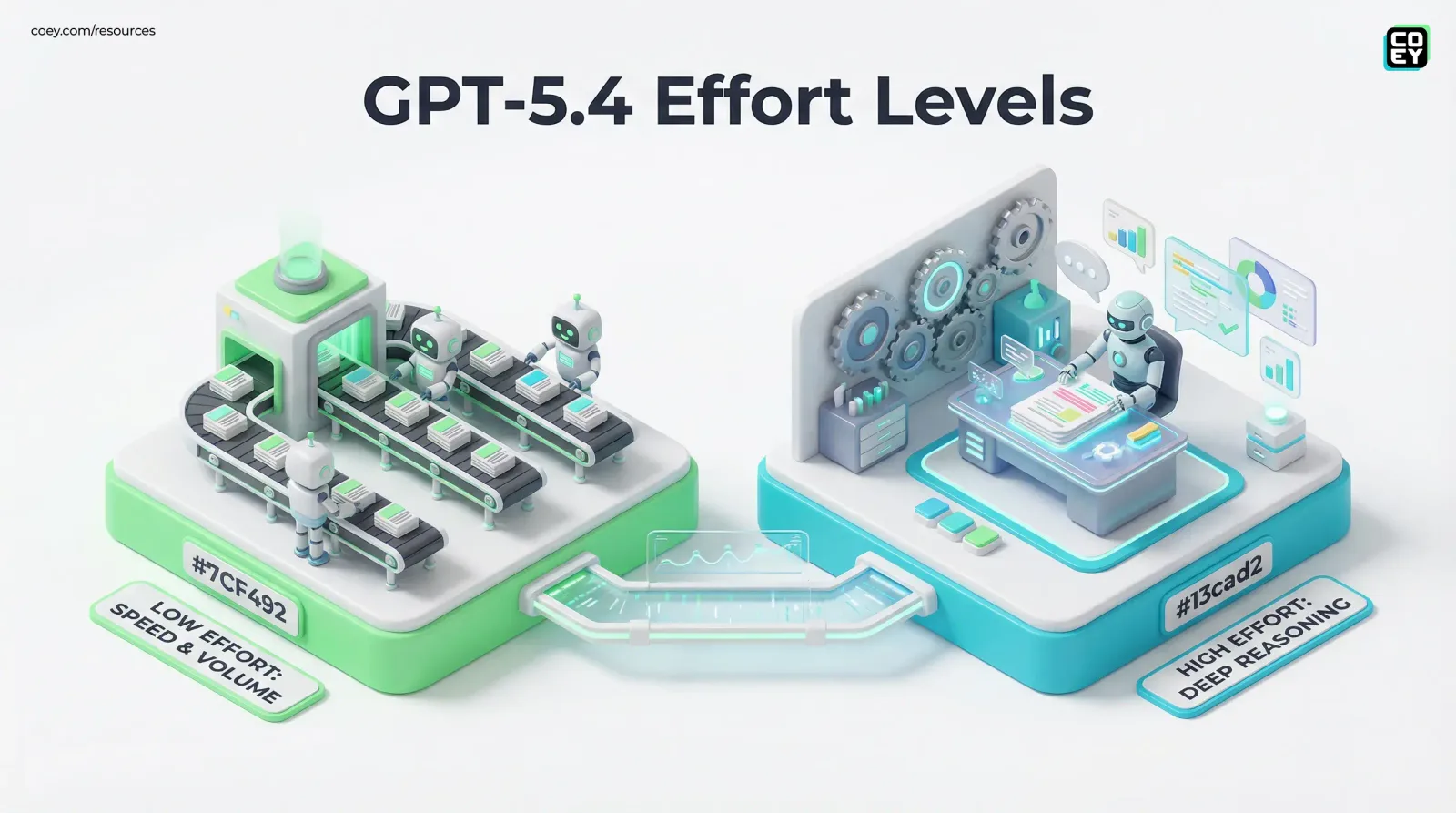
OpenAI’s newest model, GPT-5.4, is less “wow it can write” and more “wow, we can finally operate this thing.” The headline feature is configurable reasoning, which you can use to trade off speed and cost versus deeper problem-solving. And importantly, it is not just a ChatGPT toggle. It is exposed in the API under a reasoning object as reasoning.effort, which means your workflows can make that decision automatically, step by step.
Translation for execs: GPT-5.4 is being packaged like infrastructure. You can run it cheap and fast for bulk content ops, then selectively pay for “think harder” only when the workflow hits something risky, ambiguous, or high-stakes.
What OpenAI actually shipped
GPT-5.4 lands as a model family designed to be agent-ready: better tool use, better reliability, and knobs that make it easier to budget and route work. OpenAI’s developer docs frame it as a production model you can call directly via the API, including the documented reasoning.effort control (GPT-5.4 model docs).
Three aspects matter most for real-world teams:
Reasoning effort control: the model can be instructed to apply less or more internal effort per request via reasoning.effort .
Computer-use automation: OpenAI’s computer use tool is available through the Responses API for UI-style workflows (preview and subject to tier and rollout limits) ( Computer use guide ).
Very long context (experimental): OpenAI documents an experimental mode that can reach roughly 1 million tokens for GPT-5.4 in supported configurations, which changes how you design research, repurposing, and QA pipelines.
Configurable reasoning is the real flex
“Configurable reasoning” sounds like a product marketing phrase until you realize it is basically a budget and latency governor that you can encode into automation.
In the API, this shows up as reasoning.effort with documented options including none, low, medium, high, and xhigh. OpenAI also offers a higher-end GPT-5.4 Pro variant, and the exact effort options and availability can vary by model and access tier.
Why it matters operationally
Most organizations do not call a model once. They call it dozens of times per asset:
- extract brief → generate variants → check claims → format for channels → localize → create metadata → route approvals
Reasoning effort lets you stop paying deep thinking prices for tasks like:
turning bullet points into 10 ad variants
rewriting subject lines into brand tone
summarizing a Slack thread into a status update
While still escalating to deep reasoning when the workflow hits:
comparisons where nuance and accuracy matter
claims and compliance checks
strategy synthesis such as positioning, segmentation logic, offer architecture
Snarky but true: using max reasoning for every micro-task is like hiring your best strategist to rename 600 JPGs. Impressive. Financially unserious.
API-first: yes, this is automatable
The important part is not that GPT-5.4 is in ChatGPT. It is that it is callable, meaning you can wire it into the place work actually happens: your automations, your middleware, your content supply chain.
What “API availability” means in plain English
Yes, you can run it on schedule: nightly batches, campaign refresh jobs, weekly reporting pipelines.
Yes, you can connect it to your stack: anything that can hit an HTTPS endpoint can route tasks through GPT-5.4.
Yes, you can enforce policies in code: dial effort up only when a critic or validator flags complexity.
| Workflow need | What GPT-5.4 adds | Readiness |
|---|---|---|
| High-volume content ops | Low-effort mode for speed plus cost control | High |
| Strategy and analysis steps | High or xhigh effort for deeper reasoning | High (validate on your tasks) |
| Agent automation across tools | Tool use plus computer use patterns (preview) | Medium-High (needs guardrails) |
Computer use: when the UI becomes the API
OpenAI’s “computer use” direction is the most disruptive and the most easy to overhype. The concept: instead of relying on a vendor API, an agent can operate the interface like a person: read the screen, click, type, submit.
OpenAI documents this as a tool inside the Responses API ecosystem (computer use guide), and it is explicitly intended for sandboxed, controlled environments because letting an agent freestyle in production is how you end up with a “why did it change billing settings?” postmortem.
What marketers can actually do with this
Last-mile platform work: updating fields in portals that do not expose the endpoint you need.
Cross-tool publishing support: upload assets, set metadata, and complete repetitive UI steps.
Visual QA loops: verify that a page renders correctly, disclaimers are present, or a campaign setting is toggled.
Reality check: UI agents reduce integration dead-ends, but they increase governance needs: allowlists, action caps, logging, and pause for human approval gates on anything sensitive.
The long-context story: fewer breakpoints
GPT-5.4’s experimental long context mode is documented as reaching roughly 1 million tokens in supported configurations. For workflow teams, the value is not bragging rights. It is reducing the number of times you have to:
chunk the docs
summarize the summaries
stitch answers back together
Long context increases the odds your model can keep a full working set in one run: brand rules plus product truth plus prior campaign outputs plus legal disclaimers plus competitive notes plus output schema. That is how you get fewer contradictions across assets, especially in multi-channel campaigns where drift is the silent killer.
Reliability claims: useful, not permission to stop checking
OpenAI is positioning GPT-5.4 as more reliable and less error-prone than earlier releases in complex workflows. That is directionally good, but production teams should treat “lower hallucination rate” like “better brakes,” not “invincibility.”
In automation, the standard is still:
Proof-first for facts (grounding, citations, source IDs)
Structured outputs (schemas that validate)
Human review where stakes are brand, legal, financial
If it can publish, spend, or change systems of record: it needs approvals, receipts, and rollback. Always.
Bottom line: a model you can route and run
GPT-5.4 is OpenAI leaning hard into “AI as a workflow component,” not just “AI as a chat experience.” Configurable reasoning is the real production feature: it enables cost-aware routing and selective depth inside one pipeline. Computer use expands automation beyond clean APIs, powerful but governance-heavy and still rolling out. And long context pushes toward fewer handoffs and less manual context babysitting.
For creators and marketers trying to scale output without scaling chaos, this is the direction you want: humans keep intent and taste; machines run the loops, with controls you can actually encode.
If you want more context on how long context is reshaping workflow design across the industry, see COEY’s recent breakdown of 1M-token positioning and what is actually operational: DeepSeek V4 Teases a 1M Token, Multimodal All in One Model. Here is What is Actually Operational.
AI Marketing That Goes Beyond the Hype
COEY builds the marketing automation systems that agencies and brands actually need: n8n workflows, Claude Cowork agents, OpenClaw models, all connected and delivering. See our automation capabilities, explore our channel work, or request a proposal.