
Kimi 2.5 Agent Swarm
Kimi 2.5 Agent Swarm brings parallel agents into reach. A look at what it unlocks for AI marketing automation and multi agent creative ops teams.
18 March 2026Team COEY
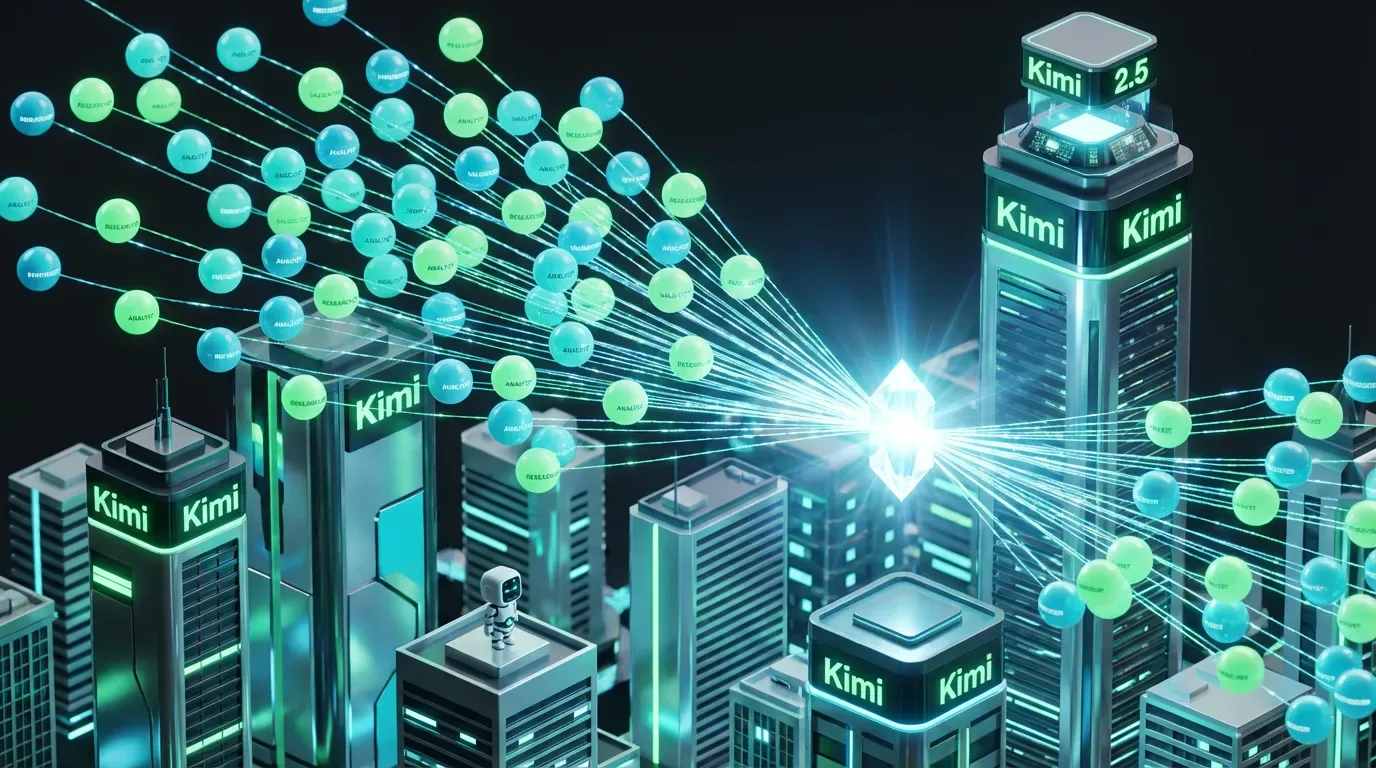
Kimi 2.5 is betting that the next “AI leap” isn’t a smarter solo model. It’s a better-managed team. With Agent Swarm, Kimi’s platform can spin up to 100 sub-agents to run complex work in parallel, coordinating 1,500+ tool calls in a single run and claiming speedups as high as 4.5× versus a single-agent, sequential workflow. If you’ve ever watched a single-agent workflow crawl through research, extraction, and synthesis like it’s trapped in a one tab at a time productivity nightmare, this is Kimi trying to delete that bottleneck.
For execs, the headline is simple: Agent Swarm is an attempt to make AI feel less like a chatbot and more like an operations layer. For marketers and creators, it’s even more practical: the same work you do with humans today (researchers, analysts, writers, QA) can now be spun up as parallel machine labor, with your team focusing on intent, taste, and approvals.
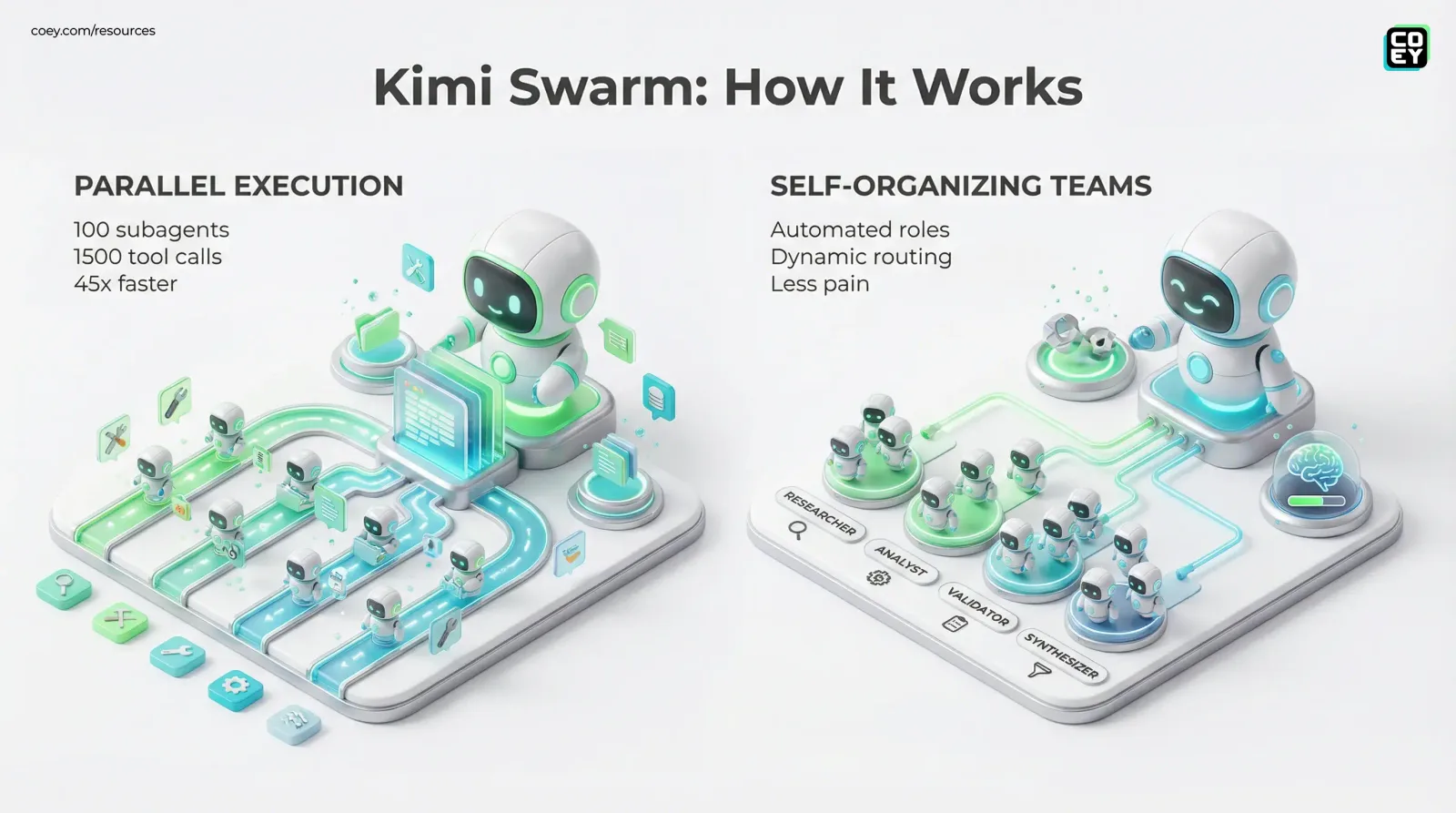
What Agent Swarm actually is
Agent Swarm is Kimi 2.5’s multi-agent automation capability designed for long-horizon, high-volume tasks, the kind that usually break single-agent systems via slow sequential steps, context drift, or sheer overload.
The core mechanism: Kimi creates a swarm of sub-agents that work simultaneously. Think of it like assembling a micro-agency on demand:
Researchers gather source material in parallel
Analysts turn raw findings into structured conclusions
Validators check consistency and sanity
Synthesizers assemble the final output into something a human can actually use
The key shift: instead of chaining prompts like dominoes, Agent Swarm runs workstreams at the same time, then merges them into one deliverable.
Parallelism is the feature, not the flex
Multi-agent gets marketed like sci-fi, but the benefit is painfully unsexy: throughput. Traditional AI automation often isn’t automation. It’s you supervising a model as it slowly completes tasks serially.
Agent Swarm’s promise is that Kimi can:
Split a giant workload (hundreds of pages, dozens of sites, many competitors) across sub-agents
Run tool calls concurrently (scraping, retrieval, transformations, calculations, formatting)
Collapse time-to-first-draft for multi-stage deliverables (brief to outline to draft to QA to packaging)
If your workflow includes repeated research plus repackaging cycles, weekly competitive monitoring, influencer discovery, audience mining, campaign postmortems, this kind of parallelism is exactly where machine collaboration starts to feel like a real multiplier.
Self-organizing teams, less orchestration pain
Kimi’s positioning isn’t “here’s a bunch of agents, go script them.” It’s closer to: the swarm organizes itself.
Instead of manually assigning each agent a job, Kimi says the system dynamically:
breaks down the task into subtasks
assigns roles across sub-agents
routes intermediate results back to an orchestrator for synthesis
That matters for non-technical teams because agent frameworks often die at the same point: the orchestration layer becomes its own project. Agent Swarm is trying to make multi-agent feel like a product feature, not a science fair.
If multi-agent requires a workflow engineer to babysit the workflow engineer, it’s not scaling creativity. Self-organization is Kimi’s attempt to keep it usable.
Use cases that map to real work
Agent Swarm is tuned for tasks that are both big and divisible. That’s a lot of modern marketing and creator ops.
1) Competitive and category research
Instead of one agent reading one competitor at a time, you can fan out across dozens of brands, landing pages, ad libraries, and reviews, then merge it into a structured report. The practical win is not more info. It’s more coverage without more calendar time.
2) Influencer and creator mapping
Kimi’s own examples include “top creators across multiple YouTube niches,” which is exactly the kind of task that benefits from parallel scanning, filtering, and validation. One sub-agent per niche, one synthesis pass at the end.
3) Multi-file processing and tagging
This is the workflow nobody brags about on LinkedIn because it’s too real: summarizing PDFs, extracting tables, tagging libraries, cross-referencing spreadsheets. Swarms can divide and conquer, then return unified outputs, ideally structured ones.
4) Long-form synthesis and reporting
Swarm behavior is a natural fit for building reports that require reading many inputs: market scans, VOC summaries, campaign retrospectives, messaging matrices. A single agent tends to get slow or sloppy here. A swarm can keep pace by distributing reading and analysis.
Automation readiness: what’s real vs. cool demo
Multi-agent systems are notorious for being impressive and fragile. So the adult question is: can this plug into workflows beyond the Kimi UI?
Kimi’s broader ecosystem includes developer-facing platform capabilities, and Moonshot AI operates an API surface through its platform. Here are the two links that matter for operational teams:
Moonshot AI platform updates (Kimi API)
Kimi-K2 repository (ecosystem plus deployment context)
But here’s the nuance: Agent Swarm being usable inside Kimi does not automatically mean Agent Swarm is fully exposed as an API primitive. As of March 2026, Agent Swarm is described as a preview or beta feature and access is gated to top-tier subscribers or eligible accounts. The strongest story today is that it’s available as a platform capability for those users. The depth of programmatic control is still evolving.
| Operator question | What Agent Swarm suggests | Practical takeaway |
|---|---|---|
| Can it run big tasks faster? | Yes: parallel sub-agents plus high tool-call throughput | Better for batch research, multi-source synthesis, libraries |
| Can we automate it end-to-end? | Partially: strong platform behavior, API story evolving | Great for human-in-the-loop ops now; deeper orchestration depends on API exposure |
| Is it production-ready? | Preview, gated access | Pilot it like a powerful workflow tool, not a guaranteed always-on backend |
Where teams will feel it immediately
Agent Swarm’s most immediate impact is in workflows where people lose time to serial grind:
Weekly executive briefs that currently require multiple analysts pulling inputs
Campaign assembly where research and drafting happen in separate slow phases
Content supply chains that stall on research, sourcing, and restructuring
Library maintenance (tagging, summarizing, extracting metadata) that never gets done because it’s boring
The real win isn’t replacing the creative team. It’s turning the machine into the parallel labor layer so the team spends its hours on judgment: what to ship, what to cut, what’s on-brand, what’s risky.
Roadmap signals worth watching
Kimi’s Agent Swarm roadmap mentions improvements like direct sub-agent communication and more granular control over parallelism. Those sound technical, but the translation is operational:
Better coordination equals fewer contradictions across sub-agent outputs
Adjustable swarm size equals cost control and load balancing
More tool support equals broader can it actually do the work coverage
If Kimi exposes these controls cleanly via API, swarms become not just a feature, but a programmable production pattern: spin up parallel workers, enforce budgets, collect structured outputs, route to human approval, publish downstream.
Bottom line
Kimi 2.5 Agent Swarm is a meaningful step toward AI that behaves like a creative operations engine, not a single chat window. Up to 100 sub-agents, 1,500+ tool calls, and parallel task execution maps directly to how real teams work, except now it runs at machine speed.
Just keep the hype disciplined: today, it’s most compelling as a platform-native preview or beta feature for heavy workflows, with access currently gated for eligible or top-tier accounts. The moment it becomes fully controllable and observable via API (job control, webhooks, agent budgeting), it graduates from cool multi-agent mode to workflow infrastructure. And that’s the line that matters when your mission is scaling human creativity through intelligent machine collaboration.
Related on COEY: Moonshot AI’s Kimi K2.5 Drops “Agent Swarm” Parallelism and It’s Built for Automation
Turn AI News Into Marketing Advantage
COEY turns the latest AI developments into real marketing firepower. We deploy n8n workflows, Claude Cowork agents, and OpenClaw pipelines that keep your channels running and your team focused on strategy. See our automation approach or request a proposal.