OpenAI’s GPT-5.4 Mini and Nano: Small Models, Big Automation Energy
OpenAI's GPT 5.4 Mini and Nano are small models with big automation energy. What they unlock for AI marketing automation, RAG, and agent workflows.
18 March 2026Team COEY

OpenAI just expanded the GPT-5.4 lineup with two “worker” models: GPT-5.4 Mini and GPT-5.4 Nano, built for speed, cost discipline, and high-volume automation. They’re positioned as the models you actually run all day inside pipelines, while bigger models handle the occasional “this needs taste” moment. The clean starting point for most teams is OpenAI’s API pricing, where the lineup and token costs are kept current.
This isn’t a vibes release. It’s OpenAI leaning into the reality that modern AI work isn’t one perfect prompt, it’s dozens of tiny calls: classify, extract, route, validate, rewrite, check policy, retry, post, log. Mini and Nano are meant to live in that loop without turning your automation budget into a haunted house.
What actually shipped
GPT-5.4 Mini and GPT-5.4 Nano are smaller, cheaper members of the GPT-5.4 family. OpenAI’s message is basically: stop burning flagship tokens on tasks that don’t deserve flagship attention. If you want the broader context on the base model and how it is designed for automation, see COEY’s earlier breakdown: OpenAI Launches GPT-5.4 With Configurable Reasoning for Automation.
The meta-shift: we’re moving from “pick one model” to “build a model stack,” where the default is fast + cheap, and you escalate only when needed.
Mini vs. Nano in plain English
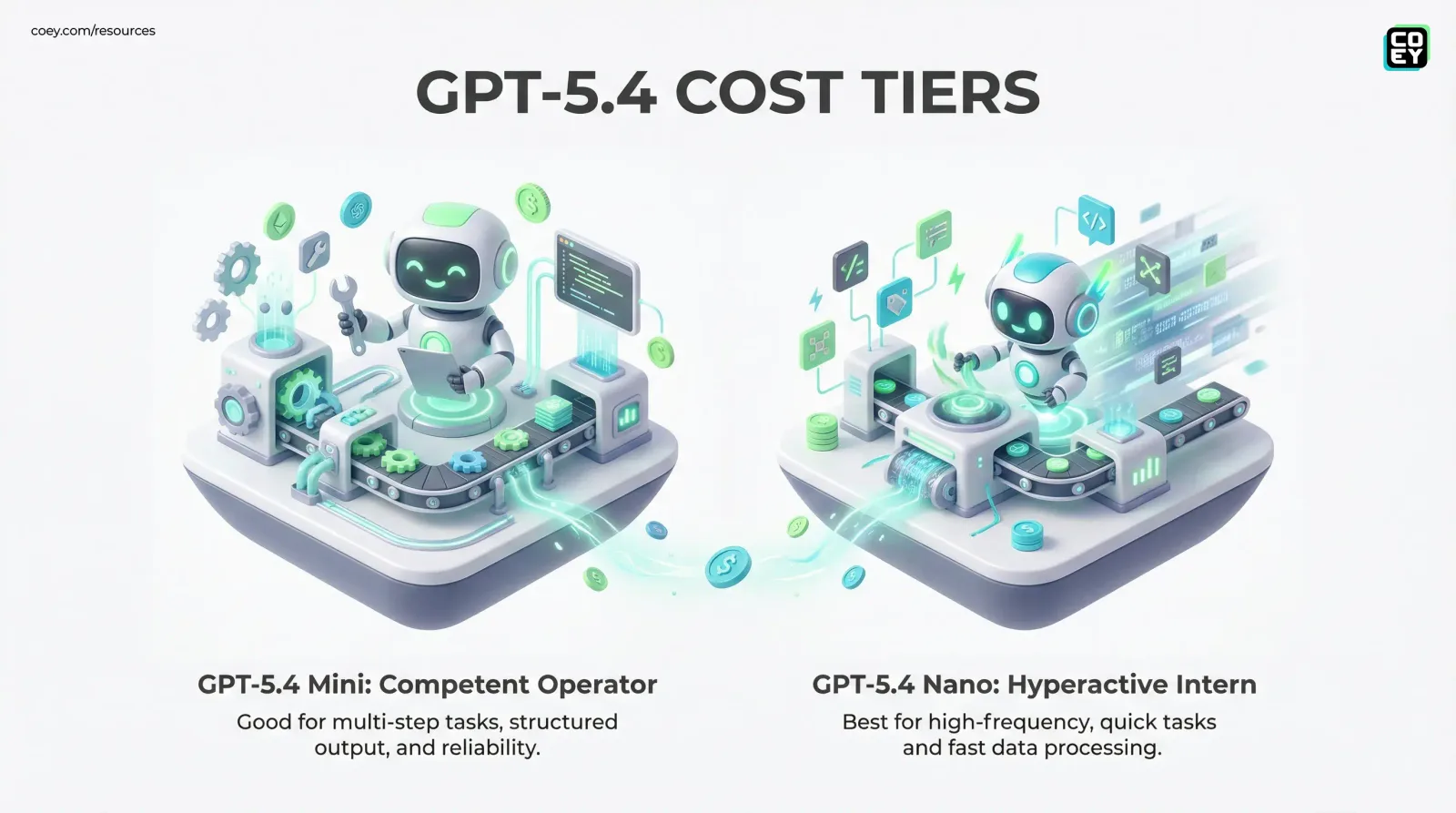
GPT-5.4 Mini is the “competent operator.” Good when the work has multiple steps (tool calls, light coding, structured output) and you want reliability without flagship pricing.
GPT-5.4 Nano is the “hyperactive intern that never sleeps.” It’s for high-frequency, bounded tasks: tagging, classification, extraction, routing, summarizing short items, quick transforms.
If you’re building an automation system, these aren’t the models you use to craft your brand manifesto. They’re the models you use to keep the content factory moving while humans focus on intent, taste, and strategy.
Pricing signals: OpenAI is optimizing for throughput
The pricing structure is the tell. OpenAI clearly wants teams to push more workflow volume through smaller models, especially when you add caching and repeated system prompts.
| Model | API price signal | What it pushes you to do |
|---|---|---|
| GPT-5.4 | Premium (listed at $2.50/MTok input and $15.00/MTok output) | Use when the task is genuinely complex or high-stakes |
| GPT-5.4 Mini | Mid-tier (listed at $0.75/MTok input and $6.00/MTok output) | Make this your default “execution” model for agents |
| GPT-5.4 Nano | Low-tier (listed at $0.20/MTok input and $1.60/MTok output) | Run it everywhere you need fast, cheap decisions |
Translation for executives: the cost curve is finally getting friendly enough that you can justify always-on automations, daily audits, continuous enrichment, and real-time routing without needing a budget exception every time someone says “agents.”
API availability: yes, this is workflow-ready
Mini and Nano are available via the OpenAI API, which is the difference between “cool model” and “operational model.” If your stack can make an HTTP request, you can wire these into:
content ops pipelines (brief → draft → QA → publish)
marketing intelligence loops (scrape/listen → classify → summarize → alert)
support and CX triage (route tickets, extract fields, suggest macros)
data enrichment (normalize inputs, map fields, validate formatting)
And because the API is the same surface area your team already uses for other OpenAI models, this becomes a routing problem, not a reintegration project.
Automation platforms: the boring (good) part
No-code and low-code automation tools that support OpenAI connections can use these models as drop-in workers. The practical win is you can:
run more steps per workflow (because each step is cheaper)
add critics and validators without doubling costs
reduce latency in user-facing flows (routing, recommendations, assistance)
When models get cheaper, quality often goes up because you can afford to add automated checks instead of praying the first draft is fine.
What this enables in real creative operations
Here’s where the release gets genuinely useful for marketing teams: it makes multi-model assembly lines feel normal. The best modern creative automation isn’t “generate one thing.” It’s “generate → validate → format → distribute,” with logging and guardrails.
Patterns that get more reliable with Mini and Nano
Variant factories: Generate 200 ad headlines, then use Nano to filter for policy risk, duplication, and format constraints before a human ever looks.
Always-on content hygiene: Nano can continuously tag assets, generate alt text, standardize metadata, and flag missing fields in your CMS or DAM.
Brief-to-bundle packaging: Mini can take a structured brief and output a full “bundle” (blog draft, social variants, email draft, CTA options) while Nano enforces formatting and schema.
Real-time routing: Nano classifies inbound leads, tickets, comments, or mentions and pushes them to the right workflow instantly.
This is the “scale human creativity” angle in practice: humans define what good is, machines do the repetitive labor at industrial pace, and the whole system stays governable because it’s API-native.
Multimodal reality check
Mini is positioned for broader capability (including vision). That matters if your automation needs to interpret images: screenshots, creative comps, or simple asset QA. Nano can also accept image inputs per current OpenAI model documentation, but it’s typically chosen for cheaper text and structured-data throughput rather than deep visual QA.
The important part: multimodal is only a workflow feature if you can automate it. If Mini can reliably interpret an asset and return structured findings (missing disclaimer, wrong logo placement, off-brand tone in text overlay), that’s real leverage. If it’s inconsistent, it’s just a demo.
Readiness: hype vs shippable
| Question | Reality | Operational implication |
|---|---|---|
| Can you automate it today? | Yes (API-accessible models) | Works in schedulers, webhooks, queues, and no-code tools |
| Is it “plug-and-play” for non-technical teams? | Mostly, if you already have workflows | The model is easy; the orchestration and QA gates are the work |
| Will it replace flagship models? | No | It’s a routing layer: do 80% cheap, escalate 20% premium |
| Is it safe to autopublish? | Only for low-risk tasks | Add critics, logging, and human approvals for high-risk assets |
What teams should do next (without turning it into a science project)
The smart move isn’t “switch everything to Nano because it’s cheap.” The smart move is:
Route by risk: Nano for classification and extraction, Mini for execution, flagship for high-stakes creative or messy reasoning.
Add a critic step: Use Nano (or Mini) to validate schema, policy, and brand constraints before human review.
Instrument costs: Track cost-per-asset and time-to-approval so “more automation” doesn’t become “more chaos.”
Small models don’t reduce risk by being smaller. They reduce risk by being cheap enough to run guardrails constantly.
Bottom line
GPT-5.4 Mini and GPT-5.4 Nano are OpenAI acknowledging the grown-up truth of AI in business: the winners won’t be the teams with the fanciest chatbot, they’ll be the teams with the most dependable automation loops. These models push a workflow-first architecture where humans set direction and machines run execution at scale, with escalation paths for quality and risk.
If your roadmap includes agents, content supply chains, campaign automation, or real-time decisioning, Mini and Nano aren’t just “new models.” They’re permission to build systems that run continuously, fast enough to feel alive, cheap enough to keep turned on, and accessible enough via API to actually plug into the stack you already have.