Midjourney V8 Alpha Is Faster, Sharper, and Still Not API-First
Midjourney V8 Alpha is faster, sharper, and still not API first. What that means for AI marketing agencies trying to automate ad creative at scale.
20 March 2026Team COEY
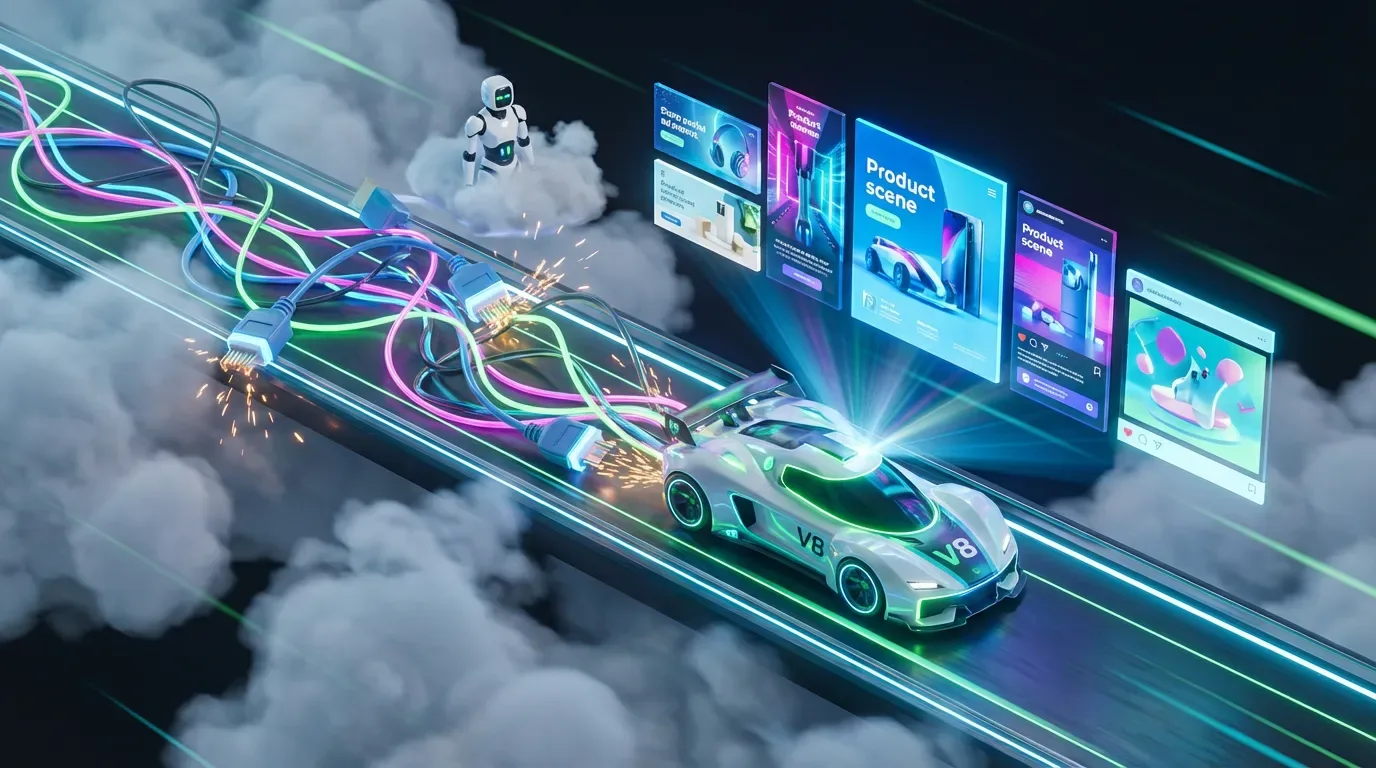
Midjourney’s V8 Alpha is here, and the headline is simple: the company is pushing image generation closer to real creative throughput. Early testing, launch notes, and community reaction point to better prompt adherence, stronger realism, improved text handling, and new native HD options that matter for actual marketing output, not just Discord flex posts. For teams making ad concepts, product imagery, social creative, or storyboards at volume, this is the kind of upgrade that can shave time off iteration loops. The catch, as always with Midjourney, is that the output engine keeps getting more production-friendly while the product plumbing still feels more boutique studio than programmable infrastructure.
That tension is the story. V8 Alpha looks more useful than a cosmetic model refresh, but it does not suddenly turn Midjourney into an enterprise-grade automation layer. If your team wants faster visuals with a human in the loop, this is promising. If you want clean API calls, predictable orchestration, and native workflow integration, we are still not there. The pixels are sprinting. The wiring is jogging.
What V8 actually changes
Midjourney is positioning V8 as a meaningful upgrade to its image model stack, and the most important improvements are the ones that reduce rerolls. That matters because in production, wasted generations are not creative exploration. They are delay, cost, and one more Slack message asking why the asset is still not ready.
Based on Midjourney’s announcement and early user testing, V8 Alpha brings several practical gains:
Improved prompt understanding for more faithful scene composition and subject control
Better text rendering , especially when text is placed in quotes in the prompt
Native HD output options including a new --hd mode that renders at about 2K, or 2048px
Support for style and personalization workflows including style references and moodboards, with strong backward compatibility from earlier setups
Stronger realism and coherence in complex scenes, according to early community reactions
Translation: V8 is less about look at this beautiful AI image and more about can this get me closer to a usable campaign asset on the first pass. That is a much more important question.
This is especially relevant for teams already using Midjourney as the visual middle layer in a broader content system: LLM writes concept, image model creates frames, downstream tools turn those frames into ads, decks, landing pages, or video references. When the middle step becomes more reliable, the whole machine gets smoother.
Speed is the real feature
Let’s be honest: image quality always gets the applause, but speed is what changes behavior. Teams do not scale creativity because a model is a little prettier. They scale because they can test more angles, review more options, and make decisions faster without melting the design team.
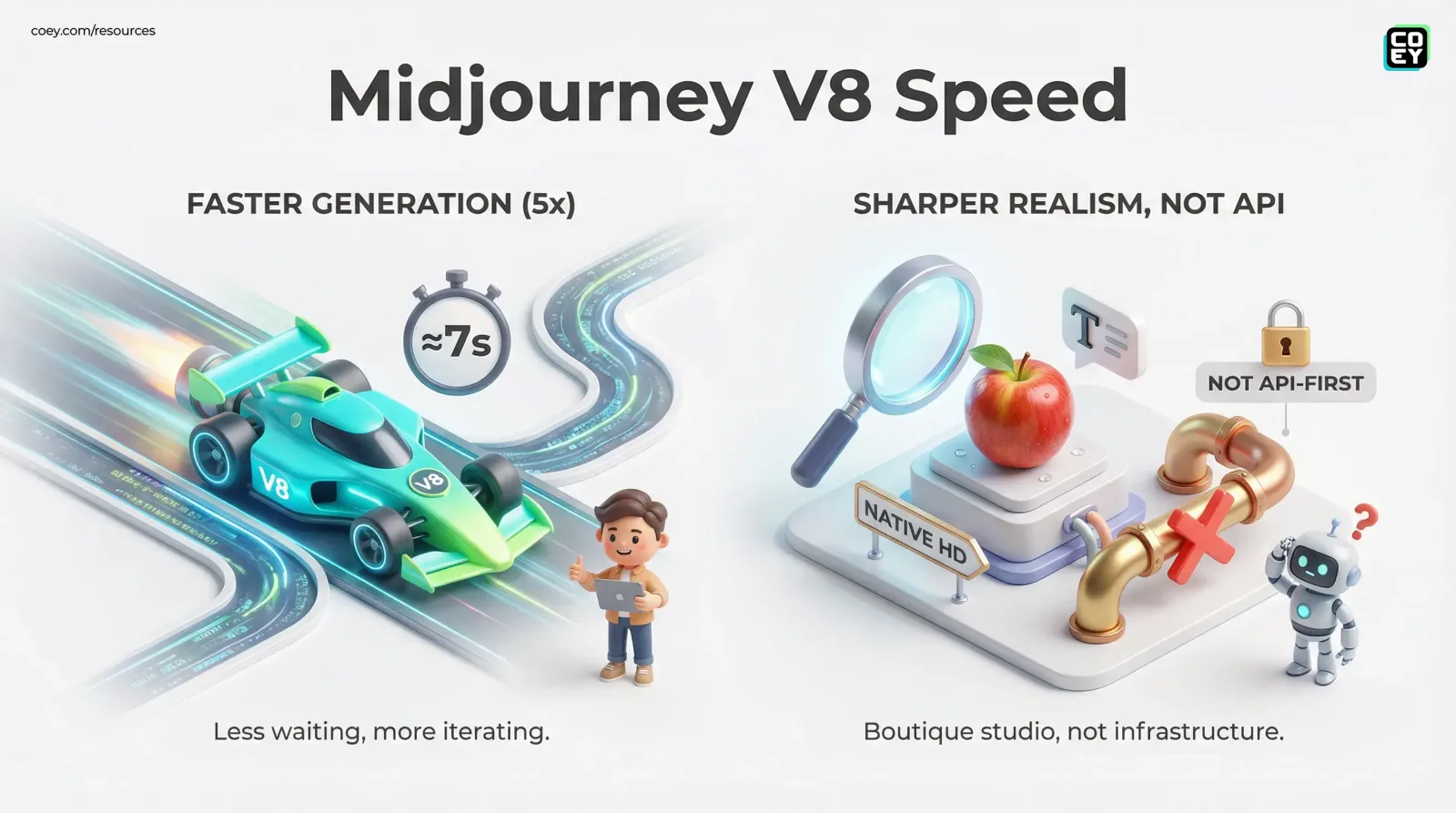
That is where V8 Alpha looks strongest. Midjourney says V8 can generate about 5x faster than V7 in standard mode, with some examples landing around 7 seconds without --hd. At the same time, Midjourney notes that premium settings like --hd, --q 4, style references, and moodboards can run about 4x slower and cost about 4x more GPU time than standard jobs for now. So yes, V8 can be faster, but not every setting is a cheat code.
| V8 capability | Why it matters | Workflow impact |
|---|---|---|
| Faster standard generations | Shorter wait between prompt and review | More creative iterations in less time |
| Native HD output | Higher-res assets without a separate upscale step | Less post-processing for ads and mockups |
| Better text and composition | Fewer obvious AI misses | Higher first-pass usability |
That last row is quietly huge. Better text rendering means banner concepts, social graphics, packaging previews, and thumbnail drafts can move faster. No, Midjourney is not replacing your real design system. But if the model can stop turning simple copy into cursed hieroglyphics, that is an actual productivity gain.
Where it fits in real workflows
Midjourney V8 Alpha looks most ready for workflows where humans already review outputs before publishing. That includes:
Paid social creative testing where teams need multiple visual directions fast
E-commerce concepting for lifestyle scenes, product storytelling, and merchandising mockups
Brand moodboards and pitch decks where speed beats pixel-perfect determinism
Storyboard and keyframe generation for video teams using stills as upstream planning assets
This is not a small lane. A lot of high-value creative work lives in the generate, review, select, refine cycle. Midjourney continues to be very good at that. In fact, its sweet spot keeps getting more commercially relevant.
If you want a broader frame for how Midjourney has been moving toward more production-ready image generation, our earlier coverage of Midjourney V7 made the same core point: reducing the reroll tax is what turns image AI from novelty into workflow component.
The API question still matters
Here is the executive summary for non-technical readers: Midjourney still does not offer a public, official API for general developer use as of March 20, 2026.
That means a lot in practice.
When a tool has a proper API, you can generally connect it to your CMS, creative ops system, campaign builder, or internal tooling with fewer gymnastics. You get predictable authentication, cleaner control, and a better chance of building repeatable pipelines. Midjourney remains primarily accessed through its own web experience and Discord workflow. Founder David Holz has said an internal API exists and may eventually ship publicly, but no public release has been announced. That keeps Midjourney highly usable for creators, but less ideal for teams trying to turn it into background infrastructure.
| Automation need | V8 status | Reality |
|---|---|---|
| Official API access | Not public | Harder to plug cleanly into enterprise stacks |
| Bulk generation | Possible through product workflow | Useful, but not as programmable as API-first rivals |
| No-code automation | Unofficial workarounds exist | Fine for experiments, brittle for mission-critical ops |
So yes, V8 improves the usefulness of outputs in semi-automated systems. But it does not solve the core operational limitation. Midjourney remains amazing at making images and awkward at becoming infrastructure. Same genius, same chaos, nicer results.
Alpha means alpha
The other important reality check: this is still an alpha release. Midjourney is actively tuning the model, and some capabilities are not fully wired. For example, Relax mode is not yet supported in V8 Alpha, and Midjourney says new infrastructure is still being built for cheaper renders. Community feedback is mixed in the normal way early model launches tend to be mixed: some users are impressed by realism and control, others say it feels more evolutionary than revolutionary, and several note that older prompts may need adjustment to get the best results.
That does not make the launch weak. It makes it normal.
Alpha releases are best treated like pilot material for teams, not instant full-stack replacements. The smart move is to test V8 in bounded use cases:
Internal concept generation
Creative exploration for campaign planning
Draft ad visuals and thumbnails
Storyboard or pitch support assets
Then evaluate hit rate, operator time, and revision burden before pushing it deeper into production.
The practical standard is not Is V8 cool? It is Does V8 reduce enough manual effort to justify a place in the workflow? That is the only metric that survives contact with a real content calendar.
What creators and marketers should watch
Midjourney V8 Alpha is a strong signal that image generation is still maturing in ways that matter to business users, not just prompt hobbyists. Better prompt fidelity, stronger text handling, and more useful resolution options all increase the odds that AI visuals can slot into actual campaign systems with less cleanup.
But the launch also reinforces a familiar split in the market. Some tools are becoming products people love to use. Others are becoming infrastructure businesses love to automate. Midjourney is still much closer to the first category, even as it edges toward the second.
That makes V8 Alpha worth watching for any team scaling creative output, especially if your workflow already includes human review and selective publishing. If your goal is high-volume visual ideation with better first-pass quality, this is real progress. If your goal is hands-off creative automation inside a larger stack, keep your expectations calibrated and your workflow diagrams humble.
Bottom line: Midjourney V8 Alpha looks like a meaningful upgrade for visual production speed and quality, particularly in marketing and brand workflows where throughput matters. It is more capable, more commercially relevant, and more likely to generate usable assets faster. It is also still Midjourney: powerful, impressive, a little chaotic, and not yet the clean API-era machine many teams ultimately want. For now, the best use case remains exactly where human-plus-machine collaboration shines most: AI does the heavy visual lifting, humans pick the winners, and the workflow moves faster without giving up taste.