
Meta’s Muse Spark Wants to Be More Than a Chatbot
Meta's Muse Spark wants to be more than a chatbot. A practical look at what it automates today for AI marketing agencies and creative ops teams.
8 April 2026Team COEY

Meta is expanding its Meta AI ecosystem with Muse Spark, a multimodal model aimed at deeper reasoning, image and text understanding, and more agent-like task handling across its apps. That sounds big because it is big. But the useful question is not whether Meta has another shiny model name to throw into the arena. The useful question is whether Muse Spark is becoming a real workflow layer for marketers, operators, and creators, or whether it is still mostly a very polished in-app assistant.
Right now, the answer is somewhere in the middle. Muse Spark looks meaningfully more capable than a basic chat layer. It also looks strategically important because Meta is rolling it out through surfaces people already use at massive scale: the Meta AI app, Meta.ai on the web, and broader Meta properties including Facebook, Instagram, and WhatsApp, with broader rollout continuing. That distribution advantage is no joke. If AI is going to become part of everyday creative work, being embedded where campaigns, conversations, and commerce already happen matters more than another benchmark flex nobody asked for.
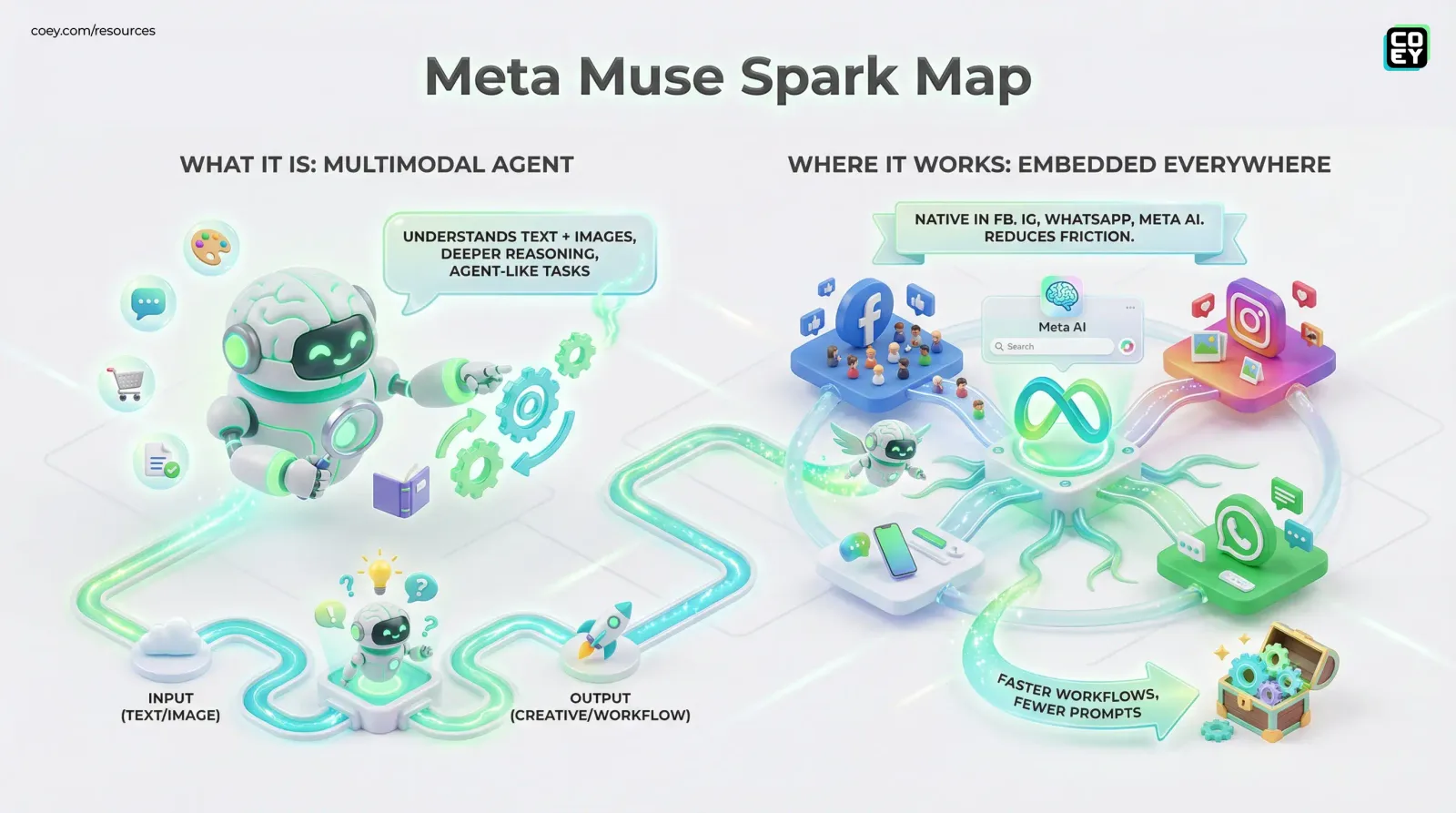
The real upgrade is not “AI that can see images.” It is AI that can combine inputs, reason through a task, and help move work forward without needing fifteen separate prompts and a small emotional support group.
What Muse Spark actually is
Muse Spark is Meta’s latest multimodal model built to work across text and images, with stronger reasoning and more agentic behavior than earlier consumer-facing Meta AI layers. In plain English, Meta wants this thing to do more than answer questions. It wants it to interpret mixed inputs, sustain longer task chains, and help users produce outputs that feel closer to finished work.
That matters because a lot of “multimodal” launches still boil down to “you can upload an image now, congrats.” Muse Spark is being positioned more ambitiously: as a model that can analyze visuals, generate text around them, and handle more complex requests in one thread.
What stands out
Text plus image understanding: useful for campaign concepts, creative review, product visuals, and content ideation tied to real assets.
Deeper reasoning: better suited to structured asks like summaries, comparisons, messaging drafts, and multi-part planning.
Agent-style behavior: Meta is positioning the model for longer chains of work with less hand-holding, especially inside Meta AI experiences.
Platform-native placement: it is being woven into products teams already use instead of sitting in an isolated sandbox.
That last point may be the most important. AI gets more useful when it shows up where work already happens. Revolutionary insight, we know.
Why Meta’s distribution changes the story
Most AI launches have to fight for workflow relevance after the launch hype fades. Meta starts from a different position. It owns attention surfaces, ad surfaces, messaging surfaces, and increasingly commerce-touching surfaces. If Muse Spark becomes the default intelligence layer across those environments, Meta is not just shipping a model. It is quietly inserting an AI assistant into the operational bloodstream of social communication and digital marketing.
For creators and marketers, that creates a very specific kind of leverage. You can concept in the same ecosystem where content gets posted, promoted, discussed, and measured. That reduces friction, and friction is usually what kills adoption faster than bad UX or LinkedIn thought leadership posts about “embracing the future.”
| Area | What Muse Spark changes | Why it matters |
|---|---|---|
| Creative ideation | Image plus text prompts | Better context for campaigns and assets |
| Content planning | Longer multi-step responses | Fewer fragmented prompt loops |
| Social commerce | Shopping and product-assistance use cases | Faster product messaging and variants |
Meta’s edge here is not openness. It is proximity. Muse Spark is close to the channels where brands already spend time and money.
Automation potential is promising, but not complete
This is where the hype needs a seatbelt.
Muse Spark looks workflow-friendly in the product sense, but the public automation story is still developing. Meta has broader developer infrastructure in market through its AI developer tooling and Meta AI platform, but Muse Spark itself does not appear to be broadly available yet as a fully open production API for general developers. Current reporting points to direct consumer access in Meta AI surfaces, with API access still limited or in preview.
That distinction matters a lot.
If a capability lives mainly inside a UI, it can speed up work. If it lives behind a stable API, it can become part of a system.
Right now, Muse Spark appears strongest as an in-product collaborator rather than a universally available automation primitive. That still has value. Teams can use it for content drafts, campaign thinking, visual-text alignment, and commerce support inside Meta environments. But if you are asking whether your ops team can cleanly wire Muse Spark into n8n, Make, internal dashboards, approval workflows, and cross-platform content pipelines today with confidence, the answer is: not fully, not yet, at least not publicly and broadly.
Practical readiness check
| Question | Current read | Implication |
|---|---|---|
| Can teams use it now? | Yes, in Meta AI surfaces | Good for immediate experimentation |
| Is it API-clear for broad automation? | Not fully | System integration is still limited |
| Is it workflow-useful already? | Yes, with humans in loop | Helpful for drafting and iteration |
That means Muse Spark is closer to operator-ready than infrastructure-complete. Important difference. Very non-sexy. Extremely real.
Where marketers will feel it first
The early value is not mysterious. Muse Spark is built for the kind of mixed-input work modern teams do all day:
upload a product image and ask for caption variants
turn a campaign concept into multiple social post angles
analyze a visual reference and generate matching copy
build product messaging around shopping intent
package assets faster for social and messaging channels
That kind of coordination work usually burns time because humans are manually translating between visual context, written strategy, and channel formatting. A model that can see the creative and respond with useful text is not magic, but it is a very practical productivity gain.
For commerce teams, the shopping angle is especially notable, even if Meta has not publicly framed Muse Spark as a fully separate “shopping mode” product in broad release documentation. Meta clearly wants AI to support product discovery and conversion flows natively inside its ecosystem. If that develops further, Muse Spark could become part assistant, part creative co-pilot, part commerce layer. Not in a sci-fi “AI runs the brand” way. In a much more practical “AI helps produce and personalize the middle of the funnel faster” way.
The winners here will not be the teams asking Muse Spark to “make content.” They will be the teams using it to compress the boring middle: drafting, matching, formatting, varianting, and iterating.
Where the limitations still matter
Muse Spark may be capable, but capability is not the same thing as operational maturity.
There are still several reasons to stay pragmatic:
API ambiguity: broad automation potential depends on clearer, stable developer access.
Platform dependence: the strongest use cases currently live inside Meta’s own walls.
Governance needs: anything customer-facing still needs review, especially around claims, brand tone, and visual accuracy.
Regional and rollout variability: feature access may differ depending on account type and geography.
That does not make the launch weak. It just means this is not yet the kind of release you build your entire content operating system around on day one. It is more like a strong signal that Meta wants AI to become a first-class production layer across social, messaging, and commerce, and Muse Spark is one of the clearest steps in that direction.
If you want a comparison point from the broader market, our recent post on Google DeepMind’s Gemma 4 shows the opposite posture: more open deployment flexibility, but less built-in proximity to where mainstream social work happens. Different strengths. Different bets.
What this means for creative operations
Muse Spark matters because it reflects a bigger shift: AI is moving from standalone chat products toward embedded creative infrastructure. Meta is betting that if the assistant is native to the environment, users will naturally fold it into campaign work, creator workflows, customer communication, and commerce activity.
That is a credible bet.
For teams trying to scale output without scaling chaos, Muse Spark already looks useful as a human-in-the-loop creative accelerator. It can help speed ideation, align visual and written assets, and reduce repetitive prompt labor inside platforms brands already use. What it is not yet, at least publicly, is a fully open automation backbone.
Bottom line: Muse Spark looks less like empty AI glitter and more like a strategically placed collaboration layer with real near-term usefulness. The immediate value is in faster, smarter content work inside Meta’s surfaces. The bigger opportunity arrives if Meta opens the automation story further and turns Muse Spark from an in-app assistant into a dependable, programmable workflow component. That is the line between “cool feature” and “creative infrastructure,” and it is the line to watch.
Let COEY Wire Your AI Marketing Stack
We help brands and agencies connect n8n, Claude Cowork, OpenClaw, and other AI tools into marketing systems that produce real output. From content automation to full campaign orchestration across every channel. See how it works or request a proposal.
Related: How to Build an AI Content System , The Full Playbook for Brands and Agencies.
For marketing leaders ready to turn AI strategy into production workflows, explore the Executive AI Accelerator.