
Claude Sonnet 5 Moves AI From Chat to Workflow
Claude Sonnet 5 Moves AI From Chat to Workflow
July 2, 2026
Anthropic has introduced Claude Sonnet 5, positioning its newest Sonnet-class model as a more autonomous, workflow-ready system for coding, marketing operations, research, and multi-step business tasks. The headline is not just “new chatbot, who dis?” It is Anthropic pushing its mid-tier model closer to agent territory: less prompt-response, more plan-execute-check-repeat.
For executives, marketers, and creative teams, that distinction matters. The AI market is full of gorgeous demos that look like Tony Stark’s lab for 45 seconds and then collapse the moment you connect them to a real CRM, CMS, asset library, approval chain, or compliance checklist. Sonnet 5 is notable because Anthropic is not only talking about better answers. It is talking about better task completion.
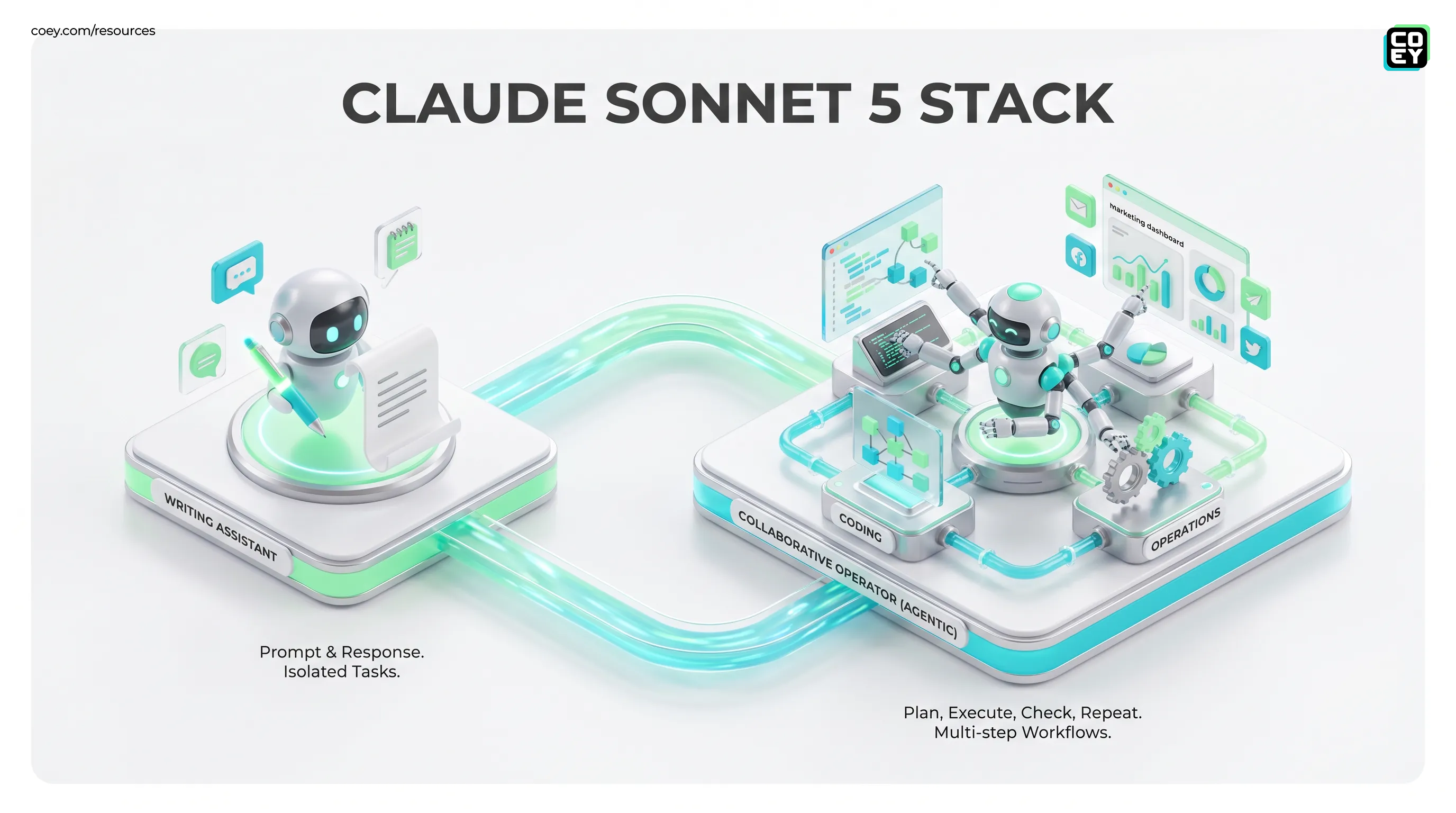
The important shift is this: Claude Sonnet 5 is designed less like a writing assistant and more like a collaborative operator that can help move work across systems, not just generate copy inside a box.
What Anthropic Announced
Claude Sonnet 5 arrives as an upgrade to Anthropic’s Sonnet line, the model family typically aimed at balancing capability, speed, and cost. Anthropic describes it as its most agentic Sonnet model yet, with stronger performance across coding, tool use, reasoning, professional knowledge work, and multi-step execution. That continues the trajectory COEY covered with Claude Sonnet 4.6, where the Sonnet line was already moving from chat toward operations.
Translation for normal people with quarterly goals: Sonnet 5 is meant to handle longer, messier assignments. Instead of asking for “ten subject lines,” a team can ask it to analyze product notes, compare positioning, draft campaign variants, prepare a landing page outline, write email copy, flag missing claims, and package the output for review.
That does not mean it should be left alone with your brand, budget, and production permissions like a raccoon in a vending machine. But it does mean the model is moving into a more useful lane for teams that already understand AI is not just a content slot machine. It is infrastructure for creative throughput.
| Capability | What changed | Why it matters |
|---|---|---|
| Agentic work | Better planning and task execution | Useful for multi-step campaigns and ops |
| Tool use | Stronger tool, code, browser, and API-connected workflows when tools are provided | Can connect model output to real systems |
| Cost profile | Lower than Anthropic’s current flagship Opus-class models | Makes volume automation more realistic |
Why Marketers Should Care
Marketing teams are where “AI assistant” fatigue is especially real. Everyone has generated ad copy. Everyone has asked a model to rewrite something “more punchy.” Everyone has watched the output arrive with the emotional range of a LinkedIn thought leader trapped in a hotel conference room.
Sonnet 5 is interesting because the value proposition is not simply better prose. It is workflow continuity. A stronger agentic model can maintain context across more steps, apply instructions consistently, call tools when available, and produce outputs that are closer to usable inside an operational chain.
That creates real potential in campaign production. A marketer could use Sonnet 5 to turn a product brief into audience segments, extract objections, draft positioning, create channel-specific copy, summarize claims for legal review, and prepare structured data for a CMS or email platform. The human still sets the strategy, taste, offer, and final approval. The machine handles the grind between intent and execution.
This is where human-plus-machine collaboration becomes more than a slogan. The creative spark remains human: the insight, the cultural read, the brand judgment, the “please do not make us sound like every B2B SaaS company wearing the same Patagonia vest.” Sonnet 5 can accelerate the operational layer around that spark.
Automation Potential
The automation story is the main event. Claude Sonnet 5 is available through Anthropic’s API using the model ID claude-sonnet-5, according to Anthropic’s model information. That means developers and automation teams can connect it to systems rather than relying only on the Claude chat interface.
For non-technical readers, an API is simply the door that lets software talk to software. If a model has solid API availability, your team can plug it into repeatable workflows: intake forms, Slack approvals, CRM records, project management boards, content calendars, reporting dashboards, and internal knowledge bases.
In practical marketing operations, that could look like:
- Campaign intake: A form submission triggers Sonnet 5 to summarize the brief, identify missing details, and draft next-step questions.
- Creative versioning: Approved messaging becomes ad variants, email sequences, product blurbs, and sales enablement snippets.
- Review routing: The model flags risky claims, checks tone against brand guidelines, and sends only exceptions to a human.
- Reporting prep: Performance data is summarized into executive-ready insights with recommendations for the next iteration.
That is not magic. It is orchestration. And orchestration is where AI finally starts paying rent.
API And Platform Readiness
Anthropic says Claude Sonnet 5 is available through the Claude API and Claude app, including Claude Code and the Claude Platform. The company has made it available across Claude plans, with Sonnet 5 serving as the default model for Free and Pro users at launch, while Max, Team, and Enterprise users can access it as well. The company’s Claude Sonnet model page lists the model’s positioning, pricing, and access details, while AWS has announced Claude Sonnet 5 on Amazon Bedrock.
That matters for procurement and production readiness. Teams already building on AWS can access the model inside an environment with enterprise security, governance, and existing cloud workflows. On Amazon Bedrock, AWS lists Claude Sonnet 5 with the model ID anthropic.claude-sonnet-5, regional availability across multiple geographies, and support for Bedrock features such as agents, knowledge bases, guardrails, and streaming. For larger organizations, that can be the difference between “cool demo from innovation lab” and “approved for actual work before the heat death of the universe.” Cloud-provider pricing and availability can vary by region and account configuration, so teams should confirm details inside their own console before budgeting production volume.
| Access path | Readiness | Best fit |
|---|---|---|
| Claude app | Easy to use | Individual creators and teams |
| Claude API | Automation-ready | Custom workflows and SaaS builds |
| Amazon Bedrock | Enterprise-ready | Cloud-governed deployments |
The API is the key distinction. A closed AI product can be useful, but it often traps value inside a single interface. API access lets teams build the model into the machine room of the business. That is where AI stops being a clever tab in the browser and starts becoming part of the operating system.
Pricing And Scale
Anthropic is also making a cost argument. Sonnet 5 launches with introductory Anthropic API pricing of $2 per million input tokens and $10 per million output tokens through August 31, 2026, later moving to $3 per million input tokens and $15 per million output tokens. In plain English: input is what you send to the model, output is what it generates back.
For high-volume marketing teams, agencies, publishers, and SaaS companies, token pricing affects whether automation is a novelty or a scalable business function. If a model is powerful but expensive, teams reserve it for premium tasks. If it is capable and cost-efficient, it can sit inside everyday workflows: content QA, metadata generation, localization, sales follow-ups, research synthesis, and internal reporting.
That said, cheaper tokens do not automatically equal cheaper operations. Sonnet 5 uses an updated tokenizer, so the same text may tokenize differently than it did in earlier Sonnet models. Long context windows, repeated retries, oversized prompts, and poorly designed automations can still turn a workflow into a tiny money furnace. Teams will need prompt caching, structured inputs, clear routing rules, and smart escalation logic to keep costs sane. For teams building real production systems, COEY’s guide to AI FinOps for modern marketers is the operating mindset to bring into these deployments.
Real-World Readiness
Sonnet 5 looks ready for serious pilots and selective production use, especially where workflows are structured and the consequences of mistakes are manageable. Marketing production, sales enablement, internal research, creative QA, code assistance, documentation, and content transformation are all strong candidates.
The model is less ready for fully unsupervised brand decisions, regulated claims, financial recommendations, medical communication, or publishing pipelines where a single hallucinated detail can become a very expensive screenshot. Improved reliability is good. Human review is still not optional when reputational risk enters the chat.
The best near-term deployments will use Sonnet 5 as a collaborative layer: it prepares, checks, summarizes, drafts, formats, and routes. Humans approve, refine, prioritize, and inject taste. That division of labor is where the model’s strengths become leverage instead of liability.
The Bigger Signal
Claude Sonnet 5 is part of a broader shift from AI as interface to AI as infrastructure. The race is no longer only about who writes the prettiest paragraph or passes the fanciest benchmark. It is about which models can connect to tools, follow procedures, reduce manual work, and help teams ship more creative output without turning operations into prompt spaghetti.
For COEY’s world, that is the part worth watching. The future of work is not humans versus machines, and it is definitely not “replace the marketing department with a chatbot and vibes.” The future is talented people directing intelligent systems that can carry more of the repetitive load. It also reinforces why teams should avoid building their entire AI stack around one app or one vendor, a risk COEY covered in Platform Lock-In Is Coming for Your AI Stack.
Claude Sonnet 5 will not replace strategy, taste, judgment, or cultural fluency. Thank goodness. The internet has enough blandness. But it may help teams move faster from idea to execution, from brief to campaign, and from manual production chaos to more automated creative systems. That is not hype. That is the shape of useful AI.