AWS, Anthropic, Google: Automation Gets Real
AWS, Anthropic, and Google make automation real at enterprise scale. What the new stack unlocks for AI marketing automation and agent native content ops.
14 October 2025Team COEY
The automation signal this week: three big moves from AWS, Anthropic, and Google
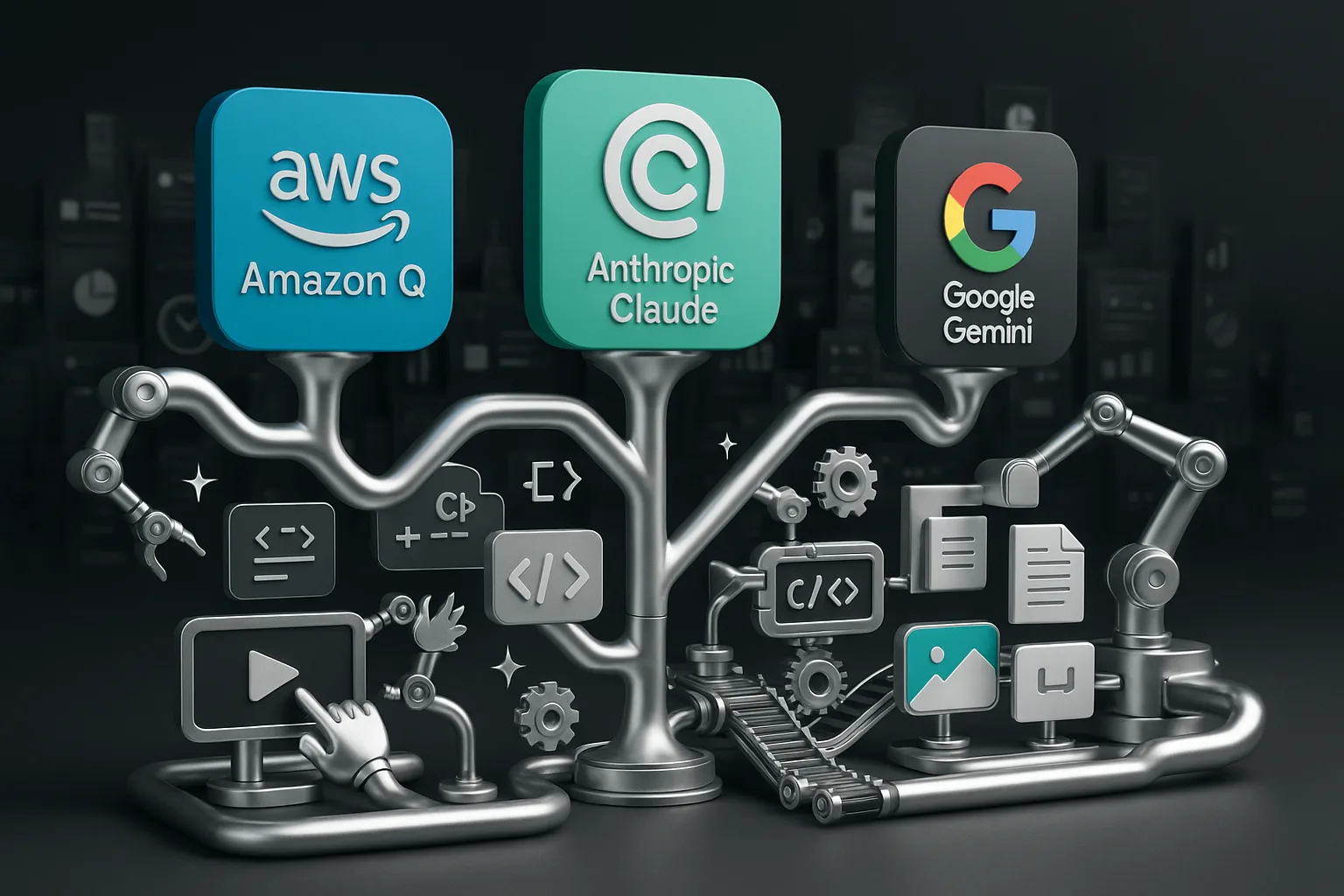
In a week packed with announcements, three stand out for teams trying to scale content and operations with AI. AWS advanced its agentic workspace vision with Amazon Q, Anthropic opened up modular automation inside Claude Code, and Google rolled out Gemini 2.5’s Computer Use model for UI-level task execution. Together, they push AI beyond chat into actual work, connecting tools, triggering actions, and closing loops. Here’s what changed, what it enables, and what still is not plug-and-play.
AWS Amazon Q: agentic AI meets the enterprise stack
What AWS is shipping
Amazon Q is positioned as an agentic, AI-powered workspace that sits on top of your data and SaaS stack. It brings components for research, workflow automation, and data visualization into a single environment. Q connects to internal sources (wikis, intranets, S3/Redshift) and broad third-party applications via modern tool-use protocols, letting agents reason over and act within your actual systems, not just your chat window. Amazon Q overview.
Automation lens
Can this be automated? Yes. Q’s agents can orchestrate multi-step workflows that move data, post updates, trigger reviews, and escalate to humans when needed.
APIs/integrations? It runs natively on AWS with SDKs and connectors, so teams can wire it into existing pipelines or call it from orchestration layers via webhooks or queues.
Real-world readiness? Enterprise-grade identity, data isolation, and audit controls are front and center. That matters when you are touching customer data, finance, HR, and PII.
Creator/marketer angle
Text: Agents can summarize campaign performance, draft briefs with live CRM pulls, and route approvals.
Photo/video/audio: Think DAM-to-CMS handoffs, automated versioning and captions, or sending edits to an S3-backed transcode pipeline, then posting finalized media to your distribution channels.
What is still unclear
Connector depth vs. breadth: Breadth sounds great, but execution matters. Are connectors read-only, or do they support safe writes and idempotent actions? Expect variation.
Governance defaults: Fine-grained permissions, rate limits, and red-teaming against prompt injection will dictate how fast enterprises move from pilots to production.
Bottom line: Q pushes agentic AI from concept to company-wide canvas. If your data sits on AWS already, this can become the orchestration layer for content and ops without duct tape.
Anthropic’s Claude Code plugins: modular automations inside your dev workspace
What Anthropic is shipping
Claude Code supports plugins that bundle custom slash commands, sub-agents, MCP servers, and workflow hooks. Teams can create and share curated repositories to standardize automations across engineers and technical content teams. Documentation and examples are live. Claude docs.
Automation lens
Can this be automated? Yes, inside Claude Code. Plugins can run code transforms, call external APIs via MCP, and trigger webhooks when certain events occur, such as test pass or review complete.
APIs/integrations? Plugins can act as bridges to your internal services and external tools. Use hooks to kick off CI jobs, deploy serverless actions, or update tickets.
Real-world readiness? It is a public beta. Great for teams already living in Claude Code, less relevant if your org has not adopted it.
Creator/marketer angle
Text: Build a house style plugin that lint-checks copy, injects product facts, and formats longform into social cuts.
Photo/video/audio: Trigger image optimization or subtitle generation jobs via hooks, then post results back in-thread for approval.
What is still unclear
Distribution: The marketplace approach is repo-driven today, not an official centralized app store. That is fine for teams, but broad discovery and trust signals will take time.
Security posture: Anthropic has guardrails, but orgs still need code reviews and scoped secrets for plugins that touch sensitive systems.
Bottom line: If your builders already use Claude Code, plugins turn one-off scripts into reusable automations. It is a force multiplier for shared tooling like linters, content formatters, or release checklists.
Google Gemini 2.5 Computer Use: agents that click, type, and submit
What Google is shipping
Gemini 2.5’s Computer Use model enables UI-level control such as navigating pages, filling forms, and clicking buttons via the Gemini API and Google’s developer tools. It is tuned for web tasks and ships with safety measures against risky instructions and prompt injection. Gemini API docs.
Automation lens
Can this be automated? Yes, for browser-based workflows. Think ad platform tweaks, CMS updates, or vendor portal exports without brittle XPaths.
APIs/integrations? Available via the Gemini API in AI Studio or Vertex AI. You can wrap it in your orchestrator of choice using webhooks, queues, or custom nodes.
Real-world readiness? Promising, but watch for site anti-bot rules, MFA challenges, and compliance around scraping or automated interactions.
Creator/marketer angle
Text: Auto-post blog updates across multiple CMS instances and apply tags or taxonomy consistently.
Photo/video/audio: Upload finished edits to YouTube Studio, attach captions, set chapters, and schedule, without manual clicking marathons.
What is still unclear
Scope: It focuses on web UIs today, not native desktop apps.
Reliability: Real sites change. You will want monitoring, retries, and guardrails like allow lists and scoped credentials.
Bottom line: For teams gated by this only exists in a web portal, Computer Use can finally automate the last mile, responsibly, if you pair it with ops discipline.
What you can do now vs. what is next
| Platform | Do-now automations | APIs & integrations | Gaps & risks |
|---|---|---|---|
| AWS Amazon Q | Agentic workflows across data, SaaS, and AWS services; brief generation; cross-app updates; approvals. | AWS SDKs and connectors; webhook or queue patterns for orchestration. | Connector capabilities vary; need granular permissions, rate-limit hygiene, and strong prompt-injection defenses. |
| Claude Code Plugins (beta) | Reusable commands for code reviews, formatting, CI triggers, content scaffolding inside Claude Code. | Plugins can call internal or external APIs via MCP; event hooks to kick off jobs. | Beta maturity; repo-based distribution; requires code review and secret management. |
| Gemini 2.5 Computer Use | Browser automation for CMS, ads, dashboards; consistent UI interactions at scale. | Gemini API in AI Studio or Vertex AI; wrap into your orchestrator via webhooks or custom nodes. | Subject to site ToS, MFA, anti-bot; reliability needs observability and retries. |
How this flows across formats
Cross-format pipelines benefit most from these moves:
Text to video: Draft a script with Q, render with your video stack, then use Computer Use to schedule the upload, add metadata, and publish across channels.
Photo to social: Use a Claude plugin to apply brand presets and alt text, Q to move assets to the DAM, then Computer Use to queue posts with tracking links.
Audio to blog: Transcribe and summarize with Q, run a style or lint plugin in Claude for on-brand edits, and push the final post via Computer Use to your CMS.
Practical impact: what matters for teams scaling with AI
Speed without sprawl: AWS is consolidating agentic capabilities in one governed place. That reduces shadow automation risk.
Reusable automation assets: Anthropic’s plugin model turns clever one-offs into team-wide tools. Standardize, version, and reuse.
Last-mile execution: Google’s Computer Use closes gaps where APIs do not exist or are too limited. Treat it like RPA, but safer and smarter.
Compliance-first design: Policy, audit logs, and scoped credentials need to ship with your automations, especially when agents can take actions.
What is hype vs. what is ready
None of these launches are magic wands. They are solid primitives for putting AI to work, especially when paired with existing orchestration and governance. The playbook is familiar: start with contained, high-frequency tasks, add human-in-the-loop checkpoints, expand once reliability and compliance are proven. Do that, and this week’s news is not just shiny, it is how you scale human creativity with intelligent machine collaboration.