
HunyuanVideo 1.5 Makes Local AI Video Practical
HunyuanVideo 1.5 makes local AI video practical on real hardware. What it unlocks for AI marketing automation and on prem generative video ad pipelines.
4 January 2026Team COEY

Tencent just open sourced HunyuanVideo 1.5, a lightweight generative video model that takes a direct swing at two things that have kept AI video stuck in demo land: cloud lock in and absurd hardware requirements. The headline is not Tencent made another video model. The headline is: you can run high quality video generation locally or in your own infrastructure with VRAM requirements that are suddenly within reach for serious creators and marketing teams.
Translation: This is less Hollywood in a prompt and more your creative ops team can actually wire video generation into a pipeline without begging for API quotas or renting a GPU farm.
What Tencent actually shipped
HunyuanVideo 1.5 ships as code plus weights plus documentation in the open. This matters because open source in AI video often means code is public but the useful part is behind a gate. Here, the useful part is the weights.
From Tencent’s repo and surrounding technical materials, the positioning is clear:
High quality short video generation (commonly framed around about 5 second clips in default configs, with community workflows often targeting short form outputs).
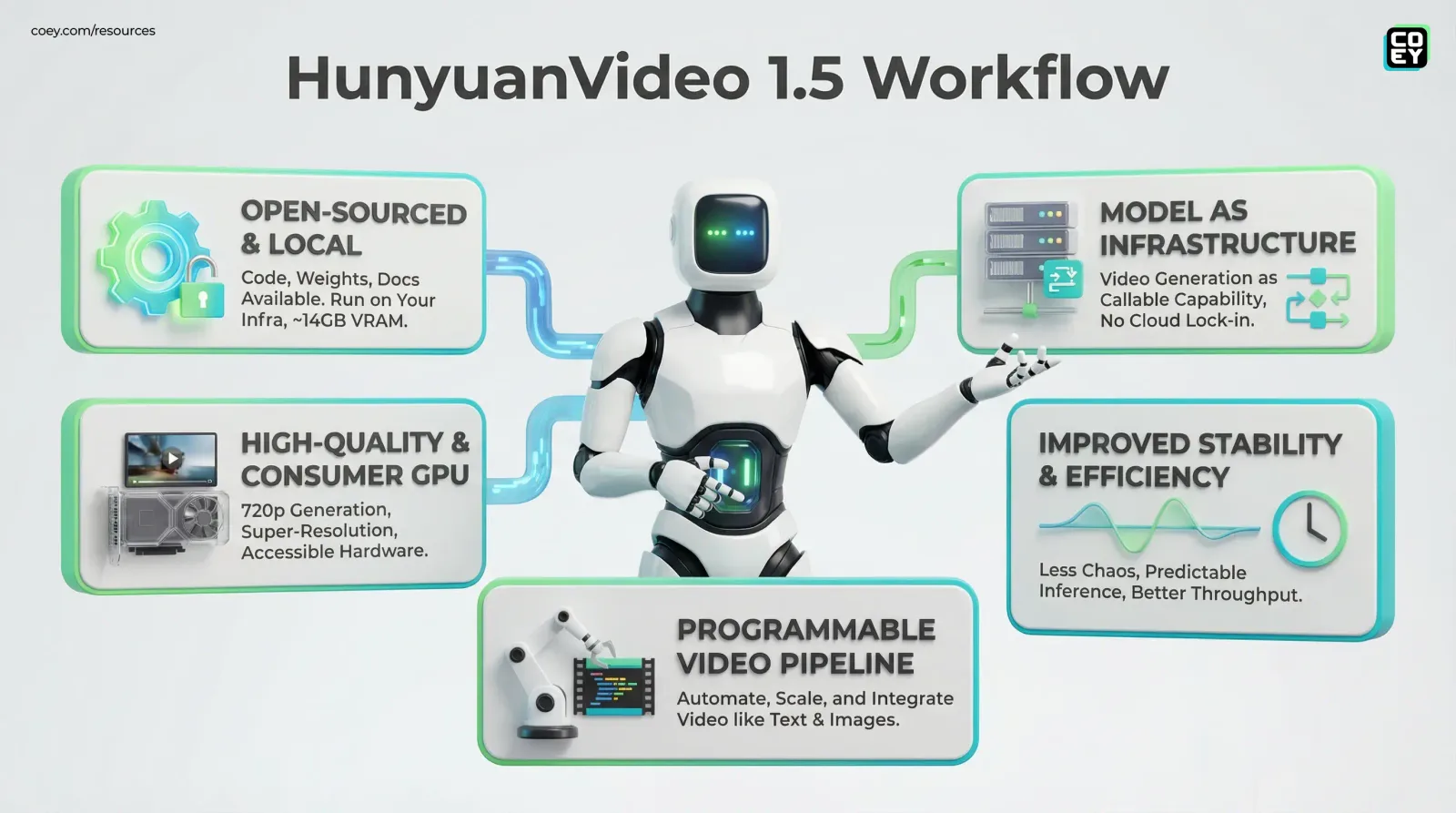
720p generation as a primary target resolution, with video super resolution described in the technical report as part of the system for upscaling outputs.
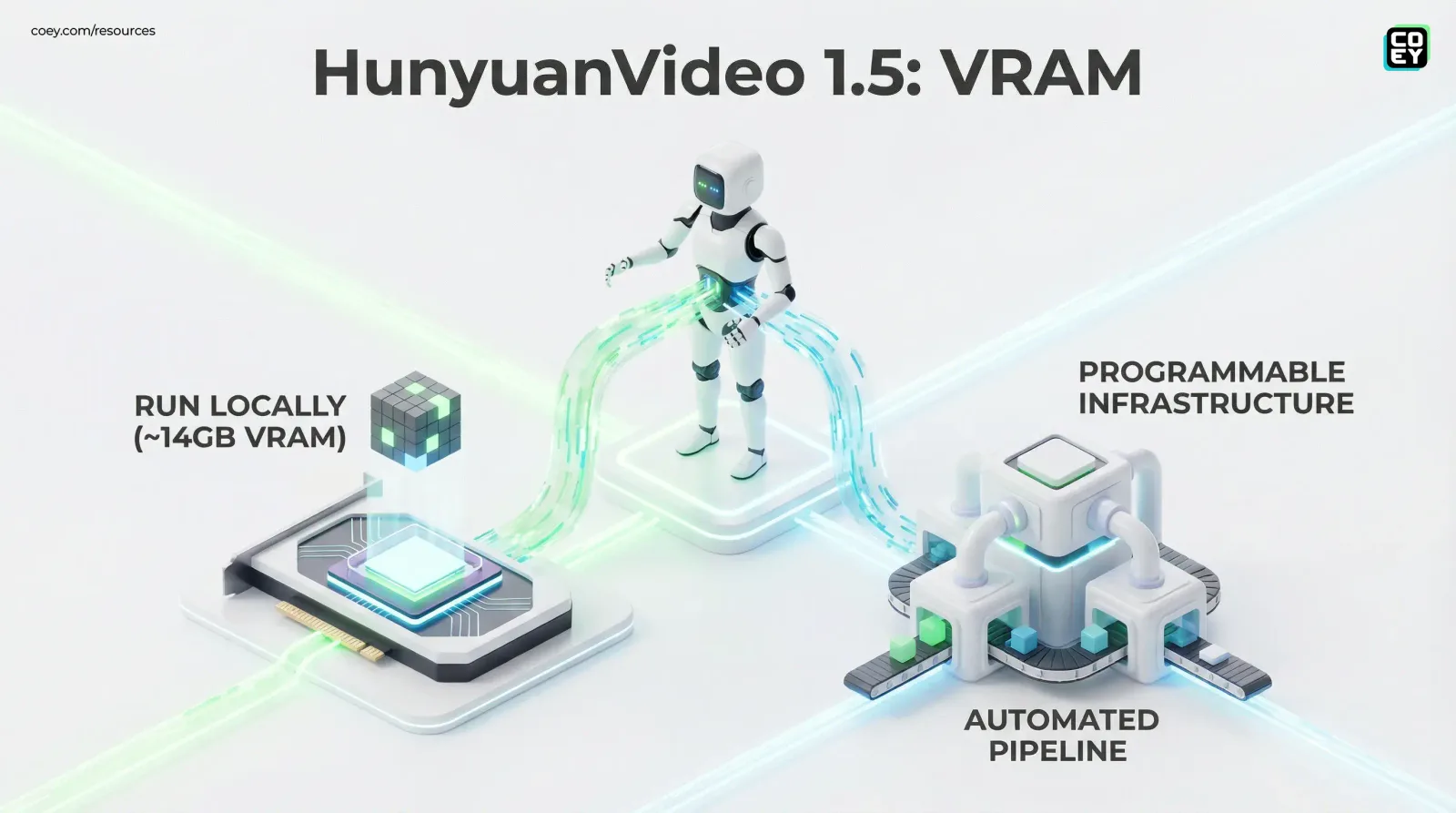
Consumer GPU feasibility with VRAM needs that can drop to about about 14GB when using memory saving approaches like offloading and or lower precision weights. Higher VRAM GPUs are recommended for smoother operation without offloading.
There’s also a technical report on arXiv for teams that want the under the hood details: HunyuanVideo 1.5 Technical Report.
Why this matters for creative teams
AI video has had a credibility problem. Not because the outputs are always bad, they’re often impressive, but because the workflow is usually bad:
Someone uses a closed UI tool.
Someone else downloads an MP4.
Someone else fixes timing, captions, framing, brand consistency, and why does the logo look melted in post.
Then the organization calls it AI powered and quietly never scales it.
HunyuanVideo 1.5 is interesting because it pushes in the opposite direction: model as infrastructure. It’s the kind of release that makes it easier to treat video generation like a callable capability, something your system triggers, rather than an artisanal ritual performed by your AI person.
Infrastructure beats vibes. When a model can run in your environment, it stops being a novelty and starts being a building block.
What’s improved (and what not to overhype)
Tencent frames HunyuanVideo 1.5 around efficiency and consistency gains, especially the classic pain points of open video models: temporal stability and compute cost. In practical terms, that usually shows up as:
Less frame to frame chaos (identity and object consistency holding longer).
More predictable inference (fewer runs that blow up halfway through or drift into nonsense).
Better throughput from attention and kernel optimizations (for example, optional attention implementations noted in the repo) aimed at making generation less punishing on hardware.
But let’s keep it grown up: open video is still open video. You should expect:
Hit or miss prompt reliability unless you standardize prompts and control inputs.
Variation costs : great for generate 30 options, less great for match this exact brand storyboard on the first try.
Post still exists (captioning, resizing, color, pacing, compliance).
API availability: can this plug into automation?
HunyuanVideo 1.5 is not a hosted Tencent first enter a credit card and get an endpoint product. It’s a model release. That’s a feature, not a bug, if you’re trying to build durable automation.
Here’s what that means in plain English:
No enter credit card get endpoint official API is the default posture from the open source release.
Yes, you can still make it API driven by wrapping inference inside a service your stack can call.
Automation is limited by your ops maturity , not by vendor permissions.
If your organization already runs internal services (image processing, transcription, content pipelines), this fits the same pattern: deploy, wrap, call, monitor. If you don’t, this is where many teams fall back to UI tools, because open still requires someone to run it.
What automation ready looks like in practice
| Automation need | What HunyuanVideo enables | Reality check |
|---|---|---|
| Batch creative variants | Run many prompts or image seeds automatically | You still need QA gates plus retries |
| Private generation | Keep sensitive brand assets on your own infra | License plus governance still matters |
| Workflow integration | Expose generation as an internal endpoint | Requires deployment plus monitoring |
Licensing: open doesn’t always mean do anything
Before anyone tosses this into production: read the license. HunyuanVideo has been distributed under the Tencent Hunyuan Community License Agreement (a source available style license), and the operational takeaway is simple: open weights doesn’t automatically mean no restrictions.
A useful explainer style reference for licensing terms (including territorial restrictions and commercial scaling triggers) is documented here: Tencent HunyuanVideo licensing overview.
If you’re a marketing leader or exec: this is the part you route to Legal once, build a policy, and stop improvising every time someone wants to ship a new workflow.
Real world readiness: where this is usable now
Local video generation becomes valuable when you aim it at workflows that benefit from volume plus iteration, not perfection on the first render. The best right now use cases look like:
Performance creative testing
Hook variations for paid social
Multiple visual metaphors for the same product benefit
Rapid concept exploration before committing to a shoot
Content studios scaling series formats
Repeatable templates (same format, new prompt inputs)
Batch generation for rough cuts and internal selection
Privacy sensitive orgs
Teams that can’t upload embargoed product shots or unreleased concepts to third party SaaS tools
Brands that want a contained, auditable creative pipeline
The ready bar isn’t does it look cool. It’s can we generate, review, select, and ship outputs predictably without heroics. Local deployment is a massive step toward that.
Where teams still get burned
Even with a solid open model, you can absolutely faceplant if you treat it like a magic wand.
Brand consistency isn’t automatic : you’ll still need reference workflows, prompt standards, and human review.
Compute reality is still real : runs on consumer GPUs doesn’t mean runs fast on every consumer GPU. Throughput depends on settings and expectations.
Ops overhead is non zero : storage, job queues, retries, and a review UI (even if it’s just a folder plus Slack workflow) matter.
The bigger implication: video is becoming programmable
The most important signal in this release is cultural, not just technical: video is inching closer to the same automation posture text and images already have. When models are runnable, scriptable, and integratable, video moves from special project to pipeline stage.
That’s exactly where human plus machine collaboration gets powerful. Humans set intent, creative direction, and taste. Machines handle repetition, iteration, and throughput. And your business stops confusing we tried AI video once with we built a scalable creative system.
If you want related context on how AI video is evolving toward workflow readiness, COEY has been tracking the category closely, see Wan 2.6 Makes AI Video Multi Shot Ready.
Bottom line
HunyuanVideo 1.5 is a meaningful make it runnable moment for AI video. Tencent isn’t just showing off a model, it’s handing creators and teams a piece of infrastructure they can control, automate, and deploy with far less dependency on closed platforms.
It won’t eliminate the need for creative judgment, review, or brand governance. But it does remove a huge blocker: the idea that high quality generative video must live behind someone else’s UI and billing meter. And once video is infrastructure, it can finally join the automation stack, where creativity scales best.
Scale Your Content With AI Agents That Deliver
COEY helps brands and agencies automate content creation, marketing ops, and campaign execution using n8n, Claude Cowork, OpenClaw, and custom integrations. See how our agentic automation works across every marketing channel, or request a proposal.