Wan 2.6 Makes AI Video Multi Shot Ready
Wan 2.6 Makes AI Video Multi Shot Ready
December 27, 2025
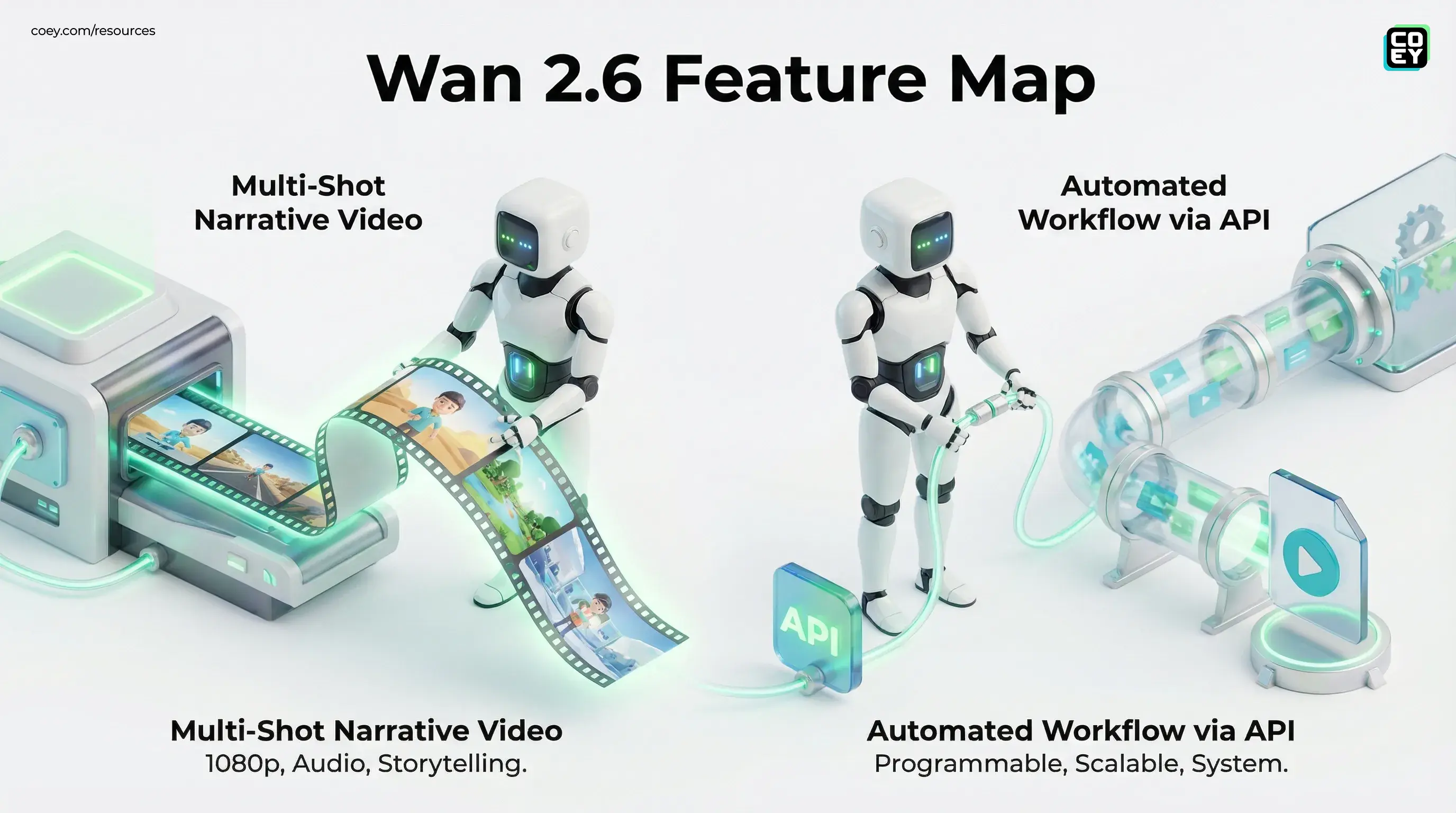
Alibaba’s Tongyi Lab is turning up the heat in generative video with Wan 2.6, a model positioned around multi-shot storytelling, higher resolution output (up to 1080p), and audio features that make AI video feel less like a tech demo and more like something teams can actually ship. The most important detail for automation minded teams: Wan is available through Alibaba Cloud Model Studio’s video generation APIs, including the video generation workflow and the image-to-video API reference.
If your current AI video workflow still involves generating four separate shots, praying the character’s face doesn’t mutate, and stitching everything together like a sleep-deprived intern, Wan 2.6 is aiming directly at that pain.
Translation: Wan 2.6 isn’t trying to win the “look what AI can do” Olympics. It’s trying to reduce the amount of human babysitting required to get a usable marketing clip.
What Wan 2.6 actually shipped
Wan 2.6’s headline is multi-shot generation: instead of producing a single continuous shot that looks good for three seconds and then collapses into chaos, it’s designed to generate multi-scene, narrative-style video with better continuity.
On paper, the capability set reads like it was written by someone who has actually sat through an AI video review session:
- Up to 1080p output (the minimum viable resolution for anything brand-adjacent that isn’t trying to look “lo-fi on purpose”).
- Up to ~15 seconds per generation (Model Studio supports multiple duration options by model, and Wan 2.6 is commonly documented with durations up to about 15 seconds).
- Multi-shot planning so a single prompt can expand into a sequence rather than a one-off moment.
- Audio options (newer Wan image-to-video workflows support generating audio and can also accept custom audio via an audio URL parameter where supported by the selected model).
If you want a quick model-specific reference point inside COEY’s library, see WAN 2.6 I2V.
Why multi-shot is the real milestone
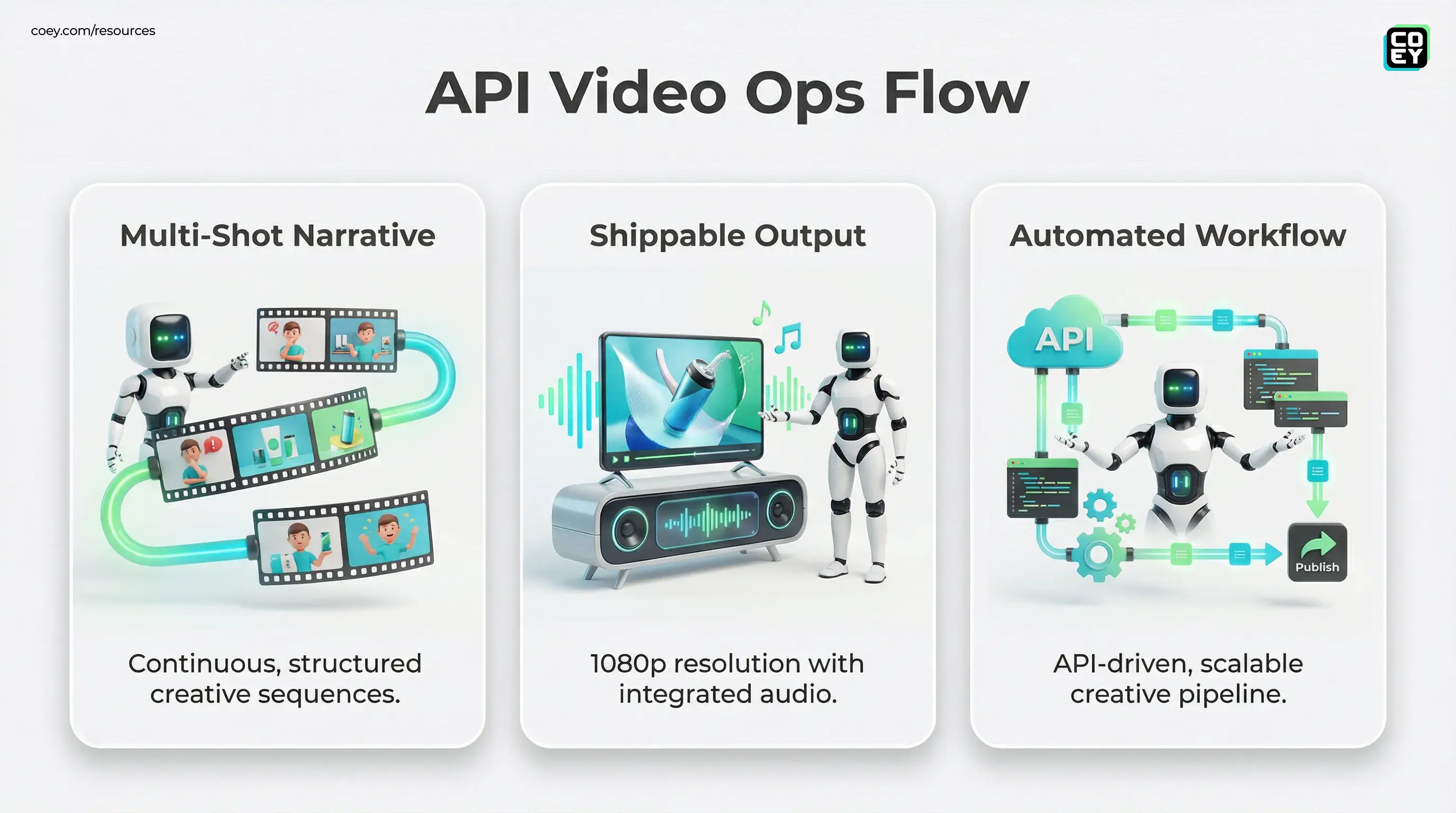
Resolution upgrades are nice, but multi-shot is the operational unlock. Marketing doesn’t run on isolated clips. It runs on sequences:
- Hook → proof → payoff
- Problem → product → CTA
- Scene 1 → scene 2 → scene 3 (with the same spokesperson)
Historically, AI video has been great at generating a single “vibe moment” and terrible at delivering repeatable structure. Multi-shot generation shifts AI video from “output” to “format.” And formats are what scale.
Multi-shot is how AI video stops being a novelty. If the model can hold continuity across scenes, you can build series content, not just clips.
Automation readiness: API access changes everything
Here’s where Wan 2.6 gets especially relevant to COEY’s mission: this isn’t trapped behind a closed UI-only tool. Wan is available through Alibaba Cloud Model Studio as a programmable service. The docs cover a video generation workflow and specific API references (including image-to-video), meaning this can be wired into real pipelines.
For non-technical leaders, API access answers the only question that matters:
Can this become part of a system, or does it require a human clicking buttons forever?
| Workflow need | What Wan enables | What to watch for |
|---|---|---|
| Batch creative variants | Programmatic generation via Model Studio endpoints | Cost controls, queue times, and retry logic |
| Video from existing assets | Image-to-video pipeline (first-frame plus prompt) | Asset rights, brand consistency, and output QA |
| Automation into your stack | Callable service that can be orchestrated like any other API | Governance: approvals, logging, and safe prompts |
In practical terms, teams can plug Wan into orchestration tools (custom services, webhooks, workflow platforms) to generate videos automatically from structured inputs, like product feeds, campaign briefs, or approved scripts, then route outputs into review and publishing steps.
Where this is “real” vs. where it’s still hype
Let’s separate what’s shippable from what’s shiny.
Real: faster campaign iteration
Wan’s combination of longer duration and higher resolution makes it more viable for high-velocity creative iteration. That means more usable drafts per week, more performance testing, and less dependence on manual editing for every single concept.
Real: structured creative ops
If your team already treats marketing as a pipeline (brief → generate → QA → approve → deploy → learn), Wan’s API posture makes it possible to run video generation as a repeatable step, not a “someone go play with the AI tool” task.
Still hype: push-button brand safety
Nothing about a video model automatically solves:
- claim compliance
- rights and consent
- tone alignment
- visual brand rules
Those require process: constraints, reviewers, and ideally machine-readable governance.
What this changes for marketers and content teams
Wan 2.6 reinforces a broader shift: video is becoming a programmable medium. Not because every brand is about to run fully autonomous AI video campaigns (please don’t), but because teams can increasingly automate the grind layer:
- Variant generation (same concept, multiple hooks and scenes)
- Format expansion (turn a brief into a multi-shot sequence)
- Asset adaptation (seed with existing frames or reference images)
- Operational scaling (run batches, route outputs, log results)
The win isn’t replacing taste. The win is removing the repetitive labor between taste and output.
What to watch next
Wan 2.6 is a strong step, but the difference between “usable” and “infrastructure” comes down to the surrounding ecosystem. The next signals that will matter most:
- More explicit multi-shot controls (scene manifests, shot-level parameters, repeatable templates)
- Workflow hooks (webhooks, job status callbacks, structured error codes)
- Governance features (audit trails, content moderation transparency, enterprise permissions)
Alibaba Cloud’s Model Studio documentation already reflects a production mindset (for example: model-specific usage limits, content moderation, and output storage or retention behavior). That’s good. But brands will ultimately judge this on whether it reduces chaos, not just whether it increases quality.
Bottom line
Wan 2.6 is another sign that AI video is graduating from “cool clip generator” to “workflow component,” especially because it’s accessible through Alibaba Cloud’s Model Studio APIs rather than being locked behind a single creator UI. Multi-shot narrative generation, 1080p output, and audio support collectively push it closer to real marketing use.
The teams who benefit most won’t be the ones chasing viral AI aesthetics. They’ll be the ones who wire this into a human plus machine system: humans set intent and creative direction, machines generate volume and variations, and the process catches what shouldn’t ship.
For earlier context on how Alibaba has been positioning Wan as a multimodal, API-first pipeline, see Alibaba Wan 2.5-Preview: True Multimodal Pipeline Arrives.