Cosmos 2B Makes Video Predictable, Not Just Generative
Cosmos 2B Makes Video Predictable, Not Just Generative
January 11, 2026
NVIDIA is pushing hard on the idea that “physical AI” is the next platform shift, and Cosmos is the bet. The headline product page is here: NVIDIA Cosmos. In plain English: Cosmos is a family of world foundation models meant to understand scenes over time (video), predict what happens next, and generate physically plausible future frames. Not just what is in the clip, but what’s about to happen.
That’s a meaningful upgrade from the current creator tool era where “video AI” mostly means generate a pretty clip or stylize a clip. Cosmos is more like: here’s a scene, here’s context, now simulate the next moments and tell me what changes. For robotics and autonomy, that’s obvious value. For marketing and creative ops, it’s sneakily big, because prediction and simulation are how you automate decisions, not just assets.
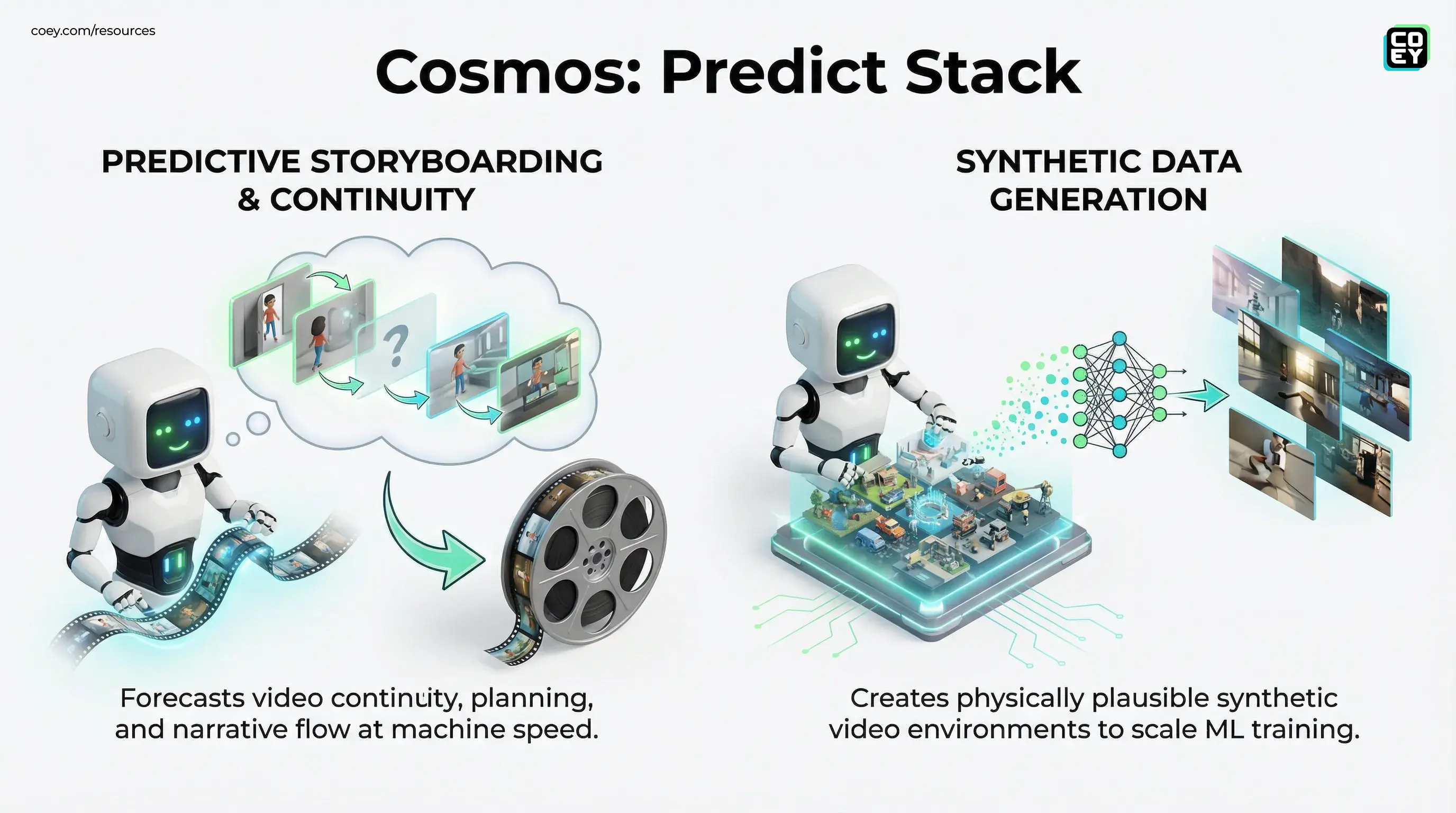
If generative video is the camera, Cosmos is the storyboard supervisor who can forecast continuity at machine speed.
What Cosmos 2B actually is
Cosmos isn’t one model. It’s a platform with multiple model families aimed at different jobs:
- Cosmos Predict: world and video generation plus future state prediction
- Cosmos Reason: vision language reasoning over images and video, built for physical understanding
- Cosmos Transfer: controlled generation across conditions (lighting, environments), useful for synthetic data
The “2B” name floating around is important: NVIDIA’s Cosmos line includes 2B parameter variants alongside larger options, positioning 2B as a smaller, more deployable size than the top end versions.
The strongest non hype framing is: 2B is the actually integrate it size. It’s still serious compute, but it’s closer to team can deploy a service than lab experiment.
For the broader announcement context, NVIDIA’s newsroom post is here: NVIDIA Launches Cosmos World Foundation Model Platform.

Why this matters outside robotics
Cosmos is branded as physical AI, but the operational pattern is relevant to any team trying to scale content and decisions:
- Spatio temporal understanding means the model understands events, not just frames
- Prediction means you can run what if loops quickly
- World generation means you can synthesize plausible video environments without filming everything
For creators and marketers, the immediate use case is pre production automation:
- narrative planning
- continuity checking
- rapid scenario ideation
- synthetic b roll concepts
- simulation for interactive experiences
Not everything needs cinematic output. A lot of teams just need faster iteration cycles and fewer expensive dead ends.
Automation potential: can you actually plug this in?
This is where COEY draws the line between cool and callable.
What’s real
Cosmos is designed like infrastructure: NVIDIA positions it as deployable, and it plugs into their broader serving ecosystem via NVIDIA NIM (NVIDIA Inference Microservices). That means you can treat Cosmos as a service endpoint in a workflow rather than a one off creative toy.
For developers, Cosmos is referenced in NVIDIA’s NIM docs here: NVIDIA NIM for Cosmos WFM (Introduction).
What still requires maturity
Even if the model is runnable, automation success depends on whether you have:
- a job queue (batch inference, retries, scheduling)
- governance (what prompts are allowed, what assets can be used)
- review gates (humans approving or rejecting predicted or generated sequences)
Cosmos doesn’t magically solve that. It just makes the capability programmable.
The model is not the workflow. The model becomes valuable when your workflow treats it like a repeatable stage, not a demo.
Quick readiness table (pragmatic view)
| Question | Cosmos 2B reality | Why it matters |
|---|---|---|
| Can it be automated? | Yes (service style deployment via NIM) | Fits n8n, Make, or custom orchestration patterns via API calls |
| Is there an API story? | Yes, via NVIDIA’s serving ecosystem | Callable is the difference between adoption and science project |
| Is it plug and play for marketers? | Not fully | You’ll want a technical owner or partner to productionize |
What creative ops can do with it (today-ish)
1) Predictive storyboarding and continuity checks
Instead of generating a full finished clip, Cosmos style prediction can help answer:
- If we cut from this shot to that, will motion continuity break?
- If the product enters frame here, what should happen next to feel physically consistent?
This is less sexy than make me a movie, but far more shippable in real teams.
2) Synthetic video data for performance and personalization
If you’re training internal vision systems (retail analytics, event capture, brand safety detection), Cosmos’ big promise is physically plausible synthetic data, which is how you scale ML without collecting endless real footage.
3) Simulation for experiential and interactive marketing
Digital twins aren’t just for factories anymore. If you’re building:
- virtual stores
- interactive product demos
- AR activations
A world model that can generate and predict plausible sequences becomes a way to test experiences without rebuilding environments by hand.
The competitive signal: open world models are a category now
NVIDIA is not quietly releasing a model. They’re trying to define a platform layer: world modeling as a primitive, like text generation became a primitive.
This matters for business leaders because it suggests a near future stack where:
- your LLM writes the brief
- your image model generates keyframes
- your world model predicts motion and continuity
- your automation layer routes tasks plus approvals
- your humans do taste, selection, and final polish
That’s the human plus machine collaboration lane that actually scales.
If you want adjacent context on NVIDIA’s broader open, production oriented model direction, COEY covered it with Nemotron here: Nemotron-3 Makes Open Agentic AI Production-Ready.
Reality check: what not to overhype
Cosmos is a big deal, but don’t confuse predictive with correct.
- Physics aware doesn’t mean error free. You’ll still see drift, weird causality, and edge case hallucinations, especially when prompts or inputs are underspecified.
- Automation needs guardrails. If this feeds downstream creative generation or planning, you need critics, validators, and human checkpoints.
- Compute is still real. 2B is smaller than larger Cosmos variants, but video workloads are inherently heavier than text. Budget accordingly.
Bottom line
Cosmos 2B is part of NVIDIA’s push to make video understanding and prediction feel like a deployable capability, not an academic flex. If your team has any workflow where time and motion matter (campaign production, simulation, interactive experiences, synthetic data), Cosmos is one of the clearest signals yet that world models are moving toward real operational use.
The win isn’t AI makes video. The win is AI makes the physical world predictable enough to automate decisions around it, and that’s where creative scale becomes a system, not a scramble.
Let COEY Wire Your AI Marketing Stack
We help brands and agencies connect n8n, Claude Cowork, OpenClaw, and other AI tools into marketing systems that produce real output. From content automation to full campaign orchestration across every channel. See how it works or request a proposal.