
Seedance 2.0 Lands Inside CapCut, and That’s the Real Flex
Seedance 2.0 lands inside CapCut and that is the real flex. What the integration unlocks for AI video marketing automation and social ad ops teams.
16 February 2026Team COEY
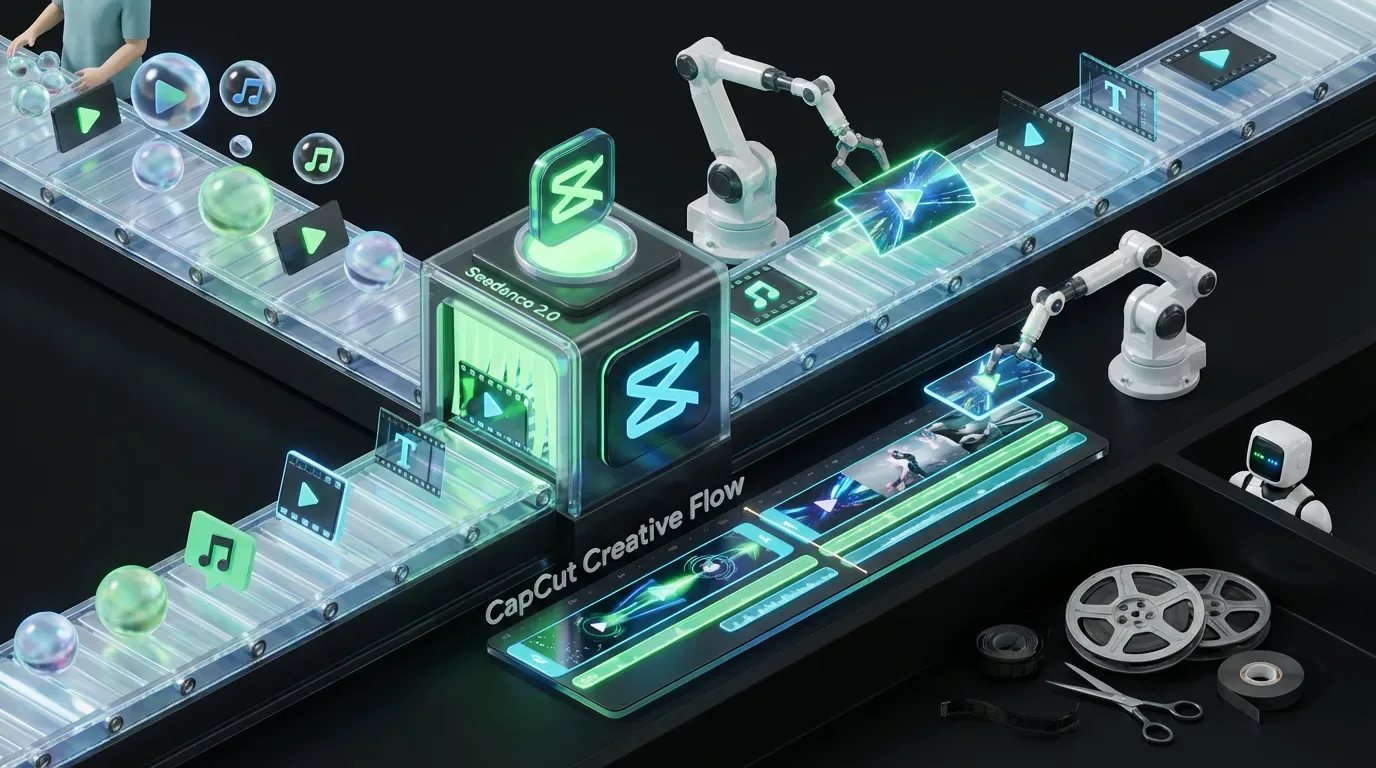
ByteDance has rolled out Seedance 2.0 as a native CapCut capability, turning “generate video” into something you can do without leaving your editing timeline. The official entry point is CapCut’s Seedance 2.0 page: https://www.capcut.com/tools/seedance-2-0.
This isn’t just another “look what our model can do” moment. It’s a distribution move. Generative video doesn’t scale because it’s impressive; it scales because it lives where work actually happens. CapCut is already the assembly line for short-form creators and marketing teams. Dropping Seedance 2.0 into that flow is ByteDance saying: “Stop tab-hopping. Just ship.”
What Seedance 2.0 actually is
Seedance 2.0 is ByteDance’s flagship generative video system, positioned for higher fidelity, better motion stability, and more controllability than earlier generations. ByteDance’s Seed team frames it as a cinematic, director-style model with multimodal inputs and audio-visual generation: https://seed.bytedance.com/en/seedance2_0.
The key shift isn’t merely “text-to-video.” Seedance 2.0 is described across ByteDance and CapCut surfaces as multimodal, meaning it can be guided by combinations of text and reference media. That matters because prompt-only video is where brand consistency goes to die.
If you’re leading marketing or content ops, think of Seedance 2.0 less like a magic trick and more like a new production primitive: “generate a usable clip” becomes a timeline action, not a separate workflow.
CapCut integration is the headline
Standalone generators win Twitter. Embedded generators win budgets.
When the model sits inside CapCut, you immediately get the stuff that makes AI real in a company:
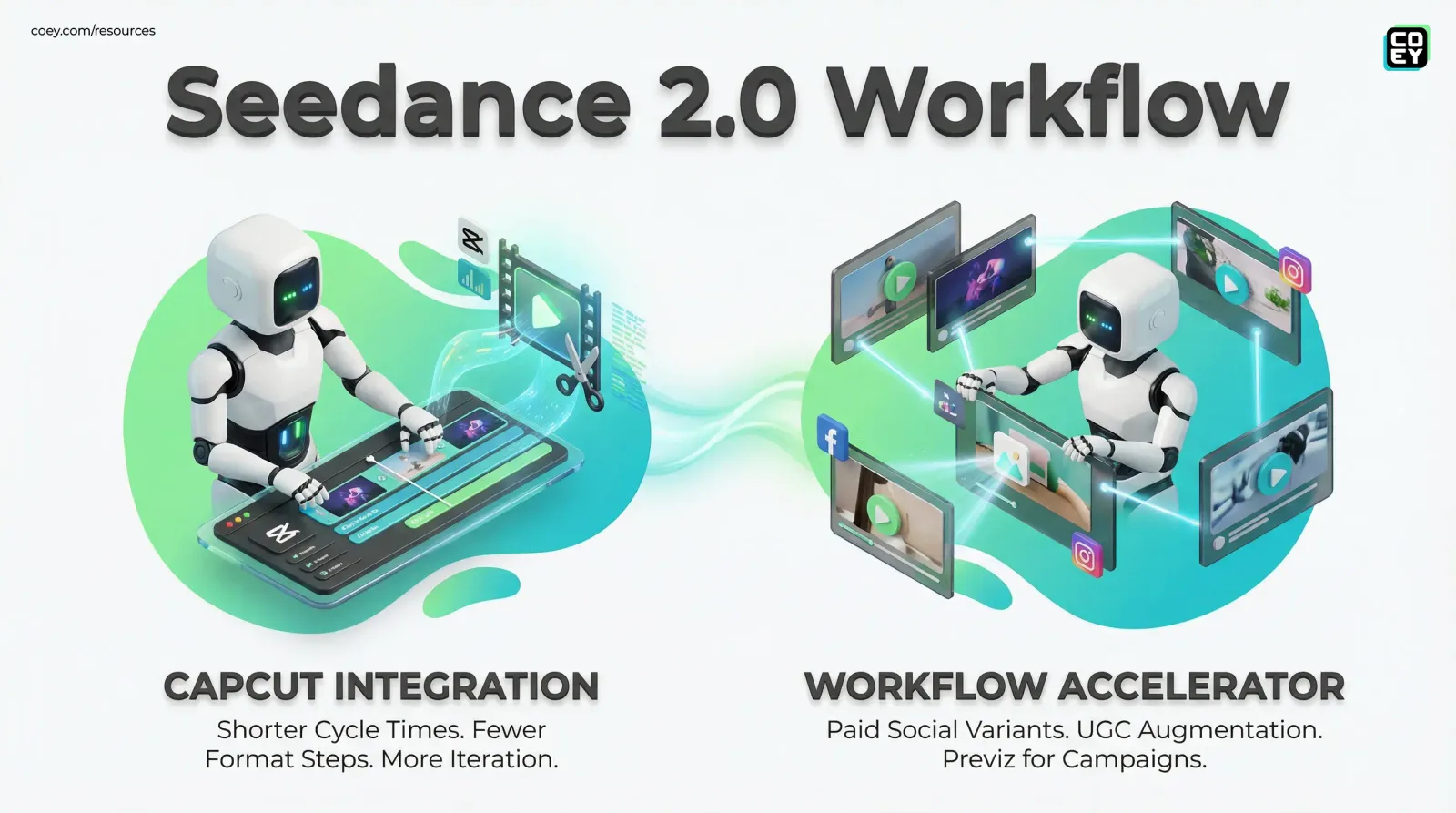
Shorter cycle time: generate → trim → caption → export without bouncing between tools
Fewer “format tax” steps: less manual resizing, re-encoding, re-importing
More iteration: the team can test 10 angles before lunch instead of getting precious about one
Big picture: video generation becomes part of editing, not a separate discipline.
That’s how “AI video” stops being R&D theater and becomes operational throughput.
What’s improved (and what’s marketing)
The claims around Seedance 2.0 focus on the classic gen-video failure modes: jittery motion, identity drift, and scenes that fall apart over time. ByteDance’s positioning leans into “immersive audio-visual” and director-level control, while CapCut’s positioning leans into ease-of-use and workflow speed.
Here’s the pragmatic view: even if the model is objectively better, your usable-output rate is what matters. The delta between “cool demo” and “shippable clip” is where teams either adopt or quit.
Production-relevant capability signals
| Signal | Why teams care | What Seedance 2.0 suggests |
|---|---|---|
| Motion stability | Less “AI wobble” on cuts and pans | Positioned as smoother and more coherent |
| Multimodal guidance | Brand consistency and repeatability | Text plus reference media support |
| High-res output | Assets survive crops, overlays, exports | Commonly positioned as up to 2K output on CapCut surfaces, often with 1080p as a default or faster option |
Automation reality: can you plug it in?
This is where we separate “workflow-ready” from “automation-ready.”
CapCut integration is real workflow value today. But it is not the same thing as having an API you can call from your systems.
Seedance 2.0’s public-facing access story is primarily UI-first through CapCut. It is also presented through Dreamina’s tool surface here: https://dreamina.capcut.com/tools/seedance-2-0.
What’s missing (for now) is the part that automation teams actually need: stable, clearly documented, first-party endpoints for batch generation, job orchestration, asset retrieval, metadata, and governance logs.
Automation readiness, in plain English
| Level | What you can do | What you can’t (yet) |
|---|---|---|
| Workflow-ready | Generate clips inside CapCut, edit immediately | Trigger generations programmatically via an official, publicly documented first-party API |
| Ops-ready | Standardize prompts and references across a team | Centralized audit trails and automated approvals (first-party) |
| Pipeline-ready | Build a repeatable “creative factory” | Official Seedance 2.0 API plus webhooks (publicly documented) |
Translation for execs: this is immediately useful for humans shipping content. It is not yet a “run overnight and fill our DAM with 500 variants” engine unless ByteDance exposes developer hooks.
What teams can ship with it right now
Seedance 2.0’s best immediate fit is not replacing your entire production pipeline. It’s removing the dead time in your pipeline: b-roll gaps, transition shots, scene setters, and “we need one more visual” moments.
High-confidence use cases
Paid social variant testing: generate multiple visual angles for the same offer, then cut fast in CapCut
UGC augmentation: add cutaways, product context shots, or vibe transitions without sourcing stock
Pre-viz for campaigns: show stakeholders motion and tone before spending real production budget
Always-on content: keep feeds fresh without needing a shoot for every minor creative refresh
The highest ROI pattern: keep human-shot “truth anchors” (founder clips, testimonials, product macros) and use Seedance-generated shots to multiply context, energy, and variety around them.
Brand safety, rights, and the messier story
As Seedance 2.0 gets more realistic, it also walks straight into the legal and ethical blast radius that’s forming around generative video.
Hollywood groups and unions have publicly criticized ByteDance’s AI video tooling over copyright and likeness concerns, with reporting captured by AP News: https://apnews.com/article/7e445388401d172c6bf51d0d42aa4f24.
For marketers, the practical takeaway isn’t “panic.” It’s: do not treat realism as permission. If your workflow touches recognizable people, recognizable characters, or protected IP, you need internal rules, approvals, and documentation. The model can accelerate production; it can also accelerate your legal exposure.
Why this matters in the AI video arms race
There are plenty of strong video models in the market. The differentiator is increasingly boring (and that’s a compliment):
Where does it live?
How fast can you iterate?
Can it be governed?
Can it be automated?
Seedance 2.0 landing inside CapCut is ByteDance leaning into the most powerful strategy in creator tech: make the new behavior feel normal. Once “generate a shot” feels like “add captions,” adoption stops being a special initiative and starts being daily habit.
If you want the broader CapCut ecosystem context, Seedream 5.0 (image generation) is also being embedded into ByteDance’s creative surfaces: https://coey.com/resources/blog/2026/02/12/bytedances-seedream-5-0-lands-in-dreamina-capcut-web-fast-photoreal-and-mostly-not-yet-automatable/.
Bottom line
Seedance 2.0 inside CapCut is a distribution win masquerading as a model update. It makes generative video easier to use where teams already edit, which is exactly how you scale creative output without scaling headcount.
The pragmatic stance: deploy it today as a workflow accelerator (more variants, faster edits, fewer gaps). Watch for what matters next: official API access and automation hooks that turn Seedance from “fast in the UI” into “repeatable in the system.”
Turn AI News Into Marketing Advantage
COEY turns the latest AI developments into real marketing firepower. We deploy n8n workflows, Claude Cowork agents, and OpenClaw pipelines that keep your channels running and your team focused on strategy. See our automation approach or request a proposal.