Kling 3.0 Makes AI Video Feel Like a Real Production Tool
Kling 3.0 Makes AI Video Feel Like a Real Production Tool
March 11, 2026
Kuaishou’s Kling 3.0 is another step toward a world where video isn’t “made,” it’s compiled, with shot lists, continuity, and in supported modes even audio assembled by machines and then directed by humans. The cleanest starting point is Kling’s global product hub at klingai.com/global.
Yes, the headline features are the ones that win the timeline: multi-shot video, stronger character consistency, and more cinematic motion. But the real story is operational. Kling is pushing generative video toward a format that looks more like a campaign pipeline and less like a “look what I prompted at 2am” clip.
The market doesn’t need more AI video that’s impressive in isolation. It needs AI video that survives revisions, brand checks, and batch production.
What shipped in Kling 3.0
Kling 3.0’s release is being positioned as a model family upgrade across video and image, with the most workflow-relevant progress showing up in how you structure a sequence. Third-party coverage highlights multi-shot generation and storyboarding as a first-class feature, not a duct-taped workaround (GlobeNewswire release).
At a practical level, Kling 3.0 is aiming to reduce three classic failure points in gen-video workflows:
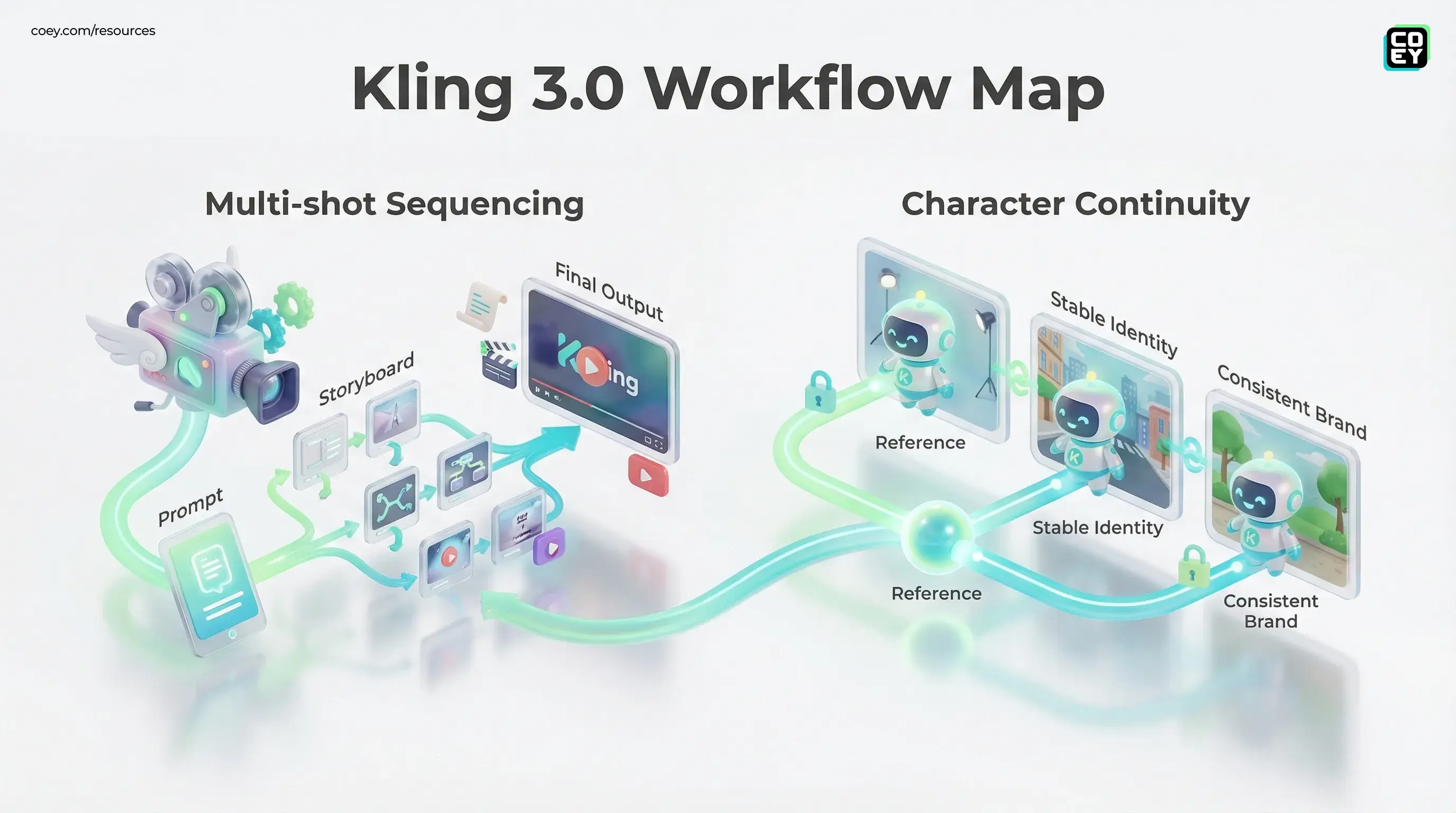
- Sequencing: moving past single-shot clips into multi-shot compositions you can actually use for ads, explainers, and social narratives.
- Continuity: keeping characters and branded objects stable across cuts, camera moves, and transitions.
- Finishing overhead: tightening motion and transitions so outputs need less “save it in post” energy.
Multi-shot is the real headline
Multi-shot generation is the most important signal in this release because it changes what Kling is for. Single-shot tools are fun, but marketing teams don’t buy fun. They buy repeatable output: multiple beats, clear progression, and predictable structure.
Kling 3.0’s Smart Storyboard framing leans into the idea that you can describe a narrative and have the system break it into shots with transitions (Kling 3.0 model page). That matters because it turns prompting into something closer to script direction:
- Creators can produce a complete 9:16 ad beat with hook, demo, and CTA without stitching separate renders.
- Agencies can generate client-ready animatics and concept boards fast, then swap scenes instead of restarting.
- Brands can standardize formats so the same structure scales across products and variants.
In other words: multi-shot isn’t a flashy feature. It’s a workflow primitive.
Character consistency gets less chaotic
Anyone who’s tried to scale gen-video knows the pain: you get a great first shot, then shot two introduces your character’s cousin with different facial geometry, wardrobe drift, and a logo that looks like it was generated from memory.
Kling 3.0 claims improvements in keeping identities stable across frames and across shots, especially when references are involved. ComfyUI’s partner documentation for Kling 3.0 also calls out multi-shot generation and subject consistency as key parts of the integration (ComfyUI coverage).
For marketing teams, better consistency is not just prettier video. It’s:
- Fewer rerolls to get a usable sequence
- Faster approvals because continuity breaks are what reviewers instantly fixate on
- More brand-safe iteration when the main character is a product, mascot, or ambassador
Continuity isn’t an aesthetic preference. It’s what determines whether video generation can be systematized.
Cinematic motion and transitions: less edit tax
Camera motion and transitions sound like cosmetics until you’re the one patching jumpy clips into something coherent. Kling 3.0’s promise here is smoother movement and scene bridging, less AI stutter and more usable flow out of the render.
This matters most in performance environments where the output isn’t a film festival entry. It’s a unit of work in a high-throughput content engine:
- paid social variants
- creator whitelisting content
- product explainer cutdowns
- localized campaign versions
If the model reduces the need for manual smoothing, speed ramps, or hide-the-seams editing tricks, it’s not just quality. It’s hours returned to the team.
Automation potential: is Kling 3.0 programmable?
This is where the hype usually faceplants. A model can be stunning and still be unusable at scale if it’s locked in a UI with no reliable automation surface.
Kling’s developer-facing ecosystem is increasingly API-driven, with pages that explicitly frame Kling as something you can integrate rather than just click around in (Kling API features). That’s the difference between cool tool and production layer.
In plain English: if you can call Kling through an API, you can put it inside real workflows:
- Batch generation such as 30 hooks times 10 products times 3 aspect ratios
- Triggered creation such as new product then auto-generate PDP video then route to review
- Experiment loops such as auto-produce variants then tag metadata then test then feed learnings back into a prompt template
| Workflow need | What 3.0 enables | What to expect |
|---|---|---|
| Multi-shot ads at scale | Storyboard-style generation typically up to about 15 seconds per generation | You’ll still need a human approval gate |
| Repeatable same character series | Improved consistency via references | Edge cases will drift, plan for rejection and redo |
| Automation into a stack | API-facing surfaces | Availability and limits can vary by plan and region |
| Lower post-production time | Smoother motion plus transitions | Brand-critical scenes may still need finishing |
Real-world readiness: what’s solid vs shiny
Kling 3.0 is absolutely a move toward production, but production-ready depends on what you mean by production.
Looks ready for
- Pre-visualization and concepting that can go straight into decks and pitches
- Short-form ad iterations where speed plus volume matters more than pixel-perfect determinism
- Creator-style campaign content where good enough and on-brand beats perfect and late
Still risky for
- Exact product accuracy including logos, packaging, UI screens, regulated claims
- Deterministic repeatability where legal or compliance wants the same output every time
- High-stakes hero assets where one uncanny frame becomes the only thing anyone remembers
The pragmatic move is to treat Kling 3.0 like a high-power production assistant: it drafts sequences fast, gives you options, and reduces grind, but your team still owns taste, approvals, and responsibility.
Why this matters for scaling creativity
Kling 3.0’s trajectory is aligned with where the industry is heading: tools that don’t just generate content, but generate structured content that fits into how marketing teams actually ship work. Multi-shot storyboarding and better continuity are not nice-to-haves. They’re the bridge from gen-video novelty to programmable creative operations.
For more context on how Kling 3.0 fits into the broader shift toward production-grade AI video workflows, see Kling 3.0 Goes Full “Production Mode” With 4K/60, Multi Shot Continuity, and Native Audio.
When AI video can reliably output sequences, maintain identity, and expose automation surfaces, you start getting the real compounding effect: humans direct, machines iterate, and creative throughput stops being capped by manual assembly.
AI Marketing That Goes Beyond the Hype
COEY builds the marketing automation systems that agencies and brands actually need: n8n workflows, Claude Cowork agents, OpenClaw models, all connected and delivering. See our automation capabilities, explore our channel work, or request a proposal.