
Meta’s Llama 3.3 (70B): The Less Sexy, More Useful Model Release
Meta’s Llama 3.3 (70B): The Less Sexy, More Useful Model Release
February 28, 2026
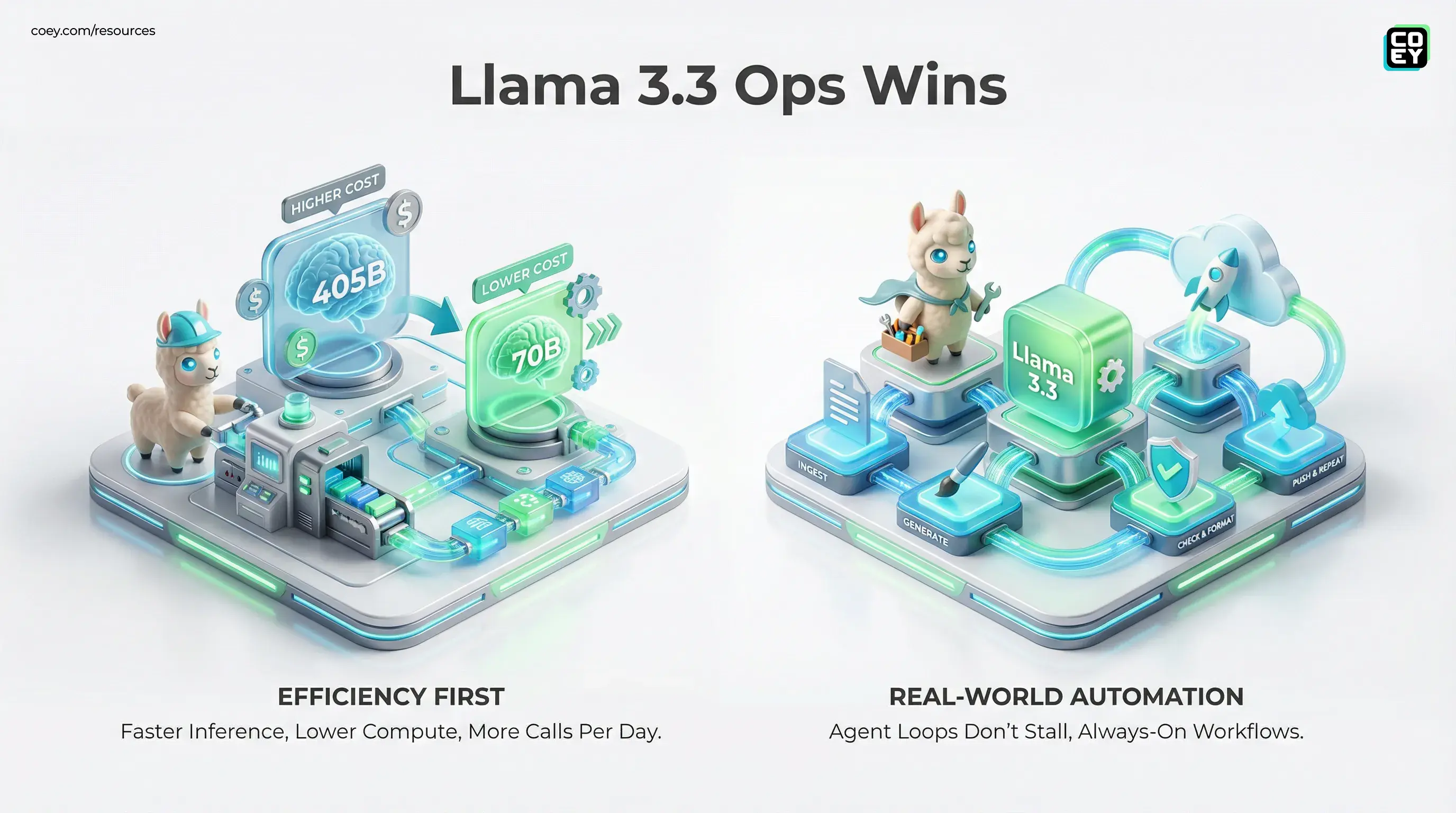
Meta’s Llama 3.3 (70B) is the less sexy, more useful kind of model release: a text-only, instruction-tuned roughly 70B model that Meta says delivers performance comparable to its much larger Llama 3.1 405B on a range of benchmarks, but with dramatically lower inference cost and operational overhead. That shift matters because it moves LLMs from boardroom demo to we can actually afford to run this inside workflows all day.
In other words: the hype is not that it is smarter. The story is that it is cheaper and faster to operationalize, which is how human creativity scales through machine collaboration without turning your finance team into your biggest AI critic.
You can start from Meta’s official Llama hub here: https://llama.meta.com/.
What Meta actually shipped (and why it’s not just a new number)
Llama 3.3 (70B) is positioned as an efficiency-first upgrade: text-only general reasoning, improved instruction-following, and tuned post-training, while targeting lower inference cost than frontier-scale giants.
TechCrunch’s coverage frames the release as Meta’s attempt to deliver 405B-like capability in a 70B footprint, which is exactly what ops teams want to hear when they are trying to run automation at volume rather than spar with a single chatbot prompt. https://techcrunch.com/2024/12/06/meta-unveils-a-new-more-efficient-llama-model/
Translation for execs: This is not AI got a little better. It is AI got more deployable, which is the difference between experimentation and an internal production layer.
Efficiency is the feature (because agents are expensive)
Most companies do not run one prompt. They run chains:
- ingest brief
- generate variants
- check policy and brand
- localize
- format for channels
- push into CMS, ESP, or ad platform
- summarize performance
- repeat forever
Every step is a model call. Every model call has latency and cost. So a 70B model that is good enough to replace heavier routing for many tasks can materially change throughput.
Here’s the operational difference in plain terms:
| What changes | Why it matters | Outcome in workflows |
|---|---|---|
| Lower compute needed | More calls per day, less budget anxiety | Always-on automation becomes realistic |
| Faster inference | Agent loops do not stall | Less human babysitting per workflow |
| Stronger coding posture | More reliable glue code | Fewer bottlenecks between tools |
Availability: open weights, but open with a license footnote
A big reason Llama keeps showing up in real stacks is distribution: you can download the weights, run it in your environment, and fine-tune.
But let’s be adults about the licensing: Meta uses the Meta Llama 3 Community License Agreement, which is broadly usable but not OSI open source in the strict sense. It includes restrictions, including that organizations with more than 700 million monthly active users (including affiliates) must request a separate license from Meta.
The Open Source Initiative has been blunt about why these terms do not qualify as open source. https://opensource.org/blog/metas-llama-license-is-still-not-open-source
Pragmatic takeaway: for most brands, agencies, and enterprise teams, the license behaves like commercially usable. For the biggest consumer platforms, it can become talk to Legal.
API reality: can you automate it or is it stuck in a UI?
This is where Llama 3.3 gets practical fast: it is not trapped in one product UI. You can run it:
- self-hosted (on-prem or your cloud)
- via managed enterprise platforms (for example, IBM watsonx, Oracle Cloud Infrastructure, NVIDIA NIM, and other providers that offer hosted Llama endpoints)
- via model hubs (Hugging Face)
Hugging Face listings make it straightforward to integrate into modern MLOps workflows (evaluate, deploy, version, pin). A commonly referenced entry point is Meta’s official org page on Hugging Face. https://huggingface.co/meta-llama
What API available means for non-technical teams
If your team can hit an HTTPS endpoint, you can plug Llama 3.3 into:
- n8n, Make, or Zapier (HTTP steps plus webhooks)
- internal middleware (your AI gateway service)
- agent frameworks that support OpenAI-style tool or function calling patterns (often via an adapter layer)
The model itself does not magically come with Zapier buttons. But the moment you serve it behind an endpoint (common stacks include vLLM or TGI), it becomes workflow-capable.
Real-world readiness: where it fits today (and where it doesn’t)
Llama 3.3 (70B) is most ready when the work is:
- repeatable
- bounded
- reviewable
- high volume
Think: content ops, QA, transformation, internal research synthesis, and code-adjacent automation (the glue that quietly eats your week).
High-confidence wins for marketing and creative ops
- Variant factories: ads, hooks, CTAs, subject lines, at scale, with critics
- Localization drafts: faster multi-locale expansion, cheaper iteration
- Structured packaging: generate content and return it in schemas for CMS or ESP fields
- Ops-side copilots: briefs to outlines to asset bundles to formatted handoffs
Where you still need guardrails (no hero moves)
- autopublishing without critics plus approvals
- compliance-heavy claims without grounding
- agents with write access to production systems and no receipts
Snarky but accurate: Agentic is just multi-step with better PR. Multi-step systems fail by a thousand tiny errors unless you build verification and rollback into the pipeline.
Automation economics: why this release is a signal, not a flex
Meta’s strategic message here is clear: the market is shifting from best model to best operating envelope. If a model is good enough and cheap enough to run continuously, it stops being a tool and becomes infrastructure.
That’s aligned with how creativity actually scales:
- Humans supply intent, taste, and constraints
- Machines supply volume, iteration, and consistency
- Systems supply verification, routing, and receipts
If you want the playbook for keeping high-volume AI output reliable, this pairs naturally with our broader push toward oversight and validation: Verifiers Are The New Writers: Why AI Needs Oversight.
Bottom line
Llama 3.3 (70B) is Meta leaning into the part of AI that compounds: efficiency plus deployability. It is a model sized for real automation economics, where latency, cost-per-run, and integration options matter more than winning a single benchmark screenshot.
If you are building human plus machine creative systems, this is the kind of release that can actually move the needle: not because it replaces the creative spark, but because it makes the grind cheap enough to automate and reliable enough to trust with volume.