
Alibaba’s Qwen3.6-Plus Pushes Multimodal AI Closer to Real Agent Work
Alibaba’s Qwen3.6-Plus Pushes Multimodal AI Closer to Real Agent Work
April 2, 2026
Alibaba’s Qwen team has unveiled Qwen3.6-Plus, a new flagship model aimed less at chatbot theater and more at the messier world of real agent workflows. That distinction matters. Plenty of AI launches still boil down to “it can answer questions, but make it shinier.” Qwen3.6-Plus is being positioned for something more operational: long-horizon coding, multimodal reasoning, UI-aware tasks, and automation loops that can actually plug into business systems. For marketers, ops teams, and creative leaders, the real question is not whether it sounds smart. It is whether it can help ship more work with fewer human bottlenecks.
The answer looks promising, with some caveats. Qwen3.6-Plus brings a 1 million token context window, multimodal inputs across text, images, documents, and video, plus an architecture tuned for what Alibaba calls “real-world agents.” In plain English: this model is being built to hold onto large amounts of information, reason across it, and take multi-step action instead of tapping out after one clever reply. That makes it more relevant to workflow builders than to people collecting screenshots for the group chat.
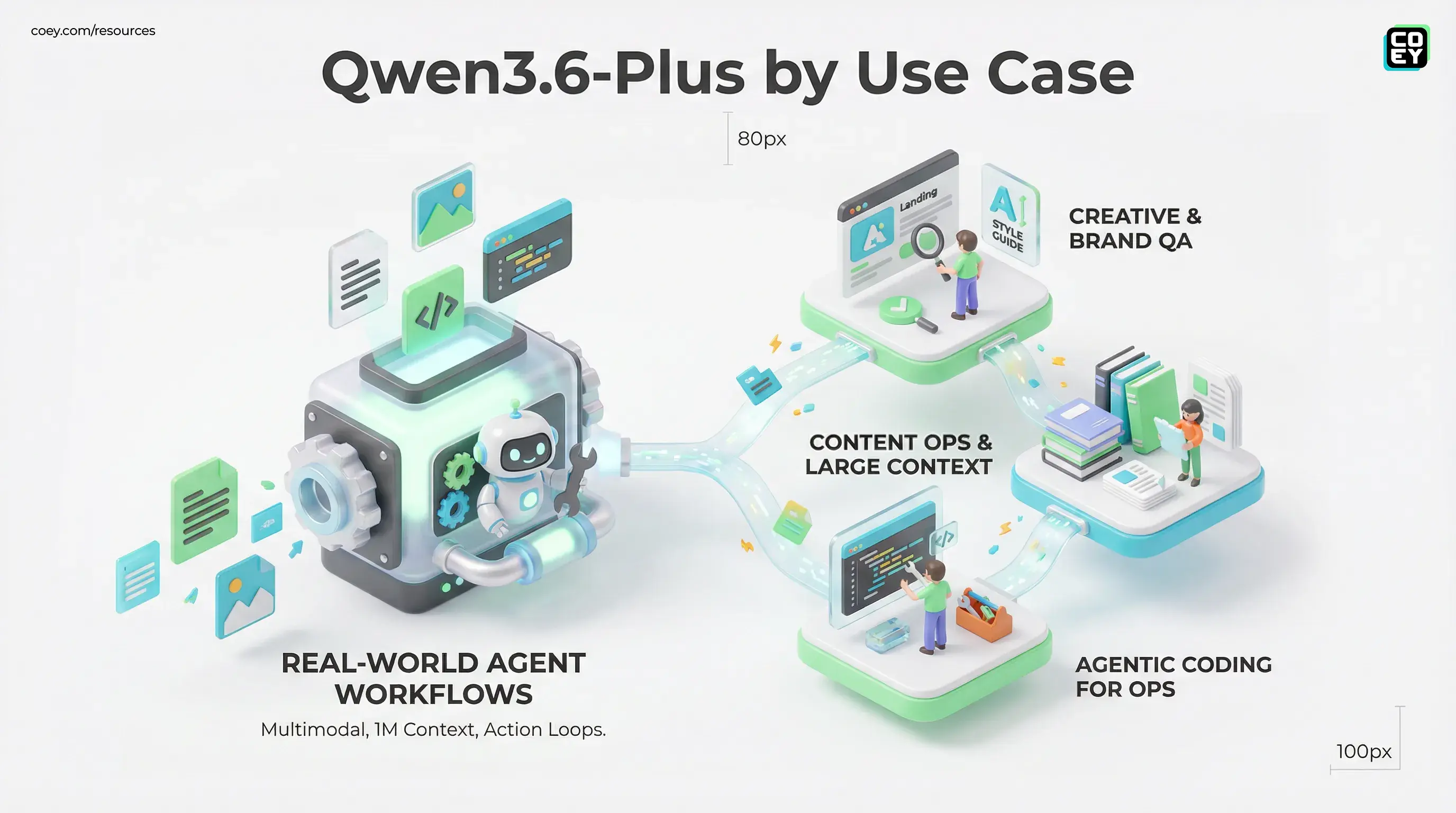
The headline here is not bigger context for the sake of a benchmark flex. It is bigger context in service of agents that can keep track of a project, a codebase, a campaign history, or a pile of messy business inputs without constantly forgetting what happened five minutes ago.
What Alibaba actually shipped
According to Alibaba’s launch materials and technical write-up, Qwen3.6-Plus is designed around a full-loop agent model: perceive, reason, act. It is tuned for agentic coding, visual understanding, document parsing, and video reasoning, with access through Alibaba Cloud Model Studio. The company is also highlighting compatibility with standard API patterns, including OpenAI-style chat completions, which matters because nobody wants to rebuild their automation stack from scratch just to test one new model.
There are a few standout capabilities behind the pitch:
- Agentic coding: Qwen3.6-Plus is positioned to plan, write, test, and refine code across larger repositories, not just autocomplete snippets and call it a day.
- Multimodal perception: It can work across text, screenshots, documents, prototypes, images, and video as part of one broader reasoning chain.
- Long context by default: The model supports up to 1M tokens in Model Studio, though pricing and operating mode vary depending on context length and whether thinking mode is enabled.
- Reasoning controls: Alibaba’s docs describe
enable_thinkingand apreserve_thinkingparameter for retaining reasoning continuity across turns.
| Capability | What Qwen3.6-Plus offers | Why teams care |
|---|---|---|
| Context window | Up to 1M tokens | Handles large briefs, repos, docs, and history in one flow |
| Input types | Text, images, docs, video | Supports mixed-media workflows without model switching |
| API posture | Model Studio, OpenAI-style compatibility | Easier integration into existing automations |
Why this matters for workflows
The most useful part of this launch is not the multimodal label by itself. Every model is “multimodal” now in the same way every startup used to be “disruptive.” The useful part is whether those capabilities reduce workflow friction.
Qwen3.6-Plus looks interesting because it aims at jobs that usually break current automations:
- keeping large project context intact
- moving between content, visuals, and code without handoffs
- handling UI and screenshot-based tasks that live outside clean text inputs
- supporting longer chains of reasoning without immediate goldfish-mode failure
For marketing and creative ops, that could translate into a more useful class of assistants. Think agents that review campaign screenshots against brand rules, parse long strategy decks, inspect landing page variants, summarize performance notes, and generate implementation tasks without splitting the work across five separate models and a prayer.
That is where the human-plus-machine angle gets real. Humans still define the goal, the taste, the claim boundaries, and the approval logic. The machine handles the repetitive scanning, sorting, drafting, and iteration. That is not replacement. That is leverage.
API access is the real story
If you only read one section as an executive, make it this one. Qwen3.6-Plus appears to be genuinely automatable, not just trapped in a branded demo box. Alibaba is offering it through Model Studio documentation and API pathways, with support for common developer protocols. That means teams can call it from custom apps, internal tools, and orchestration platforms without inventing a weird new integration layer.
There is also a preview path through OpenRouter, including a free preview route that, as of publication, lists $0 per million input tokens and $0 per million output tokens. That lowers the barrier for testing, although OpenRouter notes that prompts and completions on the preview may be used to improve the model. That does not make OpenRouter the final production answer for every team, but it does make experimentation faster. If you want to know whether this model can survive your actual use case, you do not need a six-week procurement opera before getting started.
Non-technical translation: if your workflow can call an API, Qwen3.6-Plus can likely be wired into it. The more important question is whether your workflow has proper constraints, review stages, and logging.
That is the part people love to skip. A powerful agent model without structure is just chaos with confidence.
Where it looks ready now
There are a few high-confidence lanes where Qwen3.6-Plus already looks practical.
Creative and brand QA
Because the model can process screenshots, documents, and visual inputs, it should be useful for reviewing ad assets, landing pages, and campaign exports against brand systems or content requirements. That is the kind of boring work AI should absolutely steal from your calendar.
Content ops with large context
Long briefs, old campaign references, product docs, legal notes, customer research, performance reports, most models get flaky when you jam all of that into one task. Qwen3.6-Plus is explicitly built for exactly that kind of overloaded reality.
Agentic coding for ops teams
Marketing teams increasingly need code-adjacent support: landing page fixes, analytics QA, feed cleanup, internal dashboard glue, CMS transformations. A model that can hold repo context and iterate through bugs is far more useful than one that only writes pretty sample code.
| Use case | Readiness | What human review still does |
|---|---|---|
| Brand and asset QA | High | Final approval on risky or ambiguous outputs |
| Long-context research and planning | High | Strategic judgment and prioritization |
| Autonomous publishing or deployment | Medium at best | Permissioning, sign-off, and rollback control |
Where the hype needs a timeout
Let’s keep this grounded. Qwen3.6-Plus may be agent-ready, but that does not mean every team should let it run wild like an intern with admin access and a Celsius.
Three practical limits still matter:
- Model capability is not workflow safety. You still need approval gates, structured outputs, and audit trails.
- Benchmarks are not your environment. Real stacks have weird data, legacy systems, and failure modes that no launch post wants to discuss.
- Preview access is not governance. If you are testing through third-party routes, data handling and production suitability need a separate look.
So yes, this release feels more practical than the average “look, it can think” announcement. But practical does not mean turnkey. It means the model is finally shaped more like infrastructure and less like a toy.
What this signals for the market
Qwen3.6-Plus reinforces a broader shift we have been tracking: the race is moving from smartest chatbot to most usable agent substrate. That means context size, multimodal grounding, API compatibility, and loop reliability matter more than one-off wow moments.
If you want background on how Qwen has been moving in this direction, our earlier coverage of Qwen3.5-397B-A17B showed the same pattern: less “chat buddy,” more “workflow component.” Qwen3.6-Plus sharpens that strategy with deeper agent positioning and stronger emphasis on real-world action loops.
Bottom line: Qwen3.6-Plus is one of the more credible recent launches for teams building AI into actual operations. The multimodal support is useful, the up to 1M-token context window is genuinely important, and the API story suggests it can plug into automation stacks today. It is not magic, and it is not self-managing. But for organizations trying to scale creativity through human plus machine collaboration, this is the kind of release worth testing seriously, because it looks built for work, not just vibes.
Modernize Your Marketing With AI Agents
COEY deploys coordinated AI agent teams using n8n, Claude Cowork, and OpenClaw that compress marketing timelines from weeks to hours. See how our agentic automation works across every marketing channel, or request a proposal.
Related: How to Build an AI Content System – The Full Playbook for Brands and Agencies.
For marketing leaders ready to turn AI strategy into production workflows, explore the Executive AI Accelerator.