Anthropic Introduces Claude Opus 4.7: Reliability Becomes the Product
Anthropic Introduces Claude Opus 4.7: Reliability Becomes the Product
April 18, 2026
Anthropic has introduced Claude Opus 4.7, and the most important part of the release is not bigger benchmark flexing or another “the model is smarter now” victory lap. The real story is that Anthropic is pushing Claude further into production territory with built-in output verification, a new xhigh effort mode, beta task budgets, higher-resolution vision input handling, and a deeper review flow inside Claude Code. In other words: less “look what AI can do in a demo,” more “can this survive contact with an actual workflow?” That is a much better question, and frankly one the market needs more of.
For executives and marketing operators, this matters because the biggest blocker in AI automation has never just been raw capability. It has been trust. Can the model stay accurate enough to reduce rework? Can you control cost when an agent starts thinking with the enthusiasm of a consultant on hourly billing? Can you actually plug it into a system and know what happens next? Opus 4.7 looks like Anthropic’s answer to those questions.
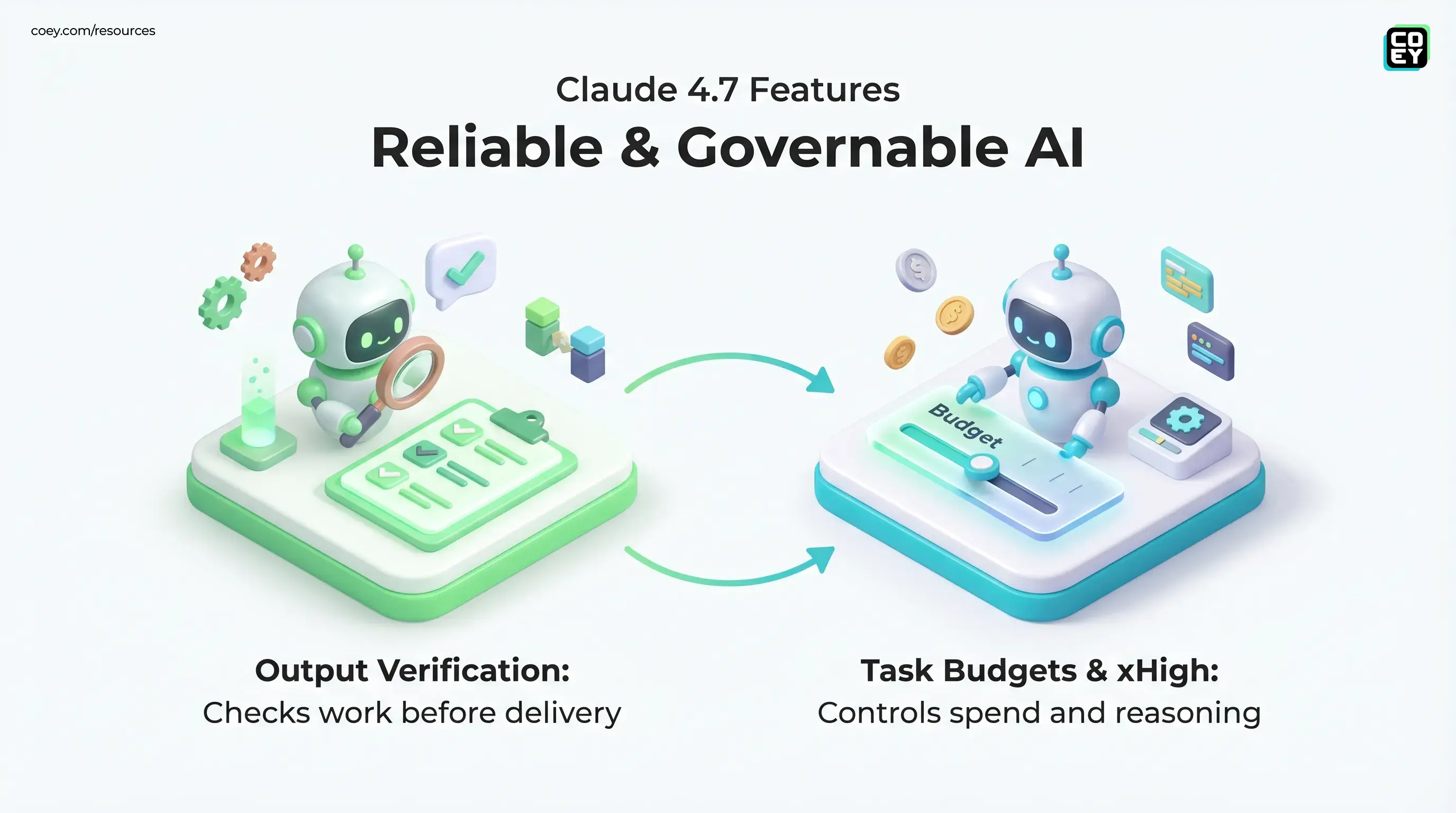
The practical shift: Claude Opus 4.7 is less about making AI feel magical and more about making AI feel governable.
What actually changed
Anthropic’s update lands across four areas that matter in real work, not just on launch threads:
- Output verification to check responses before they are returned
- xhigh effort as a new reasoning level between high and max
- Task budgets in beta for managing multi-step token spend
- Higher-resolution vision input for more reliable screenshot and document analysis
There is also a notable upgrade on the developer side. Claude Code now includes /ultrareview, a deeper cloud-based multi-agent code review command aimed at more rigorous analysis before changes ship. That is a coding feature, yes, but it also matters for marketing teams managing web properties, landing pages, tagged scripts, and other “why is the CTA button suddenly broken in Safari” forms of modern suffering.
Reliability gets first billing
The headliner here is output verification. Anthropic is explicitly targeting one of the oldest AI pain points: plausible-looking wrongness. Anyone running AI inside content, research, or reporting workflows knows the drill. The draft looks polished, everyone relaxes, and then some quiet little error slips through wearing a blazer.
With output verification, Claude checks its own work before returning it. That does not make hallucinations disappear into the void. It does mean Anthropic is adding a native reliability layer instead of pretending prompting alone will save everyone. That is a meaningful product choice.
For marketers, this matters most in repeatable tasks:
- campaign summaries that must reflect real source material
- executive briefings where confidence matters more than clever phrasing
- structured content generation that feeds into CMS, CRM, or reporting systems
- claims-sensitive copy where “close enough” is not cute
The upside is not perfection. The upside is less cleanup. In human-plus-machine systems, that is the real multiplier. If your people spend their time correcting every second paragraph, you do not have automation. You have a very expensive intern with excellent grammar.
Why xhigh matters
The new xhigh effort setting sits between Anthropic’s existing higher-end reasoning modes. In plain English, it lets teams ask Claude to think harder without going all the way to the most expensive, slowest path.
That sounds small. It is not.
One of the biggest workflow mistakes teams make is treating all AI calls like they deserve the same amount of compute. They do not. A quick classification job should not cost the same as a high-stakes strategy memo. A metadata pass should not use the same reasoning profile as regulatory language or a board-facing summary.
| Task type | Best fit | Why |
|---|---|---|
| Bulk drafting and transforms | Standard or high | Faster and cheaper for repeatable work |
| Critical analysis and summaries | xhigh | More depth without max-level overhead |
| Most expensive edge cases | max | Reserve for truly high-risk tasks |
This is exactly how production AI should work: route different jobs to different effort levels based on business value. If your workflow tool can call an API, then yes, this can be automated. That means n8n, Make, custom internal apps, and other orchestration layers can assign more expensive reasoning only where it earns its keep.
Task budgets are the adult feature
If xhigh is about quality control, task budgets are about not accidentally giving your agent a corporate Amex and a dream.
Anthropic is introducing task budgets in beta so developers can guide how much token spend a multi-step task should consume overall. This is especially relevant for agentic flows where the model may reason, call tools, inspect outputs, retry, and keep going. Great when it works. Less great when it burns through budget like it is auditioning for a finance cautionary tale.
Task budgets are not the same as a hard kill switch on every token. They are more like a planning and containment layer for longer-running work. For workflow builders, that is a big deal because it moves cost awareness closer to the model behavior itself.
Translation for non-technical teams: task budgets make AI automation more predictable, which is executive catnip for good reason.
This is one of the clearest signs that Anthropic understands where the market is going. AI is maturing from “how smart is it?” to “can we govern it at scale?” That shift is overdue.
Vision got more operational too
Anthropic says Opus 4.7 supports more than three times higher image resolution than the prior generation, improving screenshot and document analysis. That sounds like a spec sheet footnote until you remember how much business data still arrives in cursed visual formats.
Think screenshots, slide decks, PDFs, exports from random enterprise tools, UI captures, product mockups, analytics panels, and documents that were clearly designed by someone who hates copy-paste. Better vision resolution means better extraction and interpretation from those materials, with less pre-processing and less manual cleanup.
That creates more realistic workflows for:
- turning slides into summaries or blog-ready notes
- extracting competitive intelligence from screenshots
- reading dashboards and reports for narrative reporting
- repurposing design or product artifacts into structured inputs
This is not a flashy consumer feature. It is a workflow feature. And those are usually the ones that last.
Claude Code gets deeper review
The new /ultrareview command in Claude Code adds a more intensive, cloud-based multi-agent code review step. For engineering teams that is obvious value. For marketing and ops teams, the relevance is more indirect but still real.
Modern marketing runs on code more than many teams want to admit. Landing pages, analytics tags, tracking scripts, custom web experiences, personalization logic, ecommerce tweaks, and campaign microsites all create surface area for bugs. A deeper automated review layer can reduce the risk of shipping broken experiences just because a launch timeline got spicy.
Can this be automated? In a development environment, yes. It can fit into CI-style flows and review pipelines, though ultrareview itself runs remotely in Claude Code rather than as a generic API feature. For non-technical teams, the takeaway is simple: Anthropic is trying to make Claude more useful inside systems, not just inside chats.
What is ready now
Opus 4.7 looks materially more stack-ready than many AI releases because the core features sit inside the API story, not outside it. Anthropic’s developer documentation and pricing surfaces already frame Claude as an API-first product family, and this release deepens that posture rather than detouring into pure app theater. Claude Opus 4.7 is available through Anthropic’s API and Claude plans, and Anthropic has also said availability extends to Amazon Bedrock, Google Vertex AI, and Microsoft Foundry. If you need the broader context on why that matters, COEY has already covered why API access is the real dividing line in AI stacks.
| Question | Answer now | What it means |
|---|---|---|
| Can you automate Opus 4.7? | Yes | Usable in orchestrated workflows and internal tools |
| Are the new controls stack-relevant? | Yes | Better cost and quality management in production |
| Is it fully risk-free? | No | Human review still matters for high-stakes outputs |
That last line matters. Output verification is helpful. It is not a substitute for brand review, legal review, or basic operational common sense. Machines can assist, enhance, and accelerate. The spark of intent and the final judgment still belong to people. That is not a bug in the workflow. It is the whole point.
Bottom line
Claude Opus 4.7 is one of the more mature AI releases in recent memory because it focuses on reliability, controllability, and automation posture instead of just IQ theater. Output verification reduces silent mistakes. xhigh effort gives teams a more practical quality tier. Task budgets bring much-needed spend discipline to agentic flows. Better vision and deeper code review widen the set of tasks Claude can handle with less babysitting.
Anthropic’s current standard API pricing for Claude Opus 4.7 is reported at $5 per million input tokens and $25 per million output tokens.
That does not make Opus 4.7 magic. It makes it more usable.
And in production AI, usable beats magical almost every time. Magical gets a demo. Usable gets wired into the machine.