
Google has brought Veo 3.1 Lite to Vertex AI, adding a lower-cost video generation tier aimed at teams that need volume, not just wow-factor. That distinction matters. Generative video has spent plenty of time being the main character on the timeline, but for most brands the real question is less “Can it make something cool?” and more “Can it make 200 usable variants without setting the budget on fire?” Veo 3.1 Lite is Google’s clearest answer yet to that workflow reality.
The release pairs a cheaper text-to-video and image-to-video model with a separate upscaling path on Vertex AI, giving teams a more practical draft-to-deliver pipeline. In plain English: generate fast, pick winners, then enhance only what earns it. That is a much better story for marketing ops than brute-forcing every concept at premium quality and hoping finance doesn’t notice.
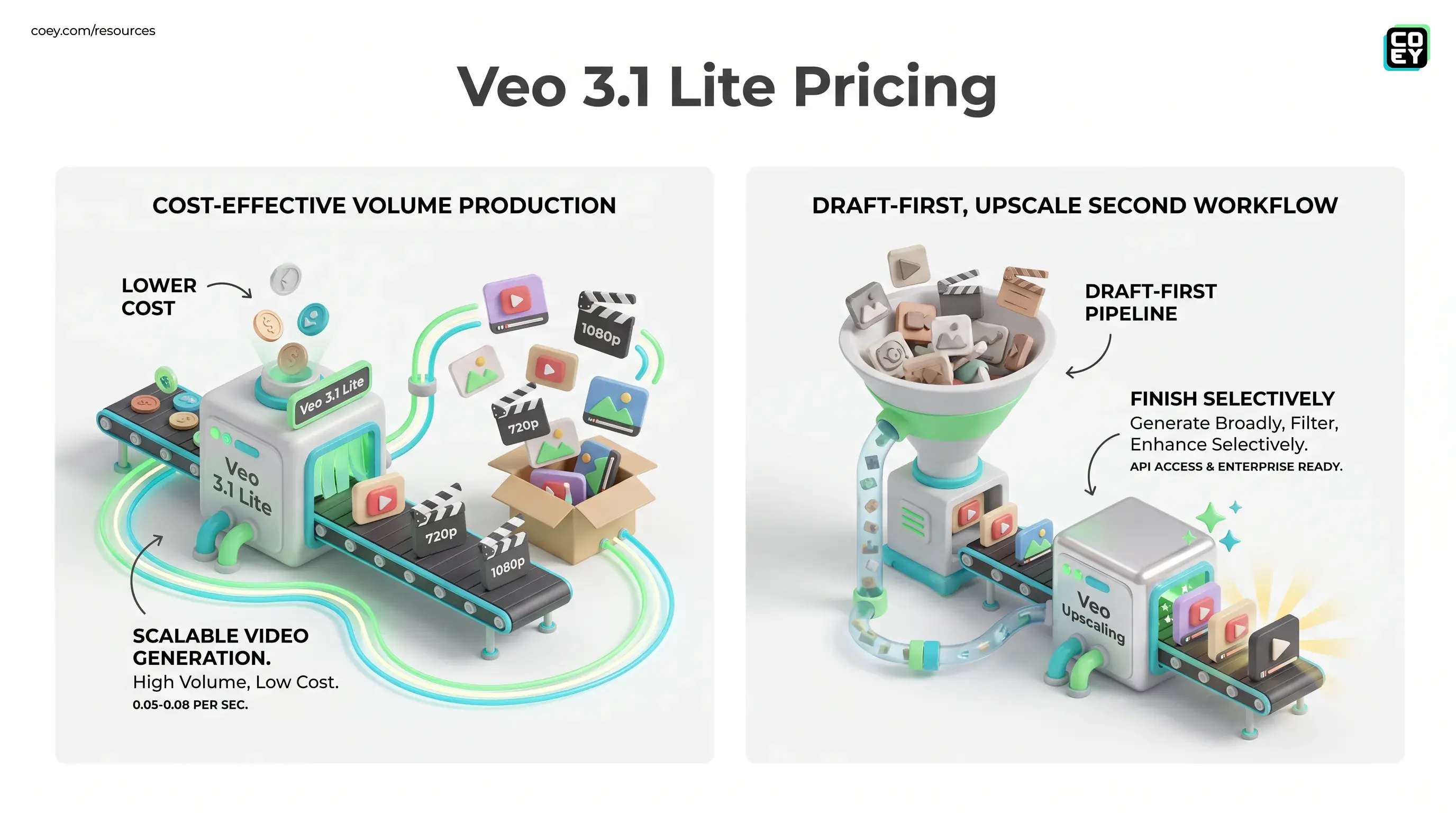
The shift here is operational: AI video is moving from prestige demo to scalable production component.
Why Lite matters more than flashy
Veo 3.1 Lite is positioned as the lowest-cost tier in the Veo 3.1 family, built for high-throughput generation on Google’s cloud stack. It supports both text-to-video and image-to-video workflows, with outputs in 720p or 1080p, plus landscape and vertical formats. That last part is not a cute bonus. It is the difference between a model built for modern content distribution and one still pretending every campaign ends in a horizontal hero cut.
Google’s move is straightforward: not every workflow needs the fanciest model. A lot of real-world content work is repetitive by design. Think product promos, regional variants, social cutdowns, ad concept testing, simple explainers, and evergreen brand assets. Those jobs reward speed, affordability, and repeatability more than cinematic perfection.
That is where Veo 3.1 Lite gets interesting. Google says it costs less than half as much as Veo 3.1 Fast while maintaining the same generation speed. For creative teams, that means more swings. For executives, it means the unit economics of AI video are starting to look less like R&D and more like an actual line item you can justify.
What Google is actually shipping
The Veo 3.1 Lite rollout on Vertex AI comes with a clean value proposition: cheaper generation, API access, and enterprise-friendly deployment. It is not the full everything-bagel version of Veo. Lite is capped below 4K for native generation, and the current Vertex AI Veo documentation limits Veo 3 generation to short clips, generally 4, 6, or 8 seconds, with support for 720p and 1080p output. Google is not pretending this is the one model to rule them all.
| Capability | What Veo 3.1 Lite offers | Workflow impact |
|---|---|---|
| Generation modes | Text-to-video and image-to-video | Useful for prompt-based ads, animated product shots, and content variants |
| Output formats | 720p or 1080p, in 16:9 or 9:16 | Fits social, promo, and mobile-first campaign needs |
| Access layer | Vertex AI APIs and cloud controls | Can be automated, monitored, and routed through real business systems |
That last row is the one that matters most. If a model sits inside a pretty interface but cannot plug into your stack, it is a demo with good PR. If it has API access inside an enterprise platform, now we are talking about something that can feed a production workflow.
The draft-first video pipeline gets real
Google is also rolling out a Veo upscaling capability on Vertex AI, including the ability to enhance selected videos to higher resolutions, up to 4K in supported workflows. Combined with Lite, this creates a sensible two-step production pattern: cheap generation first, higher-fidelity finishing second.
This is exactly how grown-up creative ops should want it. You do not need every rough concept rendered like it is premiering at Sundance. You need enough quality to evaluate the idea, compare variants, and decide what deserves polish. Then you spend more on the finalists.
That model mirrors how smart human teams already work:
- Ideate broadly with lower-cost drafts
- Filter aggressively using brand, performance, and stakeholder feedback
- Finish selectively for paid media, client delivery, or premium placements
In other words, Lite is not about replacing creative judgment. It is about making judgment cheaper to exercise. That is a much healthier use of AI than treating every generation like a final answer handed down from the machine heavens.
Can you automate it? Yes, mostly
Here is the practical read for non-technical teams: Veo 3.1 Lite is available through Vertex AI, which means it is exposed through APIs and wrapped in the same broader Google Cloud environment many companies already use for identity, permissions, storage, and governance. Translation: this is automatable.
That makes several real workflows possible:
- Batch generation: produce many video variants from one campaign brief or product feed
- Trigger-based creation: generate new assets when a SKU changes, a launch goes live, or a localization request lands
- Review pipelines: route outputs to human approval before publication or upscale
- Asset handoff: move selected clips into storage, editing, DAM, or scheduling systems
Google has also been expanding creative tooling across its broader Veo ecosystem, including vertical output options and broader developer access through Gemini API, Google AI Studio, and Vertex AI. Veo 3.1 Lite fits that same larger direction: less novelty, more workflow logic. If you want the surrounding context, COEY already covered how Veo 3.1 finally shipped true vertical AI video.
Reality check: API access does not magically make a workflow autonomous. You still need approval gates, prompt discipline, brand checks, and budget rules unless your strategy is “ship first, apologize in Slack later.”
Where it is ready now and where it is not
Veo 3.1 Lite looks most ready for high-volume, short-form, repeatable use cases. Think performance marketing, ecommerce motion assets, campaign localization, social experimentation, internal comms, and templated content production. If your team already works in variants and iterations, Lite slots in naturally.
It is less convincing for jobs that demand heavy narrative control, longer sequences, or frame-perfect brand nuance. That does not make the model weak. It just means the target use case is practical content throughput, not auteur cinema. Frankly, more AI product launches could use that level of honesty.
| Use case | Readiness | Why |
|---|---|---|
| Social ad variants | High | Short duration, multiple versions, strong fit for batch generation |
| Product animation from stills | High | Image-to-video makes catalog content more dynamic without full shoots |
| Premium brand storytelling | Medium to low | Still needs tighter control, human editing, and selective finishing |
Why this matters for marketing teams
For marketers, the biggest unlock is not “AI video exists.” We have been there. The unlock is that cheaper generation plus cloud-based APIs makes video behave more like a system component. That means teams can test more creative, localize faster, and reduce the manual drag between concept and launch.
For executives, the signal is even simpler: Google is making generative video easier to operationalize inside existing enterprise infrastructure. That lowers friction for procurement, governance, and adoption. It also raises the bar for every other vendor promising magic while quietly hiding the API or locking the good stuff behind a UI garden wall.
Google’s broader Veo 3.1 Lite announcement frames the model around affordability for developers building video-heavy applications, while the Vertex AI documentation shows where the product is meant to live: inside programmable workflows, not just creator playtime.
The bigger signal from Google
Google is not just shipping a smaller model. It is shaping a production ladder: consumer experimentation in Gemini and related tools, developer access through APIs, and enterprise deployment in Vertex AI. Veo 3.1 Lite strengthens the middle of that ladder by giving teams a lower-cost entry point for serious usage.
That is the part worth paying attention to. The future of AI video will not be won by the prettiest one-off sample on X. It will be won by the platforms that let humans direct the work, machines multiply the output, and businesses keep the whole thing governed enough to survive legal review.
Veo 3.1 Lite does not make AI video perfect. It does make it more economical, more programmable, and more realistic for day-to-day content operations. And honestly, that is the kind of update that matters most. Less cinematic chest-thumping, more usable throughput. The robots are finally getting a little better at respecting the budget.