
Claude Fable 5 Is Back, With a Credit Meter Attached
Claude Fable 5 Is Back, With a Credit Meter Attached
July 6, 2026
Anthropic has restored global access to Claude Fable 5, bringing its top publicly available Mythos-class model back into the hands of creators, enterprises, developers, and automation teams after a short but very real access disruption. The model is available again through Anthropic’s own surfaces, including Claude.ai, the Claude Platform, Claude Code, and Claude Cowork, with availability through partner platforms depending on region, plan, and provider rollout. But the comeback comes with a business-model footnote that is not really a footnote at all: Fable 5 is moving behind usage credits for many subscription users who previously had temporary included access.
That makes this more than a “model is back online” story. It is a signal that frontier AI is becoming both more capable and more metered. The free-sample era is narrowing. The premium models are moving closer to utility pricing. And teams that have been casually piping flagship AI into workflows like it was an unlimited office snack drawer now need to think harder about routing, budgets, and production controls.
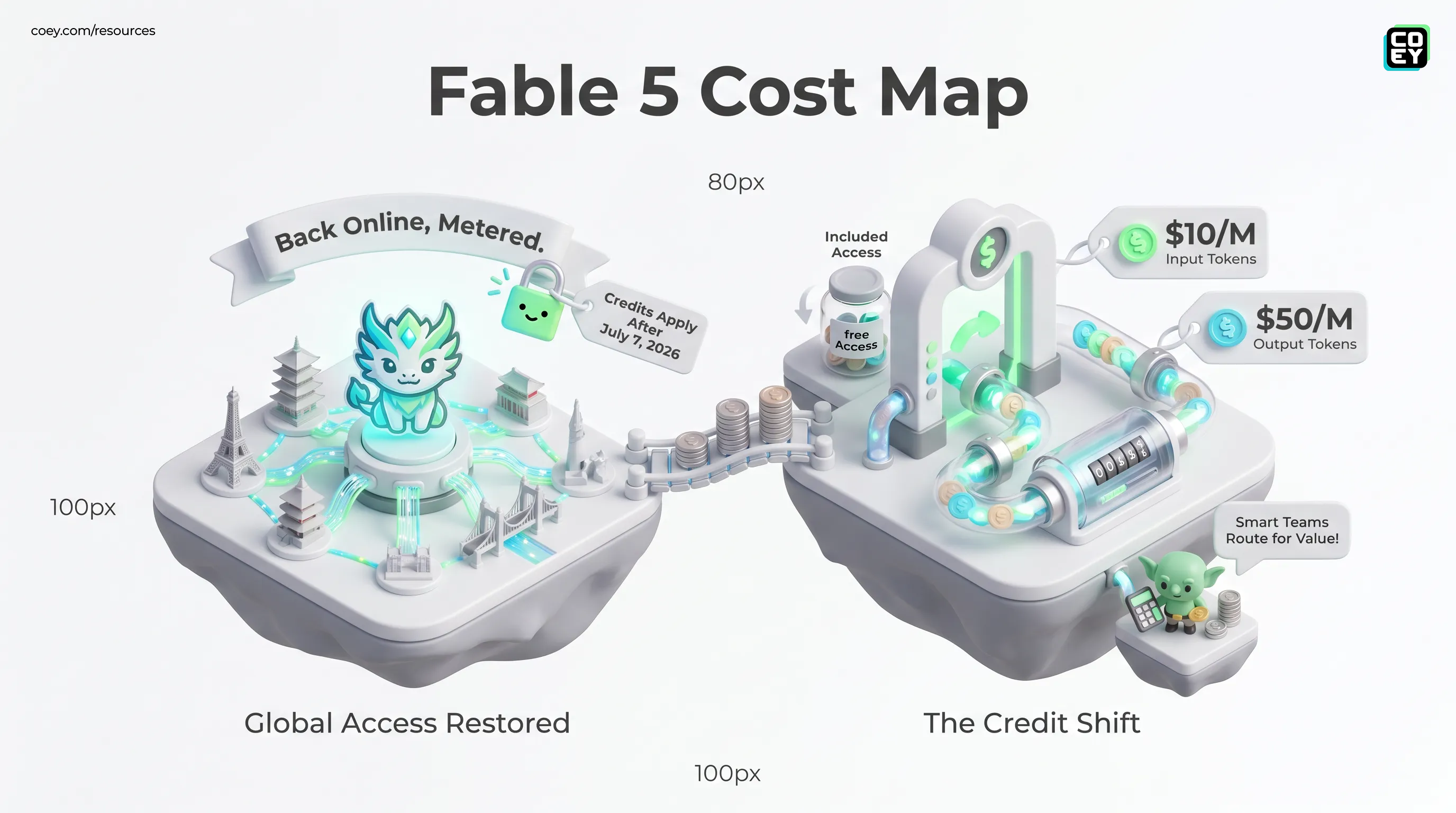
The short version: Claude Fable 5 is globally usable again, automation-ready through APIs, and expensive enough that smart teams should treat it like a premium creative engine, not a default setting for every task.
What Anthropic Restored
Claude Fable 5 was introduced as the broader-access sibling of Claude Mythos 5, built on the same underlying Mythos-class capability family but wrapped in additional safeguards for general use. Anthropic positioned it for advanced reasoning, long-context work, coding, research, and complex language tasks where weaker models start sweating through their little silicon shirts.
The disruption came from export-control concerns around high-capability models after a reported jailbreak technique could push Fable 5 toward high-risk vulnerability and exploit behavior. Because the restrictions applied to access by foreign nationals, and because reliably enforcing that in real time across global products is not exactly “just add a checkbox” territory, Anthropic temporarily disabled access more broadly. The restoration followed additional safety work, including a new classifier aimed at blocking that specific class of high-risk exploit behavior. Anthropic says the new safety layer blocks the problematic behavior in more than 99% of cases and can reroute certain blocked requests to Claude Opus 4.8.
Now Fable 5 is back globally under standard access, while Mythos 5 remains much more restricted and is currently limited to select U.S.-based, government-approved organizations. That matters for distributed teams that had workflows paused, rerouted, or awkwardly held together with duct tape and Slack apologies. Global Fable 5 access restores predictability for teams using Claude in content systems, research operations, coding workflows, customer support augmentation, or internal knowledge automation.
The Credit Shift
The bigger operational change is billing. When Anthropic introduced Claude Fable 5 and Claude Mythos 5, Fable 5 had a limited period of included usage for certain Claude subscription plans. That grace period is ending on July 7, 2026, and continued Fable 5 use is set to require usage credits for many Pro, Max, Team, and seat-based Enterprise customers after that window. API and usage-based enterprise customers were already living in token-metered reality, so this is less of a plot twist for them and more of a “welcome to the club, everyone else.”
Anthropic’s published Fable 5 pricing places it at $10 per million input tokens and $50 per million output tokens. Translation: what you send to the model costs money, and what it writes back costs more. Long answers, giant prompts, repeated retries, and poorly designed automations can turn into a tiny finance goblin very quickly.
| Item | Current Signal | Workflow Impact |
|---|---|---|
| Global access | Restored globally under standard access | Paused workflows can restart |
| Billing | Included-use window ends July 7, then usage credits apply for many users | Budget controls now matter |
| API access | Available through Claude Platform | Automation is viable |
Why Fable 5 Matters
Fable 5 is not interesting because it can write a nicer paragraph. Plenty of models can produce polished copy now, and half of them still sound like they were trained inside a B2B webinar waiting room. Fable 5 matters because it sits near the top of Anthropic’s capability stack while remaining broadly available enough for real teams to use.
Its practical value is in high-context, high-judgment work: synthesizing large research sets, drafting strategy documents, analyzing messy source material, writing nuanced campaign concepts, handling complex coding tasks, or acting as a reasoning layer inside agents. In COEY terms, this is the kind of model you use when human intent needs serious machine amplification, not when you need 400 metadata descriptions before lunch.
That distinction is crucial. The smartest AI operations do not send every task to the biggest model. They route work based on value. Fable 5 should handle the tasks where better reasoning, deeper synthesis, and more careful language justify the premium. Cheaper models should handle the repetitive grind.
Sonnet Takes The Volume Work
Anthropic’s lineup now makes that routing logic more obvious. Fable 5 is the premium public Mythos-class model. Mythos 5 remains more restricted and aimed at approved, sensitive environments. Claude Sonnet 5, which COEY recently covered as Anthropic’s push from chat toward workflow, is the more practical default for many agentic and high-volume business tasks. As of July 6, 2026, Sonnet 5 is Anthropic’s latest Sonnet model and is available across Claude apps and the Claude Platform, with introductory API pricing reported through August 31, 2026.
For marketers, this is where the money gets real. A campaign system might use Sonnet 5 to classify briefs, generate first-pass variants, summarize customer feedback, prepare CMS fields, and check brand rules. Then it escalates to Fable 5 only for the strategic layer: positioning, narrative architecture, executive synthesis, or final premium creative passes.
This is not just cost optimization. It is better system design. Asking your most expensive model to rename files, format JSON, or summarize a three-line form submission is like hiring Beyonce to sing your microwave timer. Iconic? Sure. Necessary? Please be serious.
API Readiness Is The Unlock
The strongest part of the Fable 5 relaunch is that it is not trapped inside a chat interface. Anthropic’s Claude Platform documentation lists Fable 5 in the API model family, with support for long context, tool use, code execution, batch processing, token counting, and related platform features where available. Exact tool availability can vary by environment, provider, plan, and beta status.
For non-technical readers, here is the useful translation: yes, Fable 5 can be automated. If your team has developers, an orchestration platform, or tools like n8n and Make that can call APIs, Fable 5 can be plugged into repeatable workflows. It can receive structured inputs from forms, CRMs, CMS platforms, databases, asset libraries, or internal knowledge systems, then return outputs that downstream tools can route, store, review, or publish.
That opens the door to workflows like:
- Campaign strategy synthesis: combine product notes, audience research, competitive inputs, and past performance into a launch brief.
- Premium content drafting: create long-form thought leadership, scripts, speeches, or executive narratives from structured source material.
- Research agents: analyze large document sets and return structured findings for human review.
- Creative QA: review messaging for tone, claims, clarity, and strategic fit before approval.
The API is the difference between “cool assistant” and “workflow component.” A model in a browser tab can help one person move faster. A model behind an API can help a team build a production system.
Where The Hype Needs Guardrails
Fable 5 is powerful, but it is not a permission slip for unsupervised automation. Anthropic’s safeguards may refuse or reroute certain high-risk requests, particularly in sensitive domains such as cybersecurity, biology, or chemistry. That is good for responsible deployment, but it also means production teams need fallback logic. If a request is rejected or handled by another model, your workflow should know what to do next instead of collapsing like a group project five minutes before presentation time.
Teams also need cost containment. Credit billing makes usage visible, but visibility is not the same as control. Automations should include model routing, request caps, alerting, logging, and human approval for high-cost or high-risk paths. This is especially true for agents that can loop, retry, call tools, or produce long outputs. Without limits, “autonomous” can become “autonomously expensive.”
| Risk | Why It Matters | Practical Response |
|---|---|---|
| Cost spikes | Output tokens are pricey | Set caps and alerts |
| Refusals | Safeguards may block or reroute tasks | Add fallback routing |
| Overuse | Premium models get misrouted | Use tiered model logic |
Real-World Readiness
Fable 5 looks ready for serious production pilots and selective deployment, especially in structured workflows where humans remain in the approval loop. It is strongest as a high-end collaborator: the model that handles complex synthesis, premium creative reasoning, and difficult knowledge work after cheaper systems have prepared the inputs.
It is less appropriate as the default engine for every repetitive marketing task. Bulk tagging, routing, formatting, simple summaries, metadata, and templated copy should usually go to lower-cost models. That is not a knock on Fable 5. It is the whole point of having a model portfolio.
For teams already building AI operations, this relaunch also reinforces the need for AI FinOps, the discipline of tracking model spend, value, and routing across workflows. COEY has covered that mindset in AI FinOps for modern marketers, and Fable 5 is exactly the kind of model that makes the practice non-optional.
The Bigger Signal
Claude Fable 5’s return is a useful snapshot of where frontier AI is heading. Access is expanding again, but with more controls. Capability is rising, but so is regulatory attention. Premium models are becoming more workflow-ready, but also more explicitly metered.
It also reinforces a lesson COEY covered in Platform Lock-In Is Coming for Your AI Stack: if your workflow depends on one vendor’s current access policy, your workflow is not fully yours. Model access, pricing, routing, fallbacks, and budget controls are now part of creative operations, not just engineering hygiene.
For creative and marketing teams, the opportunity is still huge. Fable 5 can help compress the distance between messy human intent and polished strategic output. It can read more, reason deeper, draft better, and plug into systems that remove the repetitive grind around creative work. But the winning pattern is not “send everything to the smartest model and hope.” It is human plus machine, routed intelligently: people set direction, machines accelerate execution, and systems decide which model earns the next call.
Fable 5 is back. The free ride is not. That is not bad news. It is the market growing up. Useful AI is no longer just magical. It is budgeted, connected, monitored, and built into the workflow with intent. Honestly, that is where the real magic starts paying rent.