Black Forest Labs FLUX 3 Moves AI Video Closer to Real Production
Black Forest Labs FLUX 3 Moves AI Video Closer to Real Production
August 5, 2026
Black Forest Labs has introduced FLUX 3, a new multimodal model family that pushes the company beyond image generation and into video, native audio, and action prediction. That combination matters because the AI video race is no longer just about making a pretty clip of a glass fox walking through neon rain. We have plenty of those. The bigger question is whether generative media can become useful inside real creative operations: briefs, campaigns, product launches, localization, testing, approvals, and all the delightful spreadsheet goblin work marketers pretend is “strategy.”
FLUX 3 is Black Forest Labs’ answer to that challenge. The model is positioned as a shared foundation for image, video, audio, and physical-world reasoning, built around what the company calls a “Self-Flow” training approach. In plain English: instead of treating image generation, video motion, audio, and action understanding as separate magic tricks, BFL is trying to train one system to understand how the world looks, moves, sounds, and behaves.
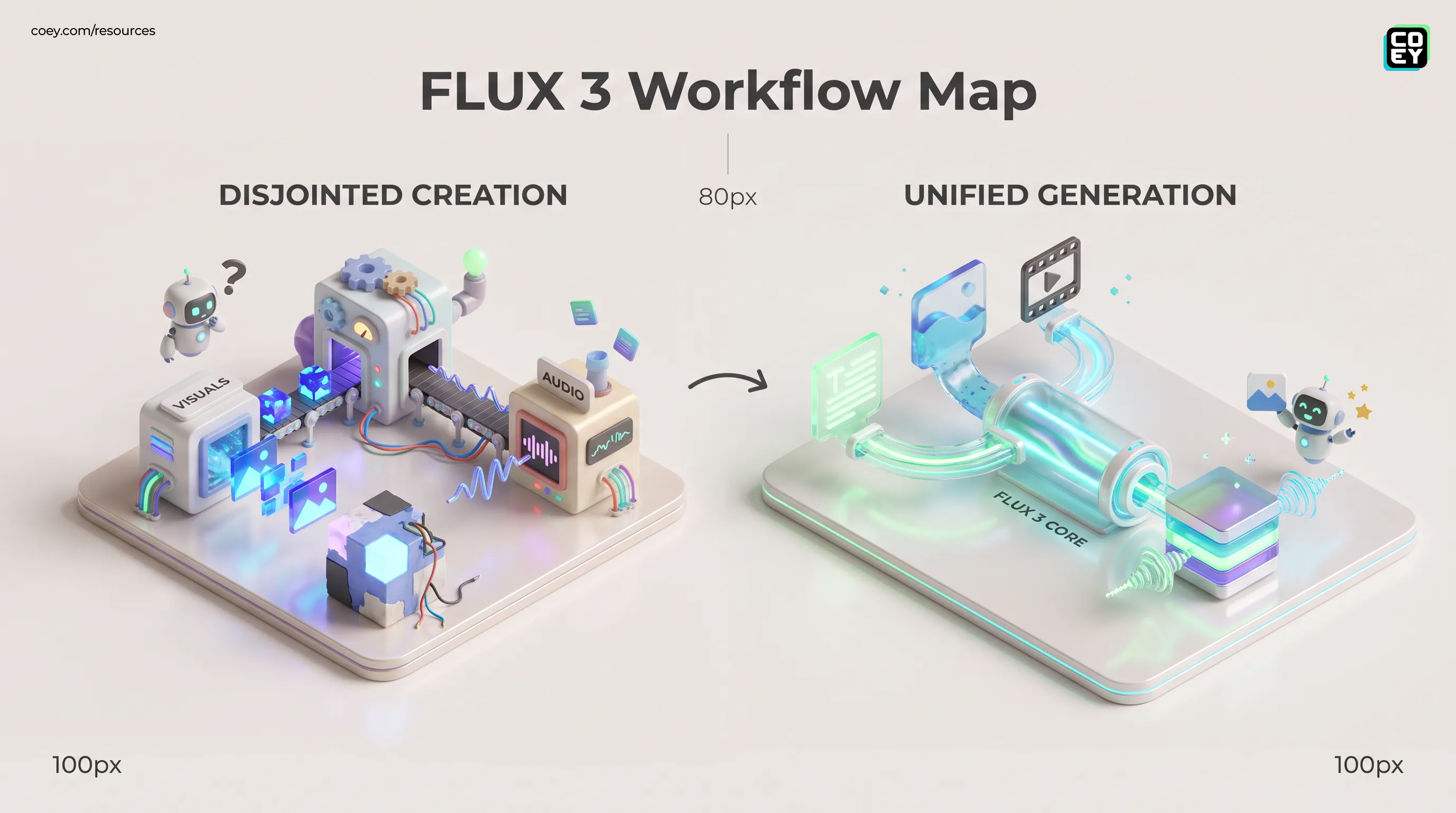
That is ambitious. It is also not the same thing as saying every brand team can plug FLUX 3 into Monday.com tomorrow and start auto-generating localized video ads before lunch. The important news is not just what FLUX 3 can do in demos. It is where it sits on the path from shiny model announcement to workflow-ready creative infrastructure.
What FLUX 3 Actually Adds
FLUX 3 extends Black Forest Labs’ footprint from still imagery into richer generative media. The headline feature is video generation with native audio: clips can include synchronized environmental sound, sound effects, and multilingual dialogue rather than requiring teams to generate visuals first and then bolt on audio afterward like a TikTok Frankenstein.
That matters for marketers because audio is not decoration. It is timing, emotional cue, pacing, context, localization, and brand feel. A generated product shot without sound is a visual draft. A generated product shot with usable ambience, synced effects, and dialogue starts to look like a campaign concept teams can actually review.
FLUX 3 also supports video generation from different input types, including prompts, reference images, existing video, and keyframes. Black Forest Labs says the early access video model supports text-to-video, image-to-video, video continuation, video-to-video style workflows, and keyframe control with up to 10 keyframes. That is a meaningful shift from the “one prompt, one mystery clip” era, where users typed a cinematic paragraph and prayed to the GPU spirits. Keyframe and reference-driven generation gives creative teams more control over continuity, composition, and brand direction.
The big leap is not simply AI video. It is controllable AI video with audio, references, and structure: the ingredients creative teams need before automation becomes more than a toy.
Early Access, Not Open Season
Here is the part executives and operators should underline twice: FLUX 3 video is not broadly available as a public, production-ready API for everyone. As of August 5, 2026, access is gated through early access programs, API or private-weight access for selected partners, and limited commercial or research collaborations. That does not make the announcement less important. It just makes it less “drop everything and rebuild your content pipeline this week.”
This distinction is where AI news often gets messy. A model can be technically impressive and still not be operationally ready. Production readiness requires more than good outputs. Teams need stable endpoints, clear pricing, usage limits, rights and licensing clarity, predictable latency, documentation, support, and governance. Without those pieces, a model is better treated as a strategic signal or pilot opportunity, not a core workflow dependency.
| Capability | Status | Workflow Impact |
|---|---|---|
| Video plus native audio generation | Early access | Useful for pilots, concepting, and partner testing |
| FLUX 3 video specs | Up to 20 seconds, 1080p native resolution, 24 fps in early access | Strong for short-form concepting, not yet a general production pipeline |
| Public FLUX 3 video API | Not broadly released | Not yet ready for scaled automation |
| Existing FLUX APIs | Available for current image models, including FLUX.2 and supported FLUX.1 models | Can support automated image workflows today |
| Open-weight FLUX 3 dev model | Expected later in 2026 | Could matter for custom infrastructure |
Why Native Audio Matters
AI video tools have been improving quickly, but many still hand off audio like it is someone else’s problem. That creates friction. If your team generates ten video concepts, then sends them to another tool for voiceover, another for sound effects, another for music, and another for editing, congratulations: you have reinvented post-production, but with more tabs open.
Native audio changes that equation. When the model understands motion and sound together, it can align footsteps, impacts, ambient noise, object movement, and dialogue more naturally. Black Forest Labs describes FLUX 3 as generating video and audio together in a shared multimodal system, including speech, sound effects, ambience, and lip sync. That does not guarantee final broadcast-quality output, but it reduces the gap between “interesting clip” and “reviewable asset.”
For brand teams, this could eventually mean faster development of social ads, product explainers, creator-style video variations, educational content, and localized campaign drafts. For agencies, it points toward a future where early creative boards are not static slides but living, sounding, moving prototypes.
The Automation Question
The most important question for COEY readers is simple: can this automate real work?
The answer is: not at full scale yet for FLUX 3 video, but the direction is promising. If and when Black Forest Labs opens stable FLUX 3 video endpoints, the automation potential becomes obvious. A campaign system could pull product data from a catalog, combine it with brand guidelines, generate multiple short video concepts, create localized audio, send drafts into review, and route approved versions into editing or ad platforms.
That is the kind of human-plus-machine collaboration that actually scales creativity. The human still defines the campaign strategy, audience insight, offer, emotion, and taste bar. The machine handles versioning, first-pass execution, localization drafts, and format expansion. Nobody gets replaced by a robot auteur wearing a tiny beret. The grind gets compressed so humans can spend more time making better creative decisions.
Where It Could Plug In
If public API access lands with mature documentation, FLUX 3 could become relevant in several workflow layers:
- Creative briefing: Turn campaign briefs, scripts, and mood boards into early motion concepts.
- Performance marketing: Generate ad variants across hooks, formats, offers, and audiences.
- Localization: Produce region-specific draft videos with synced dialogue and sound.
- Product launches: Create explainer cutdowns, feature teasers, and concept reels from structured inputs.
- Content operations: Connect generation to approval workflows, asset libraries, and campaign calendars.
That final step is the real unlock. AI tools that live only inside their own interface are fun. AI tools that connect to the rest of the stack are leverage.
API Reality Check
Black Forest Labs already operates API infrastructure for its current FLUX image models, with developer onboarding available through its API quick start documentation. That matters because BFL is not starting from zero on developer access or paid inference workflows. Its current paid API uses a credit system where 1 credit equals $0.01, and FLUX.2 image pricing is resolution-based by model tier.
That existing image-model infrastructure is also why FLUX 3 matters in the broader BFL roadmap. COEY previously covered the company’s push toward programmable image generation in FLUX.2 Makes Image Generation Finally Automatable, and FLUX 3 looks like the next step in that direction: moving from still-image automation toward richer multimodal creative systems.
But FLUX 3 video is a different operational beast. Video generation is heavier, slower, costlier, and harder to govern than image generation. Add synchronized audio and multilingual dialogue, and the system needs to manage more than pixels. It has to handle speech, timing, likeness concerns, brand safety, accessibility, rights, and review loops.
BFL’s early access terms also signal the usual caution for emerging model programs: behavior can change, access can be limited, and testing environments are not the same as production commitments. Translation for non-technical leaders: do not build a mission-critical campaign engine on an early access model unless you enjoy living dangerously and explaining outages in Slack.
Production Use Cases
The strongest near-term use case is campaign previsualization. Instead of spending days building animatics or rough edits, teams could use FLUX 3-style capabilities to show stakeholders what an idea feels like. That can speed alignment, reduce ambiguity, and help teams kill weak concepts earlier. Blessings upon any tool that prevents the phrase “can we see three more directions?” from becoming a two-week side quest.
Another strong fit is variant exploration. Performance marketers need volume: different hooks, scenes, languages, offers, and audience angles. AI video with native audio could eventually help teams produce structured sets of creative options from a single strategic brief. The human role becomes selection, refinement, compliance, and taste: the parts that actually need judgment.
But final delivery is still where teams should be careful. AI-generated video can introduce continuity errors, brand mismatches, strange physics, accidental artifacts, and legal questions around likeness or training data. For regulated categories, celebrity-adjacent visuals, children’s content, political messaging, or healthcare claims, governance is not optional. It is the seatbelt.
Why This Signals a Bigger Shift
FLUX 3 is part of a broader move from single-purpose AI tools toward multimodal creative systems. Black Forest Labs is also connecting FLUX 3 research to action prediction through projects like FLUX-mimic, which points beyond media generation into physical-world applications. FLUX-mimic uses FLUX 3 as a backbone for video-action models and has been described by BFL as being tested with partners in real industrial environments, including Audi production-line tasks. For marketers, that robotics angle may feel distant. But strategically, it shows where frontier models are heading: systems that understand not just what things look like, but how they move and respond.
That has creative implications. Better world models could mean more consistent product motion, more believable interactions, stronger scene continuity, and fewer cursed hands performing crimes against anatomy. We are not fully there yet, but the direction is clear.
What Teams Should Watch
The next milestone is not another demo reel. It is operational access. Watch for public API documentation, model IDs, pricing, rate limits, commercial usage terms, content safety controls, and examples of stable customer deployments. Those are the signals that FLUX 3 is moving from impressive announcement to usable infrastructure.
For now, FLUX 3 should be treated as a major creative technology signal with limited immediate automation availability. It shows where AI video is going: multimodal, controllable, audio-aware, and increasingly tied to production workflows. But the practical move for most teams is to test, learn, and prepare the pipeline, not pretend the future shipped fully shrink-wrapped.
The promise is real: creative teams generating more options, faster, with machines handling the heavy lift and humans steering intent, taste, and trust. That is the future worth building toward. Just maybe keep your production calendar out of early access chaos mode for now.