
Alibaba’s HappyHorse 1.0 Makes AI Video More Workflow-Ready
Alibaba’s HappyHorse 1.0 Makes AI Video More Workflow-Ready
April 29, 2026
Alibaba has introduced HappyHorse 1.0, a new video generation model that is getting attention for one reason the market actually cares about: it can generate video and synchronized audio together rather than treating sound as a separate downstream step. That may sound like a small product detail. It is not. In AI video, native audio is the difference between a clever demo and something that starts to look like real production infrastructure. If the visuals, speech, and timing arrive in one pass, creative teams spend less time doing digital duct tape work just to make a clip usable.
That is why HappyHorse matters beyond the usual benchmark flexing. Alibaba is not just claiming stronger prompt adherence and cleaner motion. The bigger signal is that the model is surfacing through developer-facing endpoints and partner platforms rather than living only inside a glossy consumer UI. For marketers, agencies, and content ops teams, that changes the conversation from “Can it make a cool clip?” to “Can this plug into a repeatable system?” Finally, the grown-up question.
The real story is not that AI video got flashier. It is that video generation is getting closer to being callable, chainable, and useful inside actual workflows.
What HappyHorse actually does
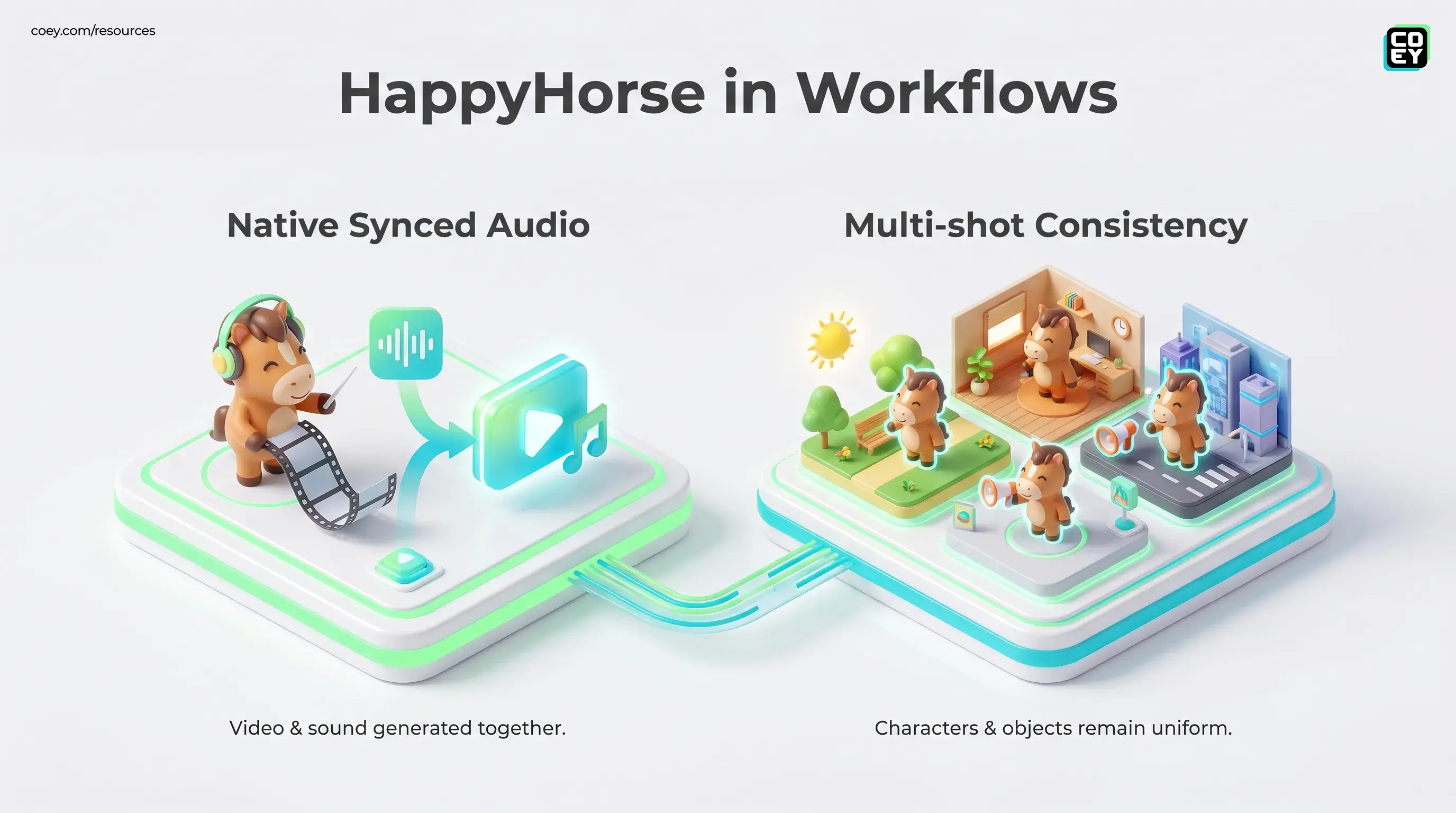
HappyHorse 1.0 is a 15B-parameter model built for text-to-video and image-to-video, with additional partner-listed support for related video workflows on some platforms. Based on current model pages and launch materials, it supports output at up to 1080p, short clips generally in the 3 to 15 second range, and multiple common aspect ratios. Those are solid specs, but they are not the headline by themselves. The standout feature is joint generation of audio plus video, including synchronized speech, ambient sound, and lip sync.
That matters because one of AI video’s most annoying recurring failure modes has been the handoff between visual generation and sound design. Teams could get a decent clip, then immediately lose half a day in voiceover, timing fixes, soundtrack alignment, or edit cleanup. HappyHorse’s pitch is that the model collapses more of that stack into one generation pass.
It is also being positioned as stronger on multi-shot consistency. That means a character, object, or environment is more likely to remain recognizable across a sequence instead of shape-shifting like the model forgot its own plot halfway through. If that holds in production testing, it is a meaningful improvement for ad concepts, branded explainers, and short narrative sequences.
| Capability | What it offers | Why it matters |
|---|---|---|
| Text-to-video and image-to-video | Works from prompts or still images | Fits both blank-page ideation and reference-led production |
| Native synced audio | Generates sound with video in one pass | Reduces post-production friction |
| Multi-shot continuity | Improved persistence across scenes | Makes story-based marketing assets more viable |
Why audio changes the equation
AI video launches love to brag about cinematic visuals. Sure. But for commercial use, sound is usually where the workflow starts falling apart. A silent clip is easy to admire and annoying to ship. Once a team has to add dialogue, sync lips, align beats, localize, and route everything into review, the labor creeps right back in.
HappyHorse’s native audio generation attacks exactly that bottleneck. If audio is generated together with the visual sequence, the clip arrives closer to a first draft instead of a half-finished asset. That is a practical win for teams making:
- short-form ads with dialogue or narration
- social promos that need sound-on relevance
- product explainers where timing matters
- concept videos for pitches and internal reviews
To be clear, this does not mean “no editor needed, everyone go home.” Audio quality, brand tone, voice selection, claims review, and final finishing still matter. But collapsing sync work into the model is exactly the kind of change that makes human-plus-machine collaboration faster instead of more chaotic.
Can you automate it?
This is where the launch gets more interesting than a typical reel dump on X. HappyHorse is appearing through partner API environments such as fal.ai’s developer coverage and Alibaba listings on provider platforms. As of late April 2026, fal.ai announced official availability, while Alibaba Cloud’s limited beta rollout has also been cited for enterprise or platform access. That suggests a genuine machine-to-machine path, even if access and feature support remain provider-dependent.
For non-technical readers, here is the plain-English translation: yes, this looks automatable. If your team uses n8n, Make, internal workflow tools, or custom apps that can send API requests, HappyHorse can potentially become a production step rather than a manual side quest.
That opens obvious workflow patterns:
- campaign triggers: approved brief in, first-pass video out
- batch variant generation: multiple hooks, scenes, or offers from one core prompt structure
- content ops routing: generate, review, tag, and archive in a DAM or CMS flow
- localization chains: adapt creative with language-specific audio where supported
That does not mean every team should wire it straight into publishing and pray. API-ready is not the same as autopilot-ready. You still need review gates, approvals, and someone responsible for making sure your AI spokesperson did not invent a second elbow or mispronounce your brand name like a sleep-deprived GPS.
| Question | Answer now | What it means |
|---|---|---|
| Can it be automated? | Yes, through partner APIs | Can fit into workflow tools and internal systems |
| Is it UI-only? | No | More useful for scale than consumer-only tools |
| Is it fully hands-off? | No | Human QA still matters for brand and accuracy |
Where it looks ready right now
HappyHorse looks strongest in the same zone where most AI video currently earns its keep: short, high-volume, variation-heavy content. Think paid social, product promos, creator-style ads, concept trailers, and internal previsualization. These are environments where speed matters, where perfect frame control is not always required, and where cutting the number of manual steps has immediate value.
For marketers, the practical upside is straightforward. A team can move from brief to rough video concept faster, generate more options per campaign cycle, and reduce the handoff load between creative, motion, and edit. That is exactly how AI should be used: not as a replacement fantasy, but as a throughput multiplier.
It also looks promising for platform and product teams building media workflows behind the scenes. Once a model is callable, it can sit behind another product experience. That means brands and agencies are not just evaluating HappyHorse as “a tool.” They can start thinking of it as a media generation layer inside a broader content system.
If you want adjacent context on how COEY has been tracking this shift from novelty to infrastructure in video, our earlier coverage of Seedance 2.0’s developer opening maps the same bigger trend: the winners will be the models that can survive real workflows, not just win launch-day applause.
Where the hype needs a leash
Now for the adult section of the internet.
HappyHorse looks impressive, but there are still real limitations to keep in view:
- Short-form remains the lane: currently available clips are still brief, generally up to about 15 seconds rather than long narrative sequences
- Access is fragmented: availability is spread across partner platforms and enterprise pathways rather than one universal public product route
- Provider differences matter: pricing, queue priority, supported features, and API behavior vary by platform
- Benchmark wins are not workflow wins: strong leaderboard placement does not automatically mean your brand asset will survive legal, compliance, and stakeholder review
There is also the classic AI video caveat: consistency is improving, not solved. A strong render rate does not guarantee that every clip will be publish-ready. Teams should still expect testing, retries, and a human decision-maker in the loop. Anyone selling “fully autonomous brand-safe video ops” today is, to put it kindly, posting through it.
Useful AI video is not about removing humans. It is about removing the repetitive glue work that keeps humans from spending time on concept, taste, and judgment.
Why this launch matters
HappyHorse 1.0 matters because it pushes AI video toward a more operational shape. Native synced audio, better continuity, and API-facing access all point in the same direction: less isolated generation, more workflow relevance. That is the lane worth watching.
For executives, the takeaway is simple. This is not just another model announcement to admire from a distance. It is a sign that video generation is getting closer to stack-level usefulness, especially for teams producing short-form content at scale. For marketers and creators, the opportunity is even clearer: faster ideation, less post-production drag, and more ways to turn human creative intent into machine-assisted output without losing control of the final result.
The pragmatic read is the right one. HappyHorse is not magic. It is not a full replacement for production teams. But it does look like a meaningful step toward AI video that can actually plug into the machine. And in this market, that is the difference between hype and leverage.