LTX-2.5 Pushes Open-Weights AI Video Toward Real Workflow Automation
LTX-2.5 Pushes Open-Weights AI Video Toward Real Workflow Automation
August 11, 2026
LTX-2.5 Pushes AI Video Into Workflows
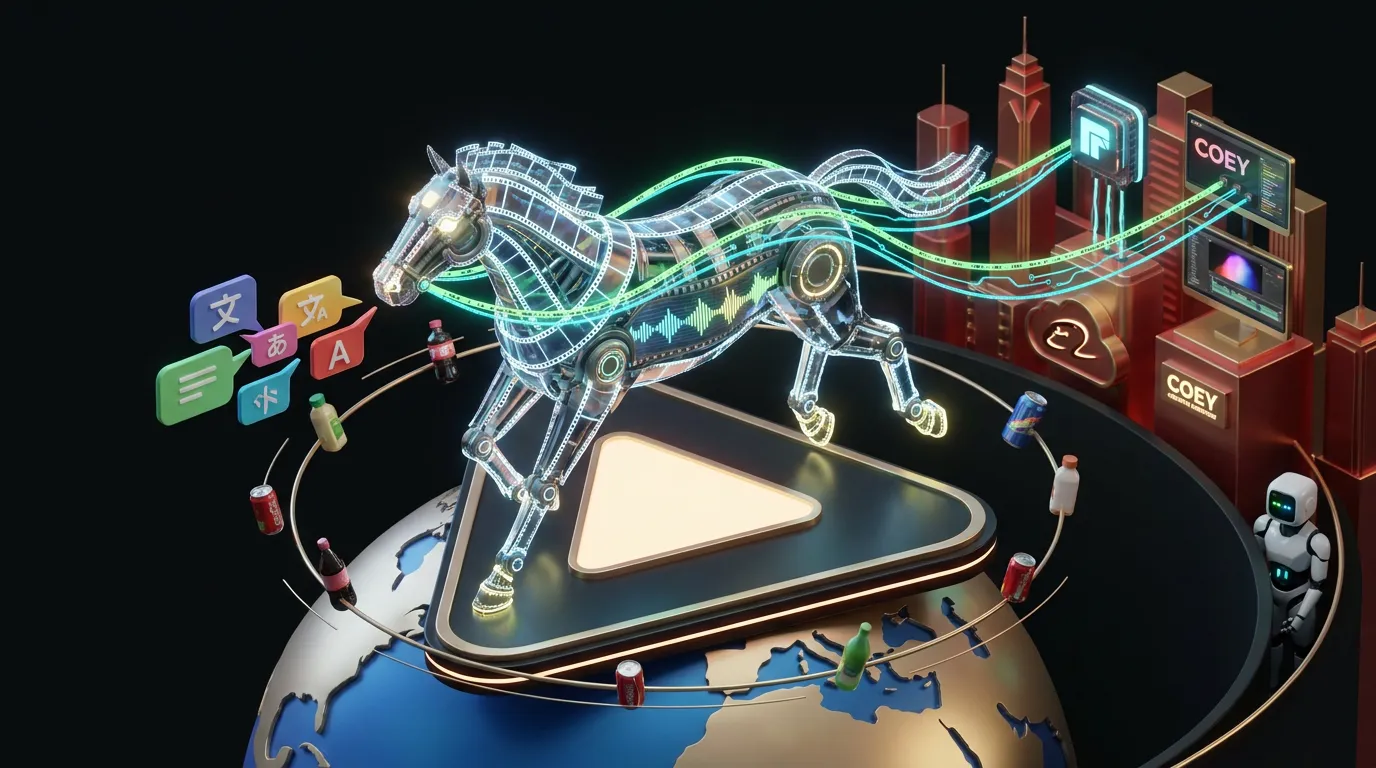
LTX-2.5, the latest open-weights video model release from Lightricks, is becoming one of the more interesting signals in AI video because it is not only chasing prettier clips. The bigger story is infrastructure: open-weights availability, local deployment potential, API-based generation, and a model family increasingly aimed at teams that need repeatable video production instead of one magical demo clip that dies in a downloads folder.
That distinction matters. AI video has spent the last few cycles living in the “look what I made with one prompt” era. Fun? Absolutely. Useful for a campaign calendar, brand governance, versioning, performance testing, compliance review, and stakeholder approvals? Not always. Sometimes the workflow has been less “future of creativity” and more “please manually export Clip_Final_FINAL_v7.mp4 and pray Slack does not compress it into soup.”
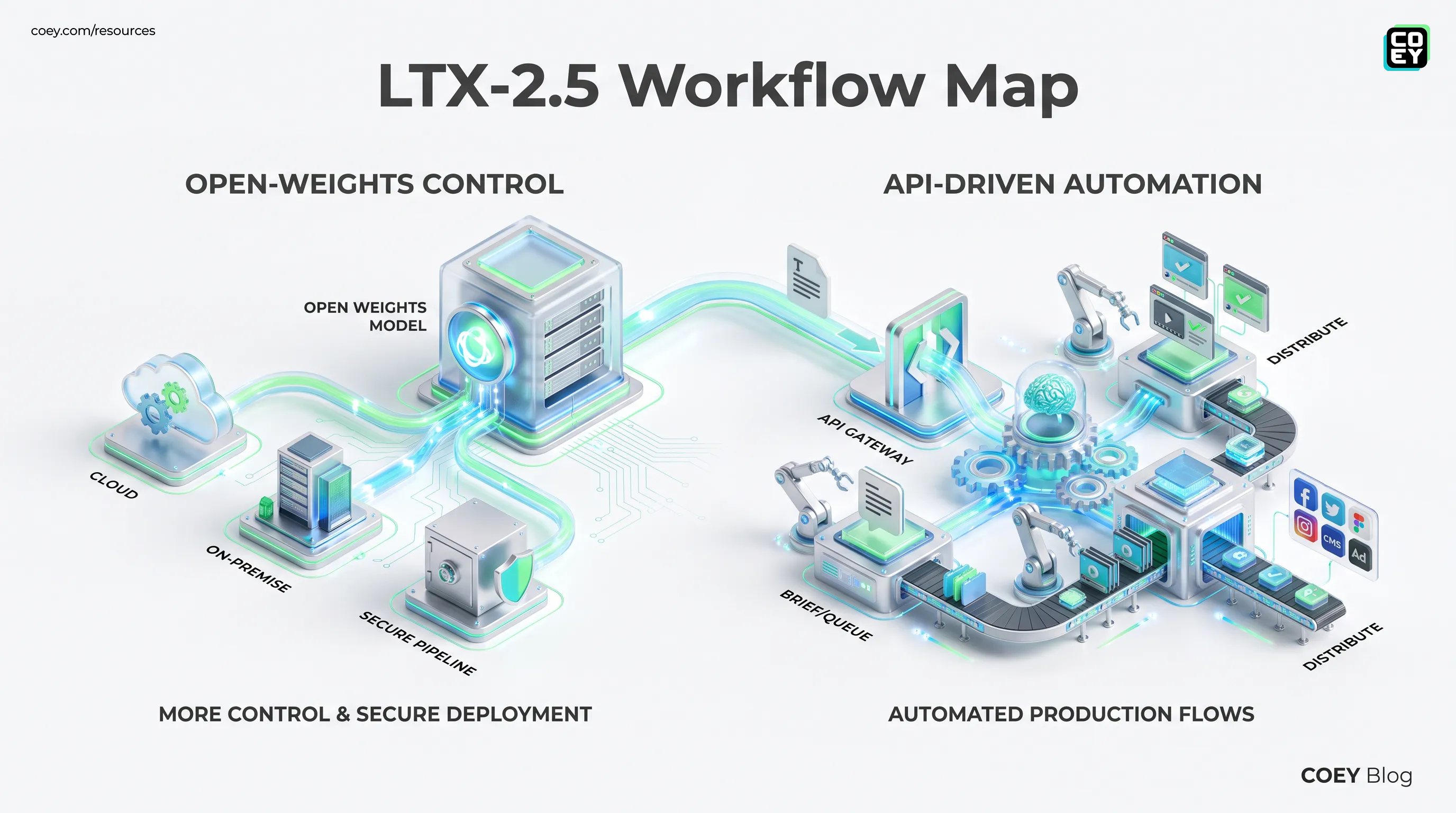
LTX-2.5 points toward a more practical version of generative video: models that can be accessed through cloud tools, distributed as weights, adapted by technical teams, and eventually stitched into the same automation systems that already power content operations. For creative leaders, marketers, and executives, the news is not just “better video.” It is whether AI video can finally become a programmable production layer.
The real unlock is not prompt-to-video. It is brief-to-versioned-campaign-asset, with humans steering the story and machines handling the grind.
What LTX-2.5 Is Trying To Solve
LTX-2.5 builds on the broader LTX-2 family, which Lightricks has positioned around synchronized audio-video generation, higher-resolution output, and more production-minded controls. The company’s earlier LTX-2 announcement framed the model family as a foundation for generating video and audio together, rather than treating sound as the awkward roommate added after the visual render is done.
That is a big deal because most AI video pain is not just about pixels. It is about continuity. Characters drift. Lighting changes. Backgrounds mutate. Motion gets weird. Audio feels bolted on. The result can look impressive in a feed for three seconds, then fall apart the moment a brand team asks for a second cut, a product mention, a specific character, and a consistent visual language across multiple placements.
LTX-2.5 is being discussed as a 22B-parameter refinement of that stack, with stronger fidelity, stronger sequence coherence, native multi-shot generation, faster generation paths, and open-weights distribution for teams that want more control than a closed browser tool can provide. The practical promise is less “make a random cinematic raccoon” and more “generate, review, revise, and route ten campaign variants without turning the creative team into file-transfer goblins.”
Why Open Weights Matter
Open weights are not a magic spell. They do not automatically make a model cheap, safe, fast, or easy. But they change the business conversation because they give organizations more deployment choices.
With a closed video product, your team typically operates inside someone else’s interface, queue, rules, rate limits, and roadmap. That can be fine for exploration. It is less ideal when a brand needs to build repeatable workflows around sensitive assets, custom templates, high-volume creative testing, or proprietary characters. Open weights, when licensing allows, let teams run the model in their own cloud environment, on-premises systems, or controlled production pipelines.
| Capability | Why It Matters | Workflow Impact |
|---|---|---|
| Open weights | More control over hosting, tuning, and deployment | Supports secure, custom pipelines when licensing allows |
| API access | Generation can be triggered programmatically | Enables automated briefs, queues, and reviews |
| Native audio-video generation | Sound and visuals can be generated together | Reduces post-production patchwork |
| Model variants and quantized builds | Teams can balance speed, fidelity, and hardware needs | Useful for drafts, local tests, and higher-quality renders |
The less glamorous but very real win: governance. If your organization works in healthcare, finance, entertainment, gaming, or enterprise brand systems, where assets are not supposed to wander off into random third-party tools like they are on a gap year, deployment control matters. Open-weights models give technical teams the option to bring generation closer to existing security, logging, and approval processes.
Automation Is The Main Event
The important question for COEY readers is simple: can this plug into the stack?
LTX maintains model documentation for supported API models and open-source integration paths, and LTX-2.5 is being made available through model repositories and related workflows. That means teams can think beyond manual prompting and toward automated production flows: campaign brief in, shot prompts generated, videos rendered, outputs routed to review, approved versions distributed to paid social, lifecycle email, landing pages, or sales enablement.
For non-technical readers, an API is basically a structured way for software systems to talk to each other. Instead of a human opening a web app, typing a prompt, waiting, downloading a file, renaming it, uploading it somewhere else, and quietly questioning their life choices, an API lets your workflow tool do those steps automatically.
In a real marketing operation, that could look like this:
- Airtable or Notion brief approved: campaign data triggers a video generation request.
- Prompt templates populate: product, audience, format, tone, and CTA are inserted automatically.
- Video jobs queue: multiple variants are generated for different audiences or platforms.
- Review links appear: drafts are sent to creative leads, legal, or clients.
- Approved assets publish: final versions move into DAM, CMS, ad platforms, or social scheduling tools.
That is where AI video stops being a toy and starts becoming operational leverage. The human still owns intent, taste, strategy, and final approval. The machine handles iteration at a speed no team wants to do manually unless the team is composed entirely of interns and Red Bull.
What Is Production-Ready?
Here is where we keep the hype in check. LTX-2.5 is exciting, but production readiness depends on how your team plans to use it.
If you are a creator or experimental brand team, early model access and open workflows can be enough to start testing immediately. If you are an enterprise team with security reviews, procurement gates, legal approvals, and brand compliance, “available” does not automatically mean “ready to run the Super Bowl campaign.” Deep breaths. Nobody needs a rogue AI-generated mascot with seven fingers becoming a compliance incident.
| Use Case | Readiness | Best Fit |
|---|---|---|
| Concept development | High | Storyboards, mood films, pitch visuals |
| Social ad variants | Medium-high | Rapid testing with human review |
| Regulated campaigns | Medium | Needs secure deployment and approvals |
| Final broadcast assets | Case-by-case | Requires QA, licensing, and finishing |
The API story is also nuanced. LTX’s documented API support is real for the broader model ecosystem, but teams should confirm exactly which LTX-2.5 capabilities are exposed through their chosen cloud endpoint, which require local inference, and which are still emerging through community workflows or model repositories. Translation: do not build your Q4 content engine on a feature you saw in a Discord screenshot. Test the actual endpoint. Validate the latency. Check the licensing. Run the boring procurement checklist. Boring is where production lives.
The Creative Workflow Shift
For marketers, the strategic impact is speed plus variation. Traditional video production often makes every new version expensive: new edit, new export, new localization, new format, new budget conversation that starts with “just a quick tweak” and ends with everyone staring into the middle distance.
AI video models like LTX-2.5 shift more of that work into dynamic generation. A brand team could create multiple cuts for different customer segments, generate localized visual concepts, produce internal sales explainers, or test motion-first creative before investing in live production. Agencies could use it to accelerate pitch work and previsualization. Media teams could prototype scenes before sending work into full animation, VFX, or editorial pipelines.
This is also part of the broader AI video workflow race that COEY has been tracking, including the move toward production-minded multimodal models in FLUX 3. The pattern is clear: video models are being judged less by isolated demo magic and more by whether they can support repeatable creative operations.
This does not eliminate craft. It changes where craft goes. The best teams will not simply prompt harder. They will design systems: reusable creative briefs, brand-safe prompt libraries, approval checkpoints, metadata tagging, feedback loops, and performance reporting. The winners will be the teams that combine taste with throughput.
That is the human-plus-machine model in practice. Humans set the creative direction. AI generates options. Humans judge, refine, reject, and elevate. Automation moves the work forward so creative people can spend less time wrangling exports and more time making the thing actually good.
What Teams Should Watch
The next signals to monitor are not just benchmark flexes. Yes, speed and fidelity matter. Yes, 4K, HDR, and RAW workflow claims are meaningful if they hold up in your pipeline. But for executives and content leaders, the bigger questions are operational:
- Can the model be triggered reliably through an API?
- Can outputs be versioned, logged, and reviewed automatically?
- Can it run in your preferred environment?
- Does licensing support your commercial use case?
- Can brand consistency be maintained across batches?
- Can your team afford the compute at scale?
LTX has also published resources around open-source access and integration, including open-source model availability and PyTorch API integration. Those matter because they indicate a broader direction: generative video that developers and production teams can actually build around, not just admire from behind a login wall.
LTX-2.5 lands in a market full of shiny video models, but its most compelling angle is practical: more control, more automation potential, and a clearer path from experiment to workflow. It is not a push-button replacement for directors, editors, producers, or brand teams. Thankfully. The world has enough soulless content sludge.
But as part of a creative operations system, it is a meaningful step. Open-weights video, API-driven generation, synchronized audio, and deployable infrastructure point toward a future where teams can scale video the way they already scale copy, images, landing pages, and ad variants. Human intent remains the spark. The machine becomes the multiplier.
And that is where AI video gets interesting: not when it makes one impressive clip, but when it helps creative teams produce more ideas, test more directions, and ship better work without sacrificing taste on the altar of “content velocity.” Finally, a little less grind. A little more magic. As intended.