PixVerse R1 Makes Real-Time AI Video Directable
PixVerse R1 Makes Real-Time AI Video Directable
January 19, 2026
PixVerse just introduced R1, a real-time “world model” that turns generative video from a one-shot render into something you can steer live, more like directing a scene than exporting a clip. The official announcement frames it as next-generation real-time world modeling, with a technical deep dive here: PixVerse-R1: Next-Generation Real-Time World Model.
The shift is subtle but huge: most AI video tools still behave like vending machines. You put in a prompt, wait, get a clip, then start over when you want changes. R1 is aiming for the opposite: a persistent, editable scene that keeps its internal state while you change direction mid-stream. In other words, less “generate and pray,” more “iterate like a normal creative person.”
What PixVerse actually shipped
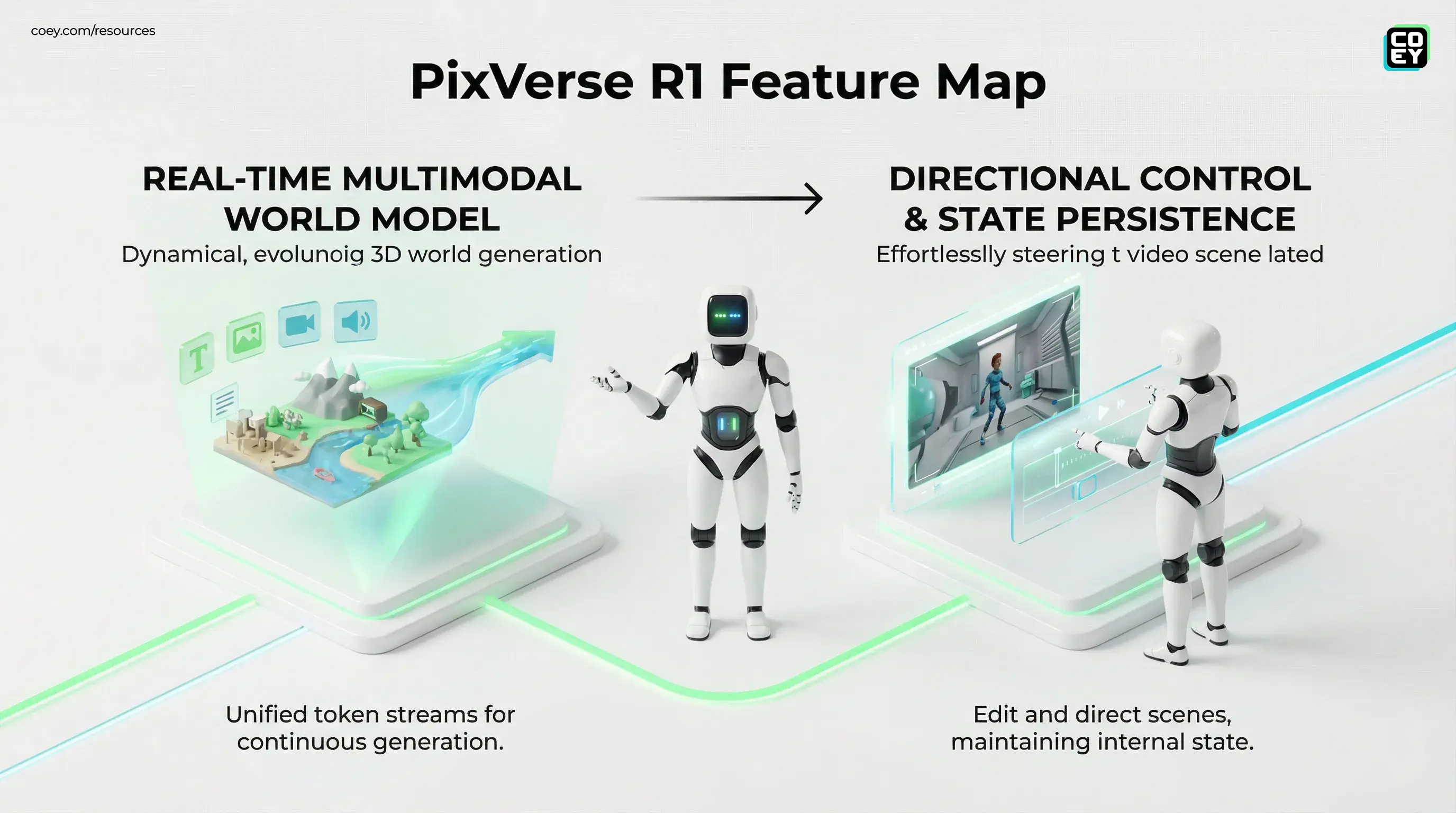
PixVerse positions R1 as a real-time, multimodal world model capable of generating an ongoing video stream at up to 1080p while responding in near real time to user guidance. The key claim is not just resolution. It is latency and continuity: the system is designed to keep the scene coherent as you interact with it, rather than rebooting the world every time you tweak a prompt.
Under the hood, PixVerse highlights three big components:
- Omni Model: a native multimodal foundation that treats text, images, video, and audio as unified token streams.
- Memory-augmented attention: a memory mechanism intended to preserve objects, spatial layout, and temporal continuity over extended generation.
- Instantaneous Response Engine (IRE): PixVerse’s optimization layer for low-latency generation, designed to cut sampling down to a few steps per update.
The real tell: PixVerse is not selling “better clips.” They are selling directional control and state persistence. That is workflow language, not demo language.
Why “world model” is more than a buzzword
“World model” is getting thrown around a lot right now, and half the time it means “video model with nicer continuity.” PixVerse is pushing the term toward something more specific: a scene that exists as an ongoing simulation, with enough internal consistency that you can interact with it without the whole thing collapsing into a new timeline.
That matters because the current dominant AI video workflow is structurally hostile to collaboration:

- A stakeholder gives feedback.
- You regenerate from scratch.
- Something else breaks.
- Everyone slowly remembers why they paid for live-action.
R1’s pitch is basically: stop rebuilding, start steering.
How it changes creative operations
If R1 works as described, it shifts gen-video from “asset generation” to “asset direction.” For teams, that is not a philosophical win. It is an operational one.
Faster feedback loops (without rerender debt)
The most expensive part of creative work is not creation. It is revision. Real-time steering means the team can do what they already do in a live review: adjust tone, lighting, pacing, and story beats on the spot.
That turns video ideation into something closer to:
live art direction + continuous iteration
instead of:
prompt roulette + export roulette.
Persistent worlds become reusable campaign infrastructure
A “world” that persists can become a campaign container: the same environment, characters, and visual rules, updated across weeks or months. That is the dream for brand consistency and high-throughput variant creation, especially if the system exposes controls cleanly.
Here is the practical implication: when the “world” is the asset, not the MP4, you can generate more deliverables without re-creating your entire baseline every time.
Automation potential: the moment it becomes callable
PixVerse’s R1 announcement is heavy on real-time tech, but for COEY readers the killer question is simpler:
Can you automate it? Is there an API? Can it plug into your stack?
PixVerse does have a broader platform documentation surface here: PixVerse Platform Docs. That matters because it signals PixVerse already understands “developer surface area” as a distribution strategy, not an afterthought.
There are also existing PixVerse API docs for specific workflows (example: Extend) here: How to use Extend? (PixVerse Platform Docs).
However, R1-specific automation is still the question. As of the current docs, PixVerse’s public API surfaces are primarily request-and-result oriented and stateless between requests, which is not the same thing as a real-time world session API.
Real-time video is cool. Real-time video with programmable controls is how you build a machine collaborator.
Real-world readiness: what is solid vs. what to pressure-test
PixVerse is describing ambitious behavior: long streaming continuity, state memory, low-latency up to 1080p generation, multimodal control. That is a big promise. The pragmatic way to read it is: the direction is right, but you should validate the boring stuff because boring stuff is what makes automation real.
Signals that it is more than hype
- Systems framing: the architecture focus (memory, response engine) is what you build when you care about usability, not just aesthetics.
- Multimodal-first posture: PixVerse’s R1 materials describe text, video, image, and audio as natively unified, which aligns with longer-term interactive intent.
- Platform docs exist: PixVerse already has developer-facing documentation, which is a major “we want this in products” signal.
Things that will make or break adoption
- Continuity under brand constraints: can it keep a product’s shape, logos, and key visual elements stable during live edits?
- Control surface clarity: can non-technical teams reliably steer outcomes without learning prompt sorcery?
- Governance: can you log changes, version scenes, and route outputs through approvals without chaos?
The competitive context: video is becoming interactive
The broader trend is clear: video generation is splitting into two paths.
- Clip generators (fast drafts, good for volume, still mostly “render and export”).
- World systems (persistent state, interactive direction, more like simulation).
R1 is a swing at the second category. And if it lands, it is not just competing with tools like Runway and Pika on quality. It is competing on the underlying workflow model: static deliverables vs. living scenes.
If you want a “world model” comparison point from a more infrastructure-first angle, COEY covered NVIDIA’s Cosmos here: Cosmos 2B Makes Video Predictable, Not Just Generative.
And once scenes are living, the real next step is inevitable: connect them to data. That is when you stop making “videos” and start running “creative systems.”
Bottom line
PixVerse R1 is pushing generative video toward the thing creators and marketing teams actually need: a tight loop where humans direct and machines execute in real time. The promise is not “AI can make video.” We are past that. The promise is: AI can behave like a collaborator, responsive, stateful, and eventually programmable.
If PixVerse follows through with robust R1 controls (session or stateful control APIs, event triggers, reliable steering primitives), this becomes a legitimate automation component, not a novelty. If it stays locked in a preview UI with limited controls, it will still be impressive, but it will live in the same place most flashy gen-video lives: “cool demo,” not “core workflow.”
Put AI to Work for Your Marketing Team
COEY builds AI marketing systems that actually run, not just demo well. From n8n-powered automation to Claude Cowork and OpenClaw integrations, we connect the tools your team needs into workflows that deliver. Explore our channel capabilities, see our AI Studio, or request a proposal.