Google DeepMind’s Project Genie: Genie 3 Turns Prompts Into Playable Worlds (And That’s Bigger Than “AI Video”)
Google DeepMind’s Project Genie: Genie 3 Turns Prompts Into Playable Worlds (And That’s Bigger Than “AI Video”)
January 30, 2026
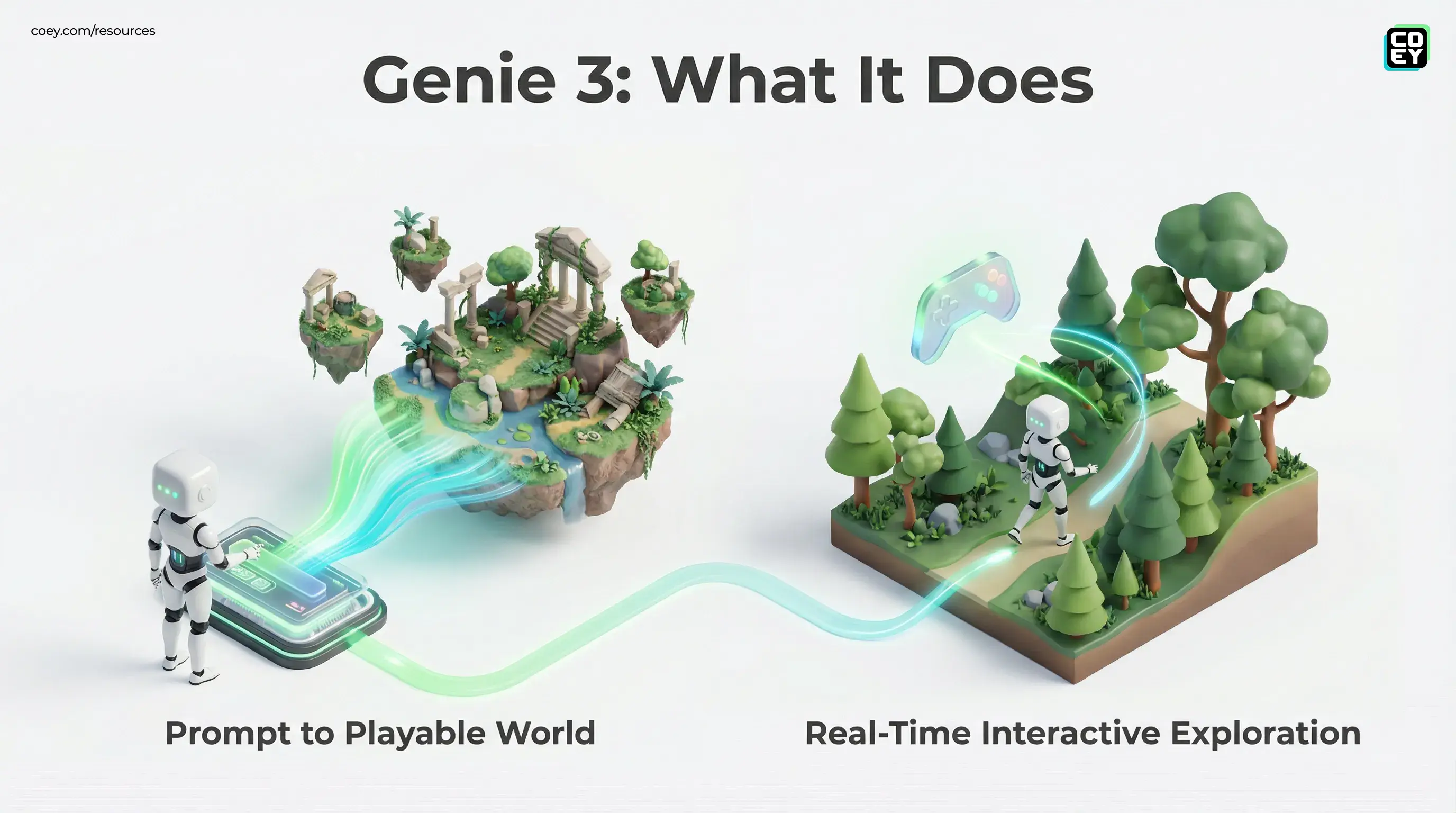
Google DeepMind just pushed generative media into a new lane with Project Genie, an experimental web prototype powered by its Genie 3 world model. The headline is not “it makes pretty scenes.” It is that you can prompt an environment and then move through it in real time, like a playable simulation, rather than waiting for a static image or a fixed video clip. Think “text to world,” but with navigation, persistence, and a real-time loop that starts to look like a machine collaborator instead of a rendering vending machine.
This matters for COEY’s mission, scaling human creativity through intelligent machine collaboration, because the moment an AI system becomes interactive, it stops being a one-off asset generator and starts behaving like infrastructure. The fun part is the demo. The serious part is what happens when this becomes callable, controllable, and routable through your creative operations.
What DeepMind actually shipped
Project Genie is a browser-based experience where you can generate and explore interactive worlds using prompts and visual inputs. It’s backed by Genie 3, which DeepMind frames as a “world model,” meaning it is built to generate coherent environments that respond to actions over time, not just output a single frame.
DeepMind describes Genie 3 as capable of real-time generation at 720p and 20 to 24 fps, which is the difference between “watch this render” and “this can feel like software.” The system also emphasizes continuity: worlds do not instantly reset every time you change direction, and previously seen elements can persist long enough to make navigation feel like exploration rather than a hallucination slideshow.
The shift: generative AI is not just creating content for you. It is creating a space with you, where your intent (movement, focus, interaction) becomes part of the generation loop.
From “video model” to “world system”
The easiest way to understand Genie 3 is to compare it to the dominant gen-video workflow most teams know:
- You generate a clip.
- You review it.
- You want changes.
- You regenerate from scratch and hope continuity survives.
Genie flips that. Instead of producing a finished artifact, it produces a stateful experience, a world that updates as you move. That is why “world model” is not just branding. It is a different workflow primitive.
For marketers, agencies, and product teams, that primitive maps to real needs: prototyping environments, pitching experiential concepts, building interactive showcases, or simulating scenarios where the audience explores instead of watches. If AI video is your drafting tool, interactive world generation is your sandbox.
Core capabilities (in practical terms)
| Capability | What it enables | Ops reality check |
|---|---|---|
| Prompt-to-world | Instant spatial concepts (venues, cities, showrooms) | Still needs human art direction for brand fidelity |
| Real-time navigation | Interactive demos and walkthrough prototypes | Compute limits mean sessions are not infinite worlds yet |
| World consistency | Believable exploration and repeatable review | Continuity is improved, not perfect, expect drift |
Why this is a creative ops story
Executives and marketing leaders do not need another cool AI headline. They need to know if this changes throughput, reduces cycle time, or unlocks formats that were previously too expensive to ship.
Interactive world generation does all three, but only if the tool evolves beyond a prototype UI into something you can integrate.
What gets faster immediately
- Concepting: spatial ideas become explorable in minutes, not days of 3D blocking.
- Stakeholder alignment: “walk through the idea” beats “imagine the idea.”
- Iteration loops: you can explore angles, layouts, and vibes without re-exporting a new clip every time.
What becomes possible (with the right controls)
- Experiential campaign prototypes: branded worlds that behave like interactive ads, not landing pages.
- Virtual events previsualization: mock environments for sponsors, booths, and stage layout.
- Interactive product storytelling: “explore the product in context” instead of “watch a product video.”
If that sounds like metaverse energy, fair. The difference is cost and iteration speed. When world-building becomes promptable, immersive formats stop being reserved for teams with game-engine budgets.
Automation potential: the real question
Here’s the pragmatic cut: Project Genie is not currently positioned as a public API product. It is a prototype experience. That means you cannot reliably wire it into n8n or Make and generate 200 interactive worlds overnight with metadata, approvals, and delivery automation, at least not with anything publicly documented so far.
But Genie 3’s existence is still an automation story, because it signals the next obvious product step: a programmable “world session” interface where workflows can create, steer, and capture interactive scenes on demand.
What “API-ready” would look like
| Automation need | What teams would want | Why it matters |
|---|---|---|
| Batch world generation | Create variants from a brief or spreadsheet | A/B testing for environments, not just headlines |
| Session control | Programmatic navigation plus camera paths | Repeatable captures for reviews and approvals |
| Exports | Frames, video, telemetry outputs via endpoint | Turns worlds into assets your pipeline can ship |
That is the line between “impressive demo” and “machine collaborator.” As soon as a system can be called, controlled, and logged, it becomes operational, and that is when creative scale compounds.
Availability and constraints (read: what to not overhype)
DeepMind is framing Project Genie as experimental, and it reads that way. The best approach is to treat it like an early signal of where interactive generation is going, not a replacement for Unreal, Unity, or a mature 3D pipeline today.
- Access is limited: as of Jan 2026, Project Genie is available in the U.S. to eligible users 18+ with a Google AI Ultra subscription.
- Performance is good, not magical: real-time at 720p and roughly 20 to 24 fps is a milestone, but not AAA game-engine quality.
- Physics and fine control are still evolving: limitations remain in prompt adherence, real-world physics, and controllability.
- Governance is still a question: brand safety, logging, and approvals matter more when outputs are interactive and harder to proofread.
We do not overhype this: interactive generation is real. Production integration is the missing piece. The moment an API shows up, this category stops being a curiosity and starts becoming a workflow layer.
The bigger market signal: video is becoming explorable
Genie 3 lands in the same broader trend we have been tracking across world-model systems: generated media is shifting from exports to experiences. When that happens, the unit of creative work changes.
Instead of shipping one video, you maintain a world state. Instead of requesting one render, you steer a session. Instead of producing one campaign asset, you produce a container that can generate infinite variations under human direction.
If you want a comparison point from the creator-tool side of the market (versus DeepMind’s research-first posture), PixVerse is pushing a similar real-time steering direction with R1, covered here: PixVerse R1 Makes Real-Time AI Video Directable.
Bottom line
Project Genie, powered by Genie 3, is a clear signal that generative AI is moving beyond “make me a clip” into “build me a world I can interact with.” That is not just a creative novelty. It is a workflow shift toward systems where humans direct and machines simulate in real time.
Right now, it is mainly a prototype experience: exciting, highly suggestive, but not yet the kind of API-first component you can fully automate. Still, the trajectory is obvious. Once interactive world generation becomes programmable, session control, exports, logs, and guardrails, it becomes a serious new building block for scaling creativity through human plus machine collaboration.
AI Marketing That Goes Beyond the Hype
COEY builds the marketing automation systems that agencies and brands actually need: n8n workflows, Claude Cowork agents, OpenClaw models, all connected and delivering. See our automation capabilities, explore our channel work, or request a proposal.