Alibaba’s Qwen3.5-397B-A17B Drops: Open-Weights, Multimodal, and Agent-Ready (Finally the Combo Ops Teams Want)
Alibaba’s Qwen3.5-397B-A17B Drops: Open-Weights, Multimodal, and Agent-Ready (Finally the Combo Ops Teams Want)
February 19, 2026
Alibaba’s Qwen team has released Qwen3.5-397B-A17B, the first open-weight flagship in the Qwen3.5 series, positioned for multimodal work and real-world agents, not just chat. The headline spec is a 397B-parameter Mixture-of-Experts model that only activates about 17B parameters per token at inference, which is a fancy way of saying: big brain, smaller bill. And for teams building automation, the bigger deal is the licensing and deployability: it ships under Apache 2.0, meaning it can move from cool model drop to owned infrastructure without legal gymnastics.
Qwen3.5-397B-A17B is a flagship-class model built with a sparse MoE design (397B total parameters, about 17B active per token). That architectural choice matters because agentic workflows are not a single model call. They are loops: plan, tool call, validate, revise, retry. MoE models are designed to survive that reality without turning your GPU budget into performance art.
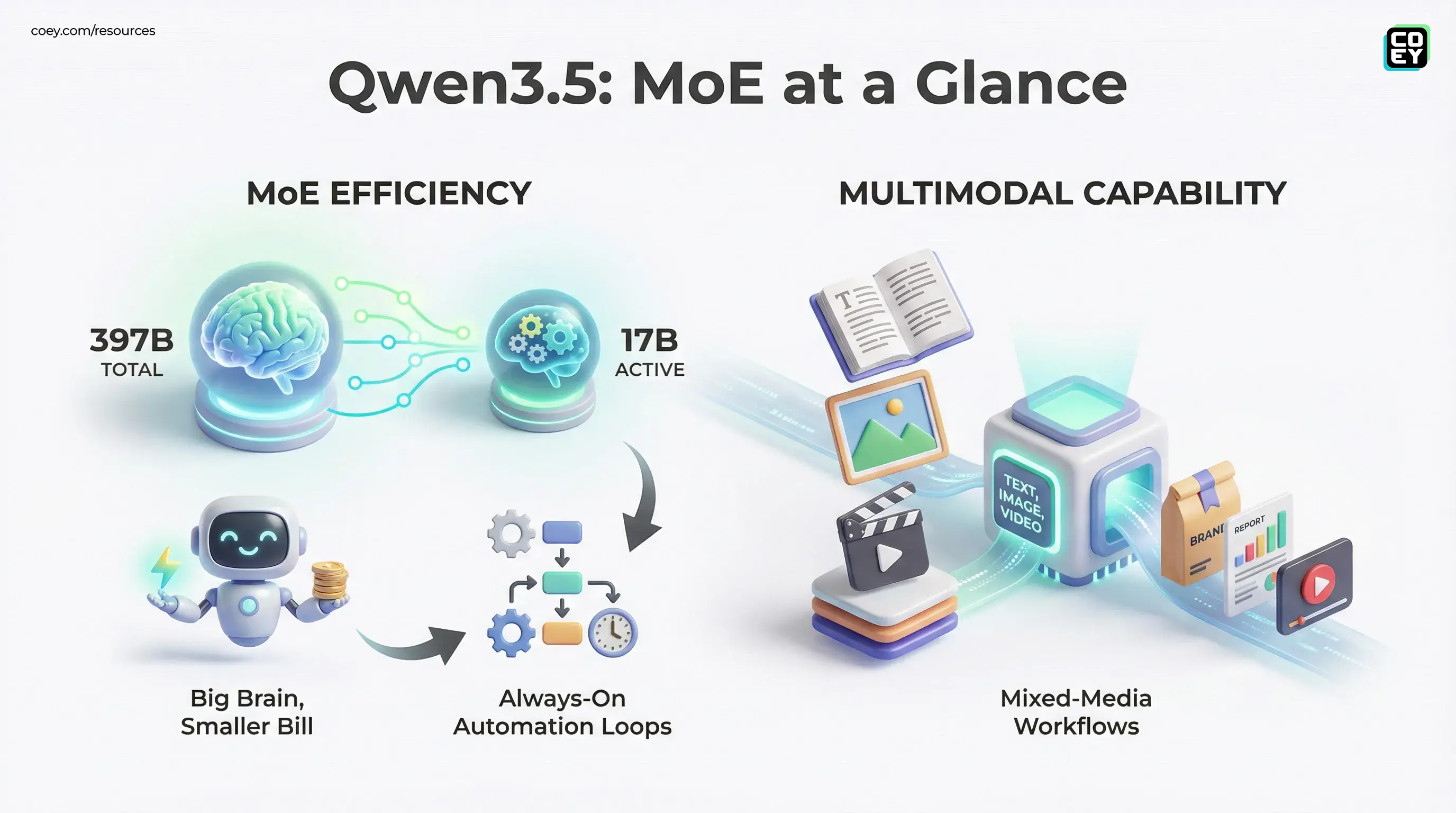
Open weights plus multimodal plus agent training is the trifecta. Most releases only deliver one or two. When you get all three, automation stops being a prototype and starts looking like a system.
What Alibaba actually shipped
Alibaba is also framing this as natively multimodal. In practice, that means a vision-language posture: the model is built to handle text plus images, and Qwen’s broader multimodal direction also talks about video understanding capabilities depending on how you serve and which endpoint you use.
Spec snapshot (translated)
| What it is | What Qwen3.5 ships | Why teams care |
|---|---|---|
| Model size | 397B total / about 17B active (MoE) | Higher capability without paying dense 400B costs per token |
| License | Apache 2.0 | Commercially usable, self-hostable, modifiable, less vendor lock-in |
| Multimodal posture | Text plus vision inputs (images; video depends on the serving endpoint) | Enables mixed-media pipelines (creative QA, asset understanding, research) |
Why MoE matters for automation economics
If you have ever tried to run agents for real, you have learned the hard lesson: agents are expensive because they iterate. Even a simple content workflow can become 10 to 30 model calls once you add critics, tool calls, formatting, and retries.
MoE is the industry’s most practical answer to that. You get a huge pool of capability, but you do not light up the entire model every time it thinks. That is how you get closer to always-on collaborator instead of we only use the model for hero moments because Finance is watching.
The shift is not smarter models. It is models that are cheap enough to be used like infrastructure, continuously, predictably, and inside workflows.
Multimodal is only useful if it’s operational
Multimodal announcements are everywhere now, and half of them translate to: it can look at an image sometimes if you beg. What is more interesting about Qwen’s direction is the push toward long-context, mixed-media work packets, because that is what production workflows require.
On the hosted docs side, Alibaba Cloud Model Studio documentation lays out how vision inputs can be structured for vision-language models. If you are using the hosted path, start with the official docs here: Alibaba Cloud Model Studio model documentation.
Where multimodal actually pays off
- Creative QA at scale: Does this ad image include the disclaimer, is the logo present, does the screenshot match the offer copy.
- Competitive teardowns: feed a landing page screenshot plus copy plus pricing table, get structured insights and a messaging grid draft.
- Video-to-assets pipelines: frames plus transcript plus brand rules, output cut suggestions, captions, and platform-specific variants (with humans still approving).
API availability: the real automation question
There are two paths that matter here, and they are not interchangeable.
1) Open-weights path: you host it
Because Qwen3.5-397B-A17B is open weights under Apache 2.0, you can run it in your environment and expose it behind your own internal API. That is the move if you want:
- privacy control (sensitive campaigns, unreleased product, customer data)
- workflow reliability (pin model versions, stable prompts, predictable regression testing)
- cost control (compute budgeting instead of per-token margin forever)
2) Hosted path: you call someone else’s endpoint
Alibaba’s broader Qwen ecosystem includes hosted access through Alibaba Cloud Model Studio, and Qwen3.5 models are also distributed via Hugging Face. For teams that need speed to pilot, hosted endpoints can be the fastest way to test whether the model’s behavior clears your bar before you invest in serving infrastructure.
The key non-technical translation:
If your workflow tool can call HTTP, you can automate Qwen3.5. The only question is whether you want to own the endpoint (self-host) or rent it (hosted).
Real-world readiness: what’s plug in now vs still spicy
Qwen3.5’s positioning is unusually aligned with production needs: agent training, multimodal posture, and permissive licensing. But model exists is still not the same thing as automation is done. The workflow is the product.
Deployable now (high confidence)
- Internal research automation: long inputs, structured reports, executive summaries, competitor digests.
- Content ops packaging: draft bundles (copy variants plus metadata plus channel formatting) that route into CMS, Notion, or Airtable with a human approval gate.
- Asset understanding plus tagging: multimodal tagging for DAM hygiene and searchability (especially if you define strict schemas).
Still needs guardrails
- Autonomous publishing: anything that can post, launch, email, or spend money without a review stage.
- Compliance-heavy claims generation: regulated industries need a prove it layer, not just a write it layer.
- Unbounded tool execution: tool calling expands the blast radius, so permissions, logging, and rate limits become mandatory.
Why this matters for scaling creativity
COEY’s mission is scaling human creativity through intelligent machine collaboration, and Qwen3.5 is the kind of release that supports that mission in a practical way: it is not only aiming to be smart, it is aiming to be runnable, ownable, and workflow-native.
When a model is open-weight, commercially usable, and efficient enough to run in agent loops, you can start building creative systems where:
- humans provide intent and taste (what we are making, why it matters, what good looks like)
- machines handle the grind (batching, formatting, tagging, first drafts, iterative revisions, packaging)
The win is not we used AI. The win is we shipped more great work with fewer boring steps, without losing control of brand, compliance, or budget.
Bottom line
Qwen3.5-397B-A17B is a meaningful open-weight flagship because it combines three things automation teams actually need: MoE efficiency for agent loops, multimodal capability for mixed-media workflows, and an Apache 2.0 license that clears the path to commercial deployment. It will not magically turn your org into an autonomous content factory, but it can become a strong foundation for one if you wrap it in the unsexy essentials: structured outputs, critics, approvals, logging, and sane permissions.
If you want adjacent Qwen context from our own archives, see Qwen3-Coder-Next-3B: Alibaba’s Lean MoE Model Aims at Real Coding Automation.
Your AI Marketing Agency, Built to Ship
COEY is the AI marketing agency that wires the whole stack together: n8n for orchestration, Claude Cowork for content intelligence, OpenClaw for open-source AI. Explore how we work across every channel, visit our AI Studio, or get in touch.