
Alibaba’s Qwen3.8-27B Tests the Open Multimodal Hype Cycle
Alibaba’s Qwen3.8-27B Tests the Open Multimodal Hype Cycle
August 14, 2026
Alibaba’s Qwen ecosystem appears to be moving into another open-weight multimodal release cycle, with community discussion pointing to Qwen3.8-27B as a dense 27B-class model under an Apache 2.0-style license. Teams should still verify the live model card, files, license, and serving notes before treating the buzz as a production decision. The official Qwen organization on Hugging Face, ModelScope, and Alibaba Cloud Model Studio are the first places teams should watch, because the clearest source of truth is still the Qwen team itself, not the “trust me bro” layer of AI social feeds.
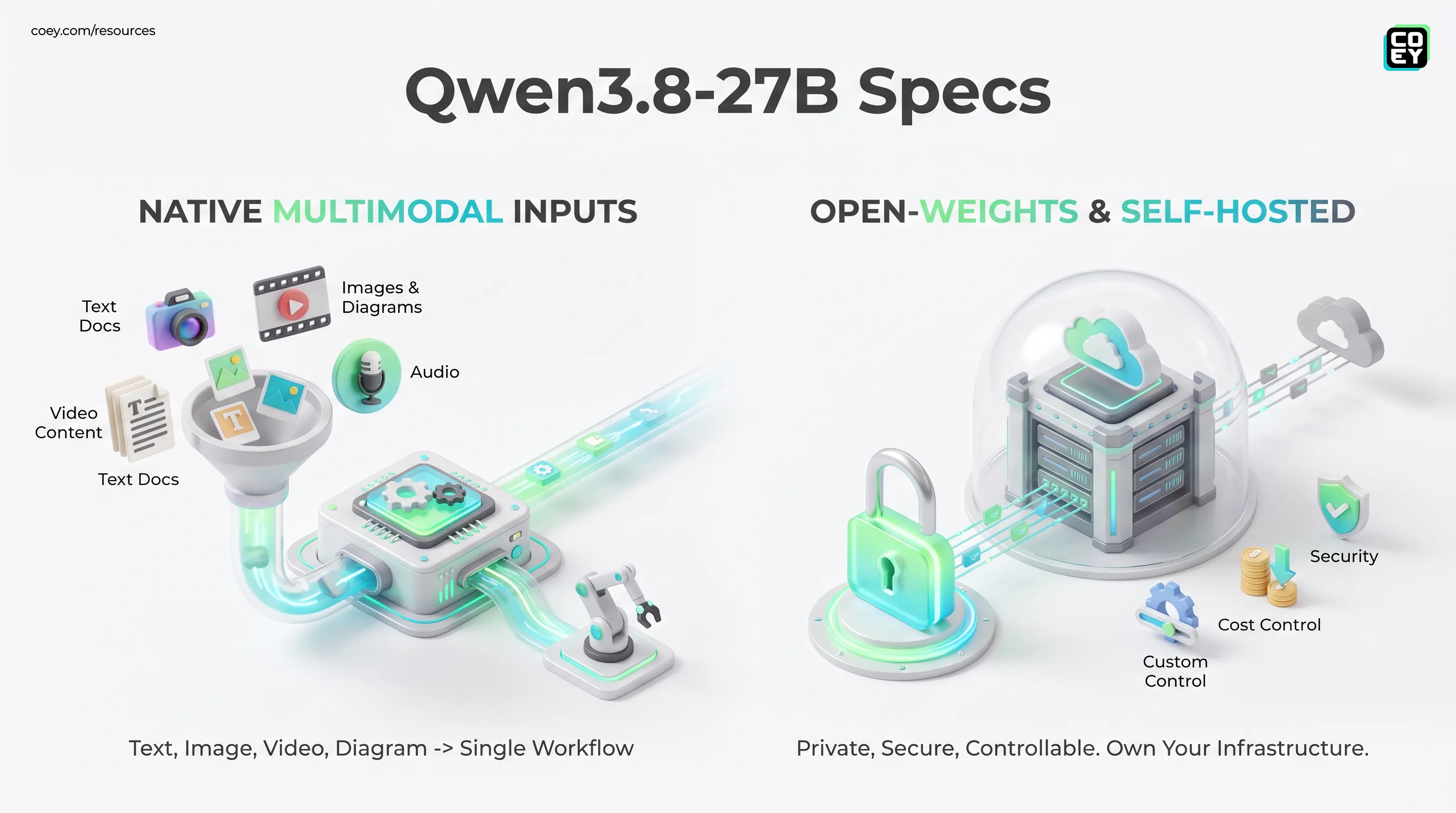
That does not make the story irrelevant. Quite the opposite. If Qwen3.8-27B performs as described, with open weights, native multimodal inputs, a 262K-token native context window, reported extension to around 1M tokens through YaRN, and a manageable 27B-class footprint, it fits directly into the next phase of AI adoption: models that are not just impressive in a demo, but actually deployable inside creative, marketing, commerce, and operations workflows.
The important question is not is this model smart? The important question is: can teams automate with it, govern it, afford it, and plug it into real systems without rebuilding the stack from scratch?
What is being reported
Current community discussion describes Qwen3.8-27B as a 27B-parameter dense model with native multimodal capabilities, meaning it can work across text and visual inputs without forcing teams to stitch together separate language and vision systems for every use case. Reports also describe support for images, documents, diagrams, and video inputs, although serious teams should validate video length, frame handling, OCR behavior, and latency on their own assets before designing around those claims.
That would be significant for creative operations because multimodal work is where most current automation pipelines get clunky. A campaign does not exist as clean text. It exists as messy bundles: screenshots, product photos, brand docs, claims language, landing page copy, social posts, decks, spreadsheets, and “final_final_v6_USE_THIS.png.” Humanity’s greatest file naming crime, still undefeated.
If a single model can understand both the words and the visuals, it can reduce the number of handoffs between tools. That is where the automation value begins: fewer glue scripts, fewer model switches, fewer brittle prompts, and fewer moments where the workflow falls over because one tool understands images but has the reasoning ability of a sleepy toaster.
The specs still need caution
The chatter around Qwen3.8-27B includes claims about open weights, Apache 2.0 commercial usability, local deployment formats, quantized variants, and compatibility with common serving frameworks such as vLLM, SGLang, TokenSpeed, Unsloth, and GGUF-based local runtimes. Those details matter, but they should still be checked against the official model card, license file, repository files, and deployment notes at the moment your team actually downloads or deploys the model.
There is also a common point of confusion around architecture. The larger Qwen3.8 line is being discussed alongside a much bigger sparse Mixture-of-Experts model, often described as Qwen3.8-2.4T-A95B. Qwen3.8-27B, however, is being described as a dense 27B model, not an MoE model. That is not a nerd footnote. It changes the cost equation. A dense 27B model activates the whole network during inference. A sparse MoE model routes work through selected expert pathways. Both can be useful, but they have different infrastructure profiles.
| Claim area | Why it matters | Status to verify |
|---|---|---|
| Open weights | Allows self-hosting and private workflows | Verify official repository files and license |
| Multimodal inputs | Enables image plus text automation, with reported document and video support | Test on real assets, especially small text and video |
| Architecture | Impacts cost, latency, serving strategy | Qwen3.8-27B is reported as dense, not MoE |
Why open weights matter
For executives and marketing leaders, “open weights” translates to a simple operational choice: you are not forced to send every asset, brief, product description, or customer-facing claim through a closed vendor API. Your technical team can potentially host the model inside your own cloud environment, private VPC, or controlled infrastructure, subject to the final license and deployment requirements.
That matters for organizations dealing with unreleased products, regulated claims, proprietary campaign strategies, customer data, or confidential brand planning. A self-hosted model can become an internal creative worker: callable by automation tools, governed by company rules, and versioned like infrastructure.
It also helps with long-term cost control. Closed APIs are great for pilots because they are fast to start. But at scale, per-token billing can turn high-volume asset review into a finance jump scare. Open-weight models shift the cost conversation from “how much does every call cost?” to “what is our compute budget, throughput target, and utilization rate?” Less sexy, more useful.
Where automation could fit
If Qwen3.8-27B becomes broadly available through the official and community channels now being reported, its strongest near-term fit is not fully autonomous creativity. Please do not hand it your brand calendar and walk into the ocean. The likely fit is bounded automation: repeatable tasks with structured inputs, clear review rules, and measurable output quality.
Creative and brand QA
A multimodal Qwen model could inspect an ad image and its copy together. That means checking whether the visual actually matches the offer, whether required disclaimers are present, whether product imagery aligns with the description, and whether the brand system is being respected. This is exactly the kind of high-volume review work machines should absorb, while humans keep control over taste, strategy, and final judgment.
Catalog enrichment
Commerce teams could use a hosted Qwen endpoint to generate alt text, product attributes, category tags, visual descriptions, and mismatch alerts. The real value is not one product page. It is thousands of SKUs processed consistently overnight, with exceptions routed to humans instead of humans reviewing everything manually.
Asset search and governance
Media teams could use multimodal descriptions and embeddings, where supported by the chosen stack, to make asset libraries searchable by natural language. “Find outdoor lifestyle shots with blue packaging and no visible hands” should not require a 40-minute Slack archaeology dig. AI should be doing that grunt work, politely and without asking if you tried searching the folder.
API availability is the test
The practical adoption question is whether Qwen3.8-27B can be served behind an API in a predictable way. Open weights help because teams can create their own endpoint using inference servers and orchestration layers. The Qwen ecosystem has already shown this pattern across prior releases, where API compatibility and workflow access often matter more than chatbot sparkle. COEY covered that same shift in Qwen3.6-Plus Wants to Be the Agent Brain, Not Just Another Chatbot.
For non-technical readers, API availability means this: can your systems call the model automatically when something happens? Can a new asset uploaded to your DAM trigger analysis? Can a product feed update generate metadata? Can a campaign screenshot be checked against brand rules before it reaches a client or media buyer?
If the answer is yes, the model is workflow-relevant. If the answer is “you can chat with it in a web app,” that is useful, but it is not the same thing as automation. Browser-only AI is where productivity goes to cosplay as transformation.
| Workflow | Automation potential | Human role |
|---|---|---|
| Alt text and tagging | High | Review samples and edge cases |
| Ad-copy visual QA | High | Approve risky claims |
| Autonomous publishing | Medium to low | Final sign-off required |
Real-world readiness
A 27B-class model is not tiny. Current reports suggest 4-bit quantized builds may fit on 24 GB-class consumer GPUs for practical local inference, while full BF16 operation requires substantially more memory, often discussed in the mid-50 GB range before accounting for long-context overhead. The reported 262K-token native context window is especially important because long context is not just a number on a model card. KV cache and attention-related memory can become the real infrastructure bill.
That means serious production workflows still need infrastructure planning: GPUs, memory, monitoring, rate limits, logging, fallback models, evaluation sets, and context-length policies. Open does not mean free. It means you own the complexity instead of renting it.
That tradeoff can be worth it for teams with enough volume or privacy sensitivity. Agencies, large retailers, enterprise marketing teams, and media operations groups may benefit from a controllable multimodal model that can run batch jobs across assets, documents, and campaign materials. Smaller teams may be better served waiting for hosted endpoints, managed inference providers, or confirmed integrations before committing engineering resources.
The biggest watch-out is quality drift. Multimodal models can sound confident while misreading small text, missing subtle visual issues, mishandling long videos, or inventing explanations for ambiguous images. That is why production systems need validators, human review stages, and audit trails. The model should accelerate review, not become the sole authority on whether your campaign is legally, visually, or strategically ready.
How this fits the Qwen pattern
The Qwen story has been building toward this moment for a while: larger context windows, more multimodal coverage, more agentic positioning, and more focus on models that can sit inside workflows. Earlier Qwen releases have already shown the direction, including COEY’s coverage of Qwen3.5-397B-A17B and the practical multimodal expansion covered in Alibaba’s Qwen3-VL and Meshy 6 Preview.
That context matters because Qwen3.8-27B, if the public details hold, would not be a random one-off. It would be part of a clear strategy: make capable multimodal models more accessible, more deployable, and more useful as infrastructure.
What this signals
Even with the caveats, the Qwen3.8-27B discussion signals where the market is heading. The AI race is no longer only about who has the biggest model or the most cinematic demo. The real competition is about who can provide models that are open enough, capable enough, and efficient enough to become components in business systems.
That is directly aligned with the human-plus-machine future. Humans bring intent, taste, ethics, strategy, and judgment. Machines handle the repetitive sensing, sorting, drafting, checking, and formatting that slows creative teams down. When the model is open and automatable, the collaboration becomes more than a chat session. It becomes infrastructure for creative scale.
Bottom line: Qwen3.8-27B is worth watching, but not worshipping. If Alibaba’s Qwen team keeps the reported open-weight multimodal package available with clear licensing, model cards, and deployment paths, it could become a meaningful option for creative and marketing automation. Until teams verify the exact repository, license, context settings, quantized builds, and serving behavior for their own workloads, the buzz should be treated as a strong signal, not a procurement decision. The opportunity is real: one model that can help review, enrich, organize, and reason across mixed creative assets. The responsibility is also real: verify the source, test on your own workflows, and keep humans firmly in the loop where judgment matters.