Google’s Gemini 3.1 Pro Is a Reasoning Upgrade and a Workflow Upgrade Too
Google’s Gemini 3.1 Pro Is a Reasoning Upgrade and a Workflow Upgrade Too
February 21, 2026
Google just rolled out Gemini 3.1 Pro, positioning it as a serious step up for teams that want AI to do more than brainstorm taglines. The official announcement is here, and the real story is simple: better reasoning, a truly huge context window, and broader availability across Google’s Gemini surfaces for both end users and developers.
In other words: this is not just “chatbot got smarter.” It is Google tightening the screws on an emerging category that executives actually care about: LLMs as operational infrastructure, callable via API, attachable to tools, and capable of handling longer, messier real world inputs without falling apart.
What actually shipped
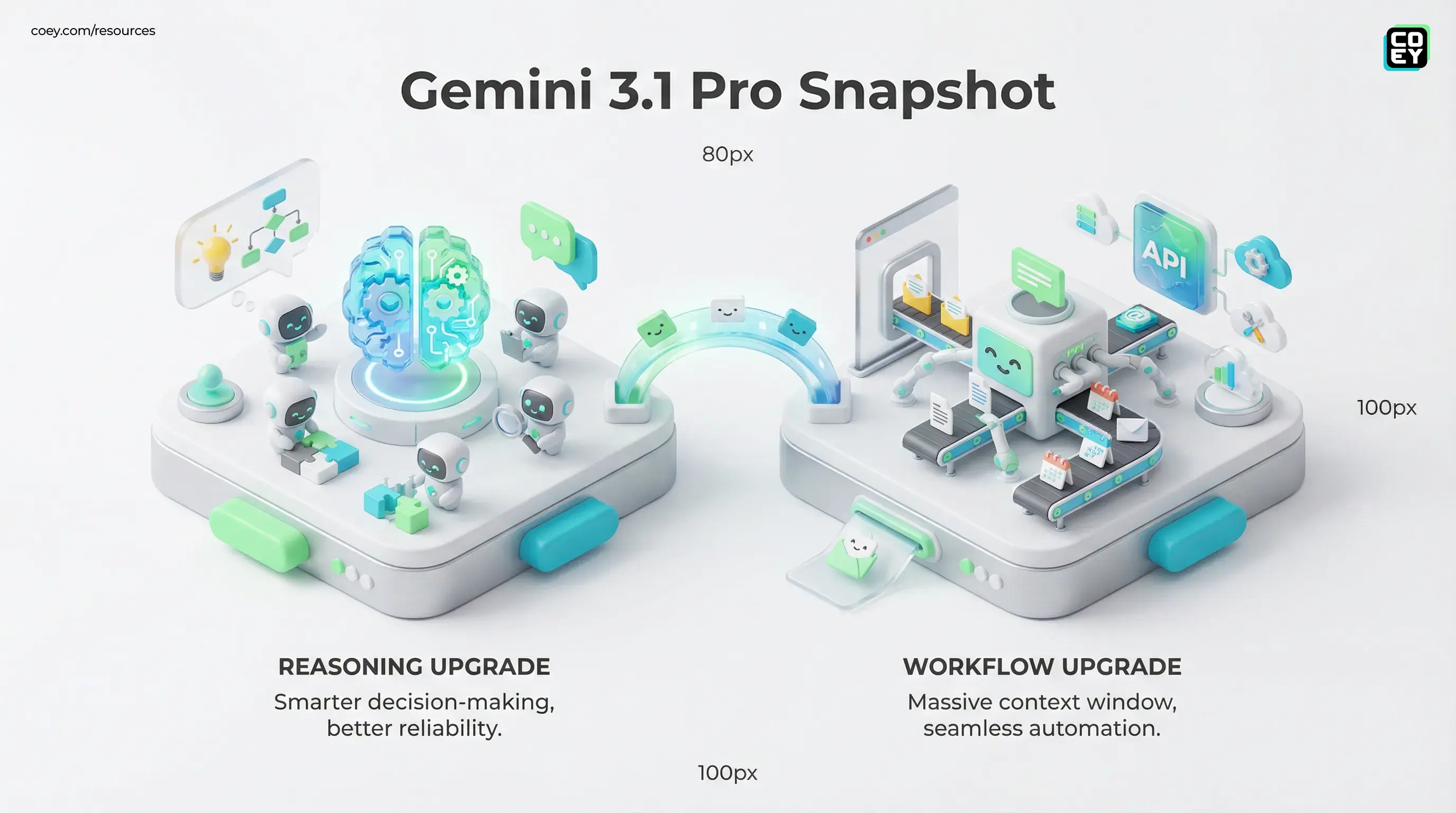
Gemini 3.1 Pro is Google’s newest “Pro” tier model with a clear emphasis on reasoning reliability and long context work. Google is distributing it across consumer and builder friendly surfaces, which matters because it is the difference between “cool demo your team plays with” and “capability you can standardize.”
Two headline specs are doing the heavy lifting in the announcement cycle:
- ARC-AGI-2 performance: Gemini 3.1 Pro is reported as scoring 77.1% on ARC-AGI-2, a benchmark that’s become the internet’s favorite “can it actually reason?” scoreboard. (And yes, benchmarks still are not your business KPI.)
- Massive context window: Google’s developer model listing indicates a 1M token context window and a 64K token output limit for Gemini 3.1 Pro. See the Gemini models page.
Translation for operators: Gemini 3.1 Pro is trying to be less “creative sidekick” and more “reliable reasoning engine you can stick inside a pipeline without constant babysitting.”
Why the context window changes behavior
Long context is not a party trick. It changes how teams design workflows.
When context is small, every automation becomes a chunking project: split docs, summarize each chunk, re summarize summaries, hope nothing important got lost, then ask the model to make a decision based on a foggy reconstruction of reality. It works, but it is duct tape.
With a million token window, you can plausibly feed:
- full customer research transcripts (not just highlights)
- entire campaign performance exports plus commentary
- brand guidelines plus past ads plus competitor examples
- product docs plus support tickets plus sales calls
That matters because the best automations are not “generate copy.” They are “generate copy in context of everything we already know”, your business rules, your historical performance, your compliance constraints, and your current strategy.
Reasoning: the less sexy upgrade that wins budgets
Marketing leaders tend to buy AI twice. First for the magic. Second for the reliability.
Reasoning improvements show up in unglamorous places that are operational gold:
- Fewer dropped steps: multi step tasks (planning, outlining, drafting, formatting, QA) fail less often when reasoning is stronger.
- Better constraint handling: “Use these claims, avoid these words, keep it under X characters, match this tone” becomes more enforceable.
- More dependable analysis: research synthesis and performance interpretation get less hand wavy, still not perfect, but more usable.
Snarky but true: creative AI is fun until it is confidently wrong in a doc your VP forwards. Better reasoning is how AI stops being a liability in leadership circulation.
Where it lands inside Google’s stack
Google is not shipping Gemini 3.1 Pro into a vacuum. It is threading it through the surfaces people already use (or can be forced to use by IT): Gemini app experiences, NotebookLM for document first workflows, and developer platforms.
- Gemini app: consumer and business users get access based on plan and rollout availability. This is where teams will try it first.
- NotebookLM: a natural home for long context work: docs, notes, sources, synthesis. Access is typically tied to Google’s paid tiers depending on rollout and region.
- Google AI Studio plus Gemini API: where it becomes automatable and repeatable, meaning it can graduate from “tool” to “system.”
That last bullet is the most important one if you care about scale.
API reality: yes, this can plug into workflows
Gemini 3.1 Pro is available via the Gemini API (surfaced through Google AI Studio), which is what turns it from a UI feature into something your ops team can wire into the stack. The model catalog and access details live on Google’s developer site: Gemini API model listings.
For non technical teams, “API available” means:
- Triggerable: run it automatically when something happens (new brief created, new campaign results posted, new competitor page captured).
- Batchable: process 200 assets or large research sets overnight.
- Integratable: connect it to tools you already use (docs, storage, CMS, analytics, CRMs) through custom code or HTTP based automation platforms.
Automation readiness snapshot
| What you want to automate | Why 3.1 Pro helps | Readiness |
|---|---|---|
| Brief plus research synthesis | Huge context plus stronger reasoning | High (add human QA) |
| Campaign analysis narratives | Long inputs plus more stable multi step logic | Medium High |
| Agentic workflows across tools | Better planning plus fewer dropped steps | Medium (needs guardrails) |
The table is the point: Gemini 3.1 Pro is usable, but it is not “hands free marketing department.” You still need governance, validation, and approvals for anything that touches brand, claims, regulated categories, or publishing.
Where this gets real for marketers
Gemini 3.1 Pro’s best early wins are in workflows that are currently half human because models have historically been too forgetful, too shallow, or too fragile when prompts get long.
1) One pass synthesis from messy sources
Think: quarterly narrative from performance dashboards plus commentary plus sales notes plus customer interviews. You are not asking for “a summary.” You are asking for structured synthesis that retains nuance and produces something leadership can use.
2) Content repurposing that does not lose the plot
Long transcripts and long documents are where many automation systems quietly fail. With long context and longer outputs, you can do more single pass repurposing: podcasts to social packs, webinars to blog outlines, research to campaign angles, without stitching 14 partial outputs together.
If you are building workflows around longer documents and synthesis-first outputs, this pairs well with the same theme we covered in NotebookLM Video Overviews: Google’s AI Shortcut for Content Creators and Marketers.
3) Planning workflows that do not derail
Multi step planning is where “reasoning” actually matters: audience segmentation logic, channel sequencing, creative variant trees, experiment planning. Better reasoning does not guarantee correctness, but it reduces the “it forgot step 4” chaos that kills trust.
The collaboration model that works: humans provide intent, constraints, and taste; the model provides breadth, structure, and speed. Gemini 3.1 Pro is clearly tuned for the structure part.
What to stay skeptical about
Google’s positioning is strong, but production teams should keep a few reality checks in frame:
- Benchmarks do not equal your workflow: ARC-AGI-2 is interesting, but your real benchmark is “did it produce a usable deliverable in our constraints without hallucinating.”
- Long context can amplify mistakes: feeding the model more data does not automatically make it smarter; it can also make it more confidently wrong if your inputs contain contradictions or bad sources.
- Agentic is not automatic: tool using workflows require permissions, logging, safe fallbacks, and “do not publish without approval” controls, especially in marketing stacks where a single wrong action can go public fast.
None of that is a knock. It is just the difference between AI news and AI operations.
Bottom line
Gemini 3.1 Pro is Google making a direct play for the “AI as workflow engine” era: stronger reasoning, massive context, and practical access via the Gemini API and Google AI Studio. For executives, it is a signal that LLMs are continuing to shift from novelty to infrastructure. For marketing and creative ops teams, it is a tangible upgrade in the kinds of work you can automate reliably, especially synthesis, planning, and long form transformations, so humans can spend more time on direction and judgment instead of glue work.
Let COEY Wire Your AI Marketing Stack
We help brands and agencies connect n8n, Claude Cowork, OpenClaw, and other AI tools into marketing systems that produce real output. From content automation to full campaign orchestration across every channel. See how it works or request a proposal.