
Google Gemini 3.1 Pro Lands as a Reasoning Upgrade You Can Actually Automate
Google Gemini 3.1 Pro Lands as a Reasoning Upgrade You Can Actually Automate
February 23, 2026
Google’s Gemini 3.1 Pro is rolling out across the Gemini app, NotebookLM, Vertex AI, and the Gemini API, and it’s positioned less like a “look what I can do” flex and more like a reliability patch for anyone trying to run multi-step creative automation without babysitting every handoff.
If you’ve ever tried to chain “research, outline, draft, QA, repurpose” and watched the model drift halfway through, this release is aimed directly at that pain. Google is pitching Gemini 3.1 Pro as better at complex reasoning, better at tool use, and practical to run at the API level.
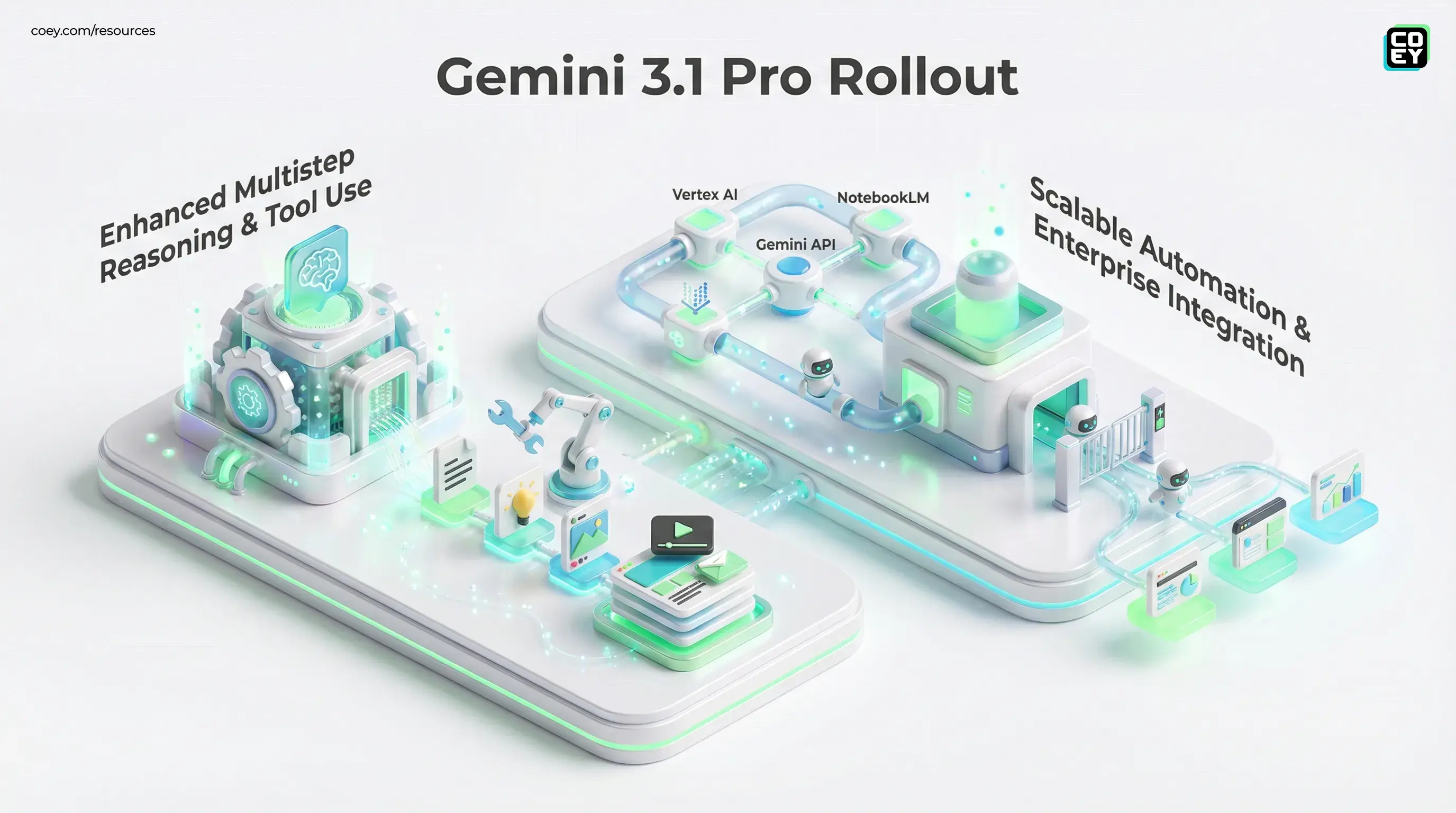
What Google is actually shipping
Gemini 3.1 Pro is a new flagship-tier model that Google says significantly improves abstract reasoning and agentic tool behavior. In the announcement, Google highlights a 2.5x improvement in abstract reasoning versus the prior Pro generation, including results on ARC-AGI-2. The figures cited in the announcement tie that headline to an ARC-AGI-2 score of 77.1% for Gemini 3.1 Pro versus 31.1% for Gemini 3.0 Pro.
The model also keeps Google’s big-context posture, with a 1M token context window part of the headline spec.
Translation for non-technical teams: this is the kind of upgrade that makes an AI more useful as a collaborator in a workflow, not just a chat buddy. Big context plus better reasoning equals fewer “wait, why did you ignore the brief?” moments.
Where it shows up: product surfaces vs pipelines
Google is rolling Gemini 3.1 Pro out across both consumer-facing and enterprise surfaces, which matters because it signals how they want it used:
- Gemini app: good for ad hoc work (strategy, writing, synthesis) and testing what the model can do before you formalize it.
- NotebookLM: more research desk than chat, built for long documents, structured notes, and turning messy sources into coherent outputs.
- Vertex AI: where this becomes an enterprise lever: IAM controls, quotas, logging, and the knobs you need when your automation connects to real business systems.
- Gemini API: the difference between “we can use it” and “we can scale it.”
Why this split matters: UI access is for experimentation; API plus Vertex access is for operations. Your team’s time dies in the gap between “works in a demo” and “works at 10,000 outputs per week.”
The big deal: multi-step automation gets less fragile
Marketing teams do not need an AI that can write a single good paragraph. They need an AI that can survive a chain. Most real workflows are sequences with dependencies:
- Pull competitive context and brand constraints
- Generate campaign angles and pick winners
- Turn angles into briefs
- Turn briefs into multi-format assets
- Validate claims, tone, and channel requirements
That’s where reasoning quality turns into money. When the model fails early in the chain, every downstream step becomes rework. In automation, rework does not just cost time, it can quietly multiply compute spend through retries.
Google is emphasizing improved agentic tool use, meaning the model’s ability to call tools and stick to the plan. That is the part that matters if you are building beyond a writing assistant, like an agent that reads a product database, checks policy rules, then writes content in structured formats your CMS or ad system can ingest.
Reasoning upgrades are not vibes. They are what make automation chains predictable enough to trust with volume.
API reality: can you plug this into your stack?
Yes, and this is one of the most automation-friendly parts of the launch. Gemini 3.1 Pro is available to developers in preview via the Gemini API and Google AI Studio, and it is also available through Vertex AI for teams that need enterprise controls. Google’s model announcement is here.
What “API available” means in practice
- You can automate it today: trigger it from events, run it in batch, or wire it into content pipelines, subject to rollout status and quotas.
- You can standardize outputs: structured responses are the bridge between “LLM wrote text” and “system did work.”
- You can monitor it: with Vertex-level logging and quota controls, you can treat it as production infrastructure.
If a model is only available in a pretty UI, it is a nice to have. If it is in the API, it is a candidate for the factory line.
What’s new for readiness: quality per token, not just “smarter”
Google also frames the release as a practical improvement: better results on complex tasks without needing to inflate responses just to get quality. This matters for two reasons:
- Cost: in production, verbosity is a tax.
- Control: automation prefers compact, structured results over meandering essays.
Pricing note: if you are budgeting, rely on current pricing tables inside your Google developer and enterprise consoles rather than screenshots and secondhand posts, since platform pricing varies by plan and token tiers.
| Need | Gemini 3.1 Pro fit | Workflow implication |
|---|---|---|
| Long, multi-step work | Strong (reasoning plus 1M context) | Fewer breakdowns across chained tasks |
| Automation plus integrations | Strong (Gemini API plus Vertex AI) | Callable from orchestration tools and internal services |
| Hands-free publishing | Not fully (still needs QA gates) | Best used with critics, validation, and approvals |
How marketing teams will feel this first
The first real win will be operational:
- Campaign planning that stays coherent: fewer contradictions two steps later.
- Research synthesis you can reuse: better long-context handling means cleaner structured summaries.
- More stable repurposing: turning one core doc into emails, social, landing copy, and FAQs tends to break when the model loses constraints.
If you are already building content pipelines, the practical move is not “replace your whole stack.” It is: swap the brain in the same call pattern, then measure whether your first-pass valid rate improves and retries go down.
For the COEY breakdown of why this model is as much a workflow upgrade as a reasoning upgrade, see Google’s Gemini 3.1 Pro Is a Reasoning Upgrade and a Workflow Upgrade Too.
What to watch before you bet the quarter on it
Gemini 3.1 Pro is positioned as more capable and more operational. Still, production teams should keep a pragmatic checklist:
- Region and quota behavior: rollout and capacity constraints can affect reliability during spikes.
- Tool-use consistency: function calling only matters if it is stable under messy inputs.
- Eval it on your workflows: benchmarks are a signal, not a guarantee.
Reality check: this is an upgrade you can operationalize, but it does not eliminate governance. Better reasoning reduces babysitting, it does not remove responsibility.
The bottom line
Gemini 3.1 Pro is Google leaning into the part of AI that actually scales creativity: reliability across multi-step work. The launch matters because it is available where real automation lives: Gemini API and Vertex AI, with NotebookLM and the Gemini app acting as human-friendly front doors.
If your team is trying to scale creative output without scaling headcount, this is the kind of model release that can shift throughput, not because it writes prettier copy, but because it breaks less often when you ask it to act like a system component.
Let COEY Wire Your AI Marketing Stack
We help brands and agencies connect n8n, Claude Cowork, OpenClaw, and other AI tools into marketing systems that produce real output. From content automation to full campaign orchestration across every channel. See how it works or request a proposal.