
Seedance 2.0 CapCut Integration 2026
Seedance 2.0 lands inside CapCut in 2026. What the integration unlocks for AI video marketing, social creative ops, and automated content pipelines.
18 March 2026Team COEY
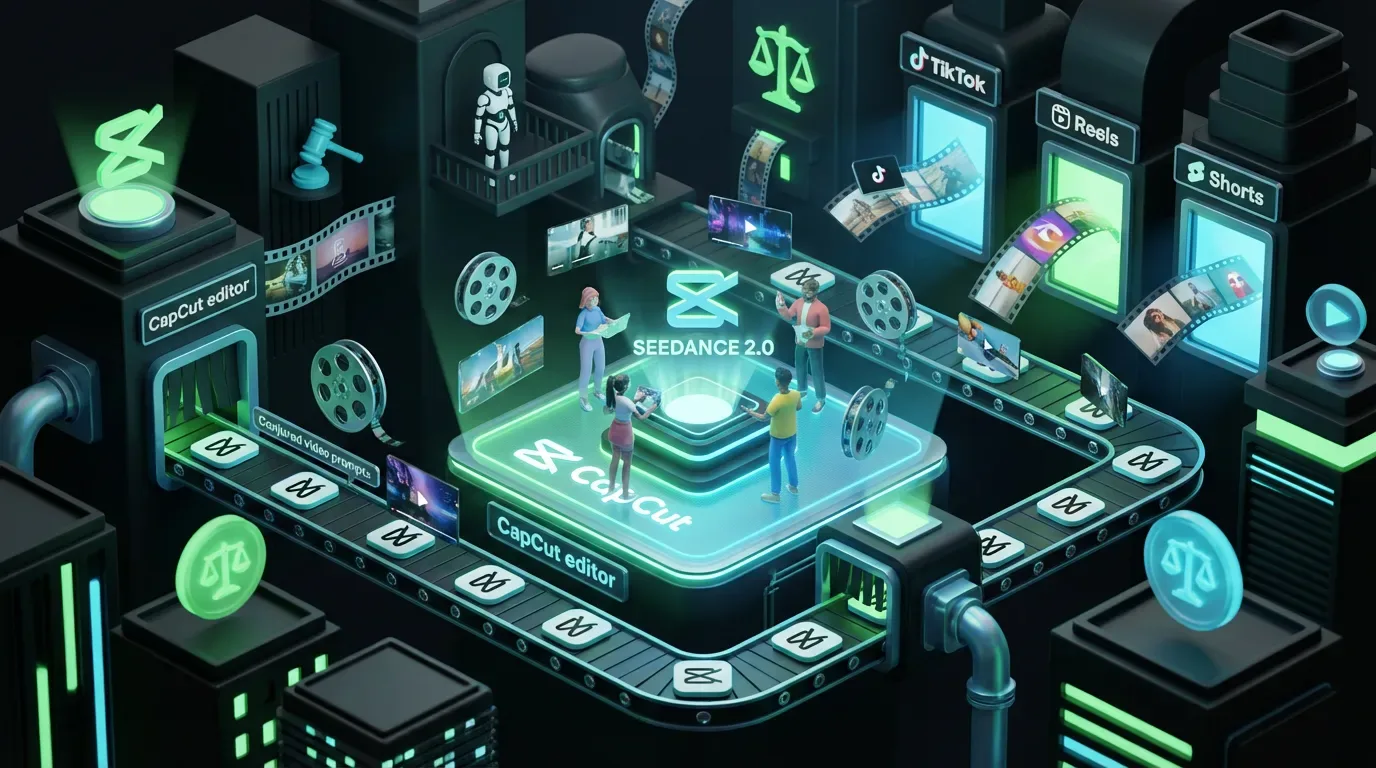
ByteDance has quietly done the loudest thing possible in AI video: it put Seedance 2.0 directly inside CapCut. Not as a separate “go play with the model” tab, but as a native part of the editor where creators already cut, caption, template, and export. The front door is CapCut’s official Seedance 2.0 page (https://www.capcut.com/tools/seedance-2-0), and the move matters for one reason: embedded generation scales. Standalone generation trends.
Seedance 2.0 is being positioned as an advanced text-to-video (and more) engine with smoother motion and better scene consistency. But the real story is workflow gravity: CapCut is already the short-form factory line, and now “generate a clip” is basically another edit action. That’s the mission-aligned unlock: humans keep intent and taste; the machine manufactures breadth; the editor becomes the collaboration surface.
If you want the earlier COEY breakdown of the same shift, see Seedance 2.0 Lands Inside CapCut, and That’s the Real Flex.
What Seedance 2.0 actually is
Seedance 2.0 sits under ByteDance’s Seed research umbrella and is framed as a multimodal video generator, meaning it can be steered by more than just a text prompt. ByteDance’s own product page for Seedance 2.0 is here (https://seed.bytedance.com/en/seedance2_0), and the positioning is consistent across ByteDance and CapCut surfaces: higher fidelity, better temporal stability, and stronger controllability than earlier generations.
What’s changed in practice is less “the frames are prettier” and more “the usable-output rate is higher.” If you’ve ever run text-to-video at scale, you know the real KPI is how often you get something shippable without doing 20 rerolls and a small ritual.
When AI video lives inside the editor, it stops being “a model.” It becomes a production primitive, like trimming, captions, or templates, something teams can standardize and repeat.
CapCut integration is the real flex
CapCut didn’t just add a button. It added a distribution advantage. AI video tools often die in the export and import tax zone: generate somewhere else, download, re-upload, rebuild your timeline, then discover the clip doesn’t fit your format.
With Seedance 2.0 inside CapCut, the creation loop compresses:
Concept → generate → edit → caption → export in one environment
Templates and formatting are one click away (so outputs actually ship to Reels, Shorts, and TikTok specs)
Iteration becomes normal , not a special project (so “give me 12 variants” becomes plausible)
This is ByteDance doing what ByteDance does: turning a new capability into a default habit.
Automation potential: workflow-ready vs API-ready
Let’s separate two things that get mashed together in AI hype:
Workflow-ready equals your team can use it today inside CapCut, quickly, repeatedly
Automation-ready equals your systems can call it via API, batch it, route outputs, log usage, and run it unattended
Seedance 2.0 is clearly workflow-ready because it’s embedded in CapCut. The API story is where things get messier. Publicly, Seedance 2.0 is also being presented through third-party developer platforms like fal.ai (https://fal.ai/seedance-2.0), which signals potential for programmatic access, but availability and stability can vary quickly with partner-hosted models.
On the CapCut side, there’s a common misconception that CapCut is “API-first.” It isn’t. As of current public developer reality, CapCut does not present itself as a broadly open, first-party automation API surface for full editor control in the way ops teams mean it (batch projects, render queues, webhooks, and similar). That gap is important because it determines whether Seedance becomes a content factory node or stays a human-in-the-loop accelerator.
| Question teams ask | Best answer today | What it means |
|---|---|---|
| Can creators use it now? | Yes (CapCut UI, but rollout can vary by region and account type) | Immediate speed gains for short-form production |
| Can we automate batch variants? | Not reliably first-party | Scale depends on stable developer endpoints, not just in-editor access |
| Is it production-ready? | Yes for short-form (with human review) | Great for b-roll, transitions, concepting, and ad variants with approvals |
Rule that never stops being true: if it’s callable, it’s composable. If it’s composable, it can become an always-on collaborator in your stack.
What teams are using it for first
Despite the cinematic positioning, the earliest “this actually saves us time” use cases are wonderfully unglamorous:
AI b-roll to fill gaps in UGC and product edits
Paid social variant factories (same offer, multiple environments and pacing)
Pre-viz to get stakeholder buy-in before real production spend
Transition shots and scene setters that would otherwise require stock footage hunting
The highest ROI pattern is hybrid: keep human-shot truth anchors (faces, testimonials, product macros), then use Seedance for “coverage” around them. That’s how you scale output without turning the whole brand into AI slop.
Legal challenges: Hollywood and unions hit “report”
The Seedance 2.0 rollout isn’t happening in a vacuum. Major studios have reportedly gone after ByteDance with cease-and-desist letters alleging unauthorized use of copyrighted material and raising concerns about the model’s ability to generate recognizable derivatives of protected IP. Reporting on Paramount’s demands has been covered by TheWrap (https://www.thewrap.com/industry-news/public-policy-legal/paramount-bytedance-stop-copyrighted-material-train-ai-cease-and-desist/).
On the performer side, unions have been increasingly direct about synthetic performers and consent. SAG-AFTRA’s public stance is clear: performer likeness and voice can’t become free training data or promptable talent without meaningful protections and consent (https://www.sagaftra.org/sag-aftra-statement-synthetic-performer).
For marketers, this isn’t entertainment gossip. It’s operational risk. The more realistic video generation gets, the easier it becomes for a team to accidentally, or “accidentally,” wander into:
copyright land (characters, franchises, recognizable scenes)
right-of-publicity land (celebrity likeness, voice, mannerisms)
brand safety chaos (outputs that look like something you don’t want to be associated with)
Compliance doesn’t slow you down. Sloppy compliance does. The fastest teams build guardrails so the machine can run without turning speed into legal roulette.
ByteDance’s response: guardrails, throttles, and reality
ByteDance has publicly said it is strengthening safeguards for Seedance 2.0 as studio pressure ramps: tighter prompt filtering and efforts to prevent unauthorized use of IP and likenesses. In practice, that tends to show up as:
blocked prompts for obvious IP or celebrity requests
inconsistent availability by region and account type
tighter restrictions around high-volume usage
This is the trade: the more powerful the model, the more governance it attracts. Great for the long-term legitimacy of AI video, annoying for anyone trying to run an always-on content pipeline today.
What’s real, what’s shiny
Seedance 2.0 inside CapCut is not the end of video production. It’s the end of some of the grind. The pragmatic read:
Real and useful now
Faster first drafts for short-form video
More variants per concept (which is how performance marketing actually wins)
Less editor friction because generation happens where finishing happens
Still needs adult supervision
Rights and likeness risks scale with realism
API stability is not a given, especially first-party
Brand fidelity (logos, packaging, on-screen text) still requires human QC
Bottom line: Seedance 2.0’s CapCut integration is a workflow milestone because it embeds generation into the editor, where creation becomes repeatable. The automation upside is obvious, but full content factory readiness depends on stable, governable developer surfaces. In the meantime, the best teams will treat it like a collaborator: humans set intent and taste, machines generate breadth, and your process keeps speed from turning into risk.
Scale Your Content With AI Agents That Deliver
COEY helps brands and agencies automate content creation, marketing ops, and campaign execution using n8n, Claude Cowork, OpenClaw, and custom integrations. See how our agentic automation works across every marketing channel, or request a proposal.