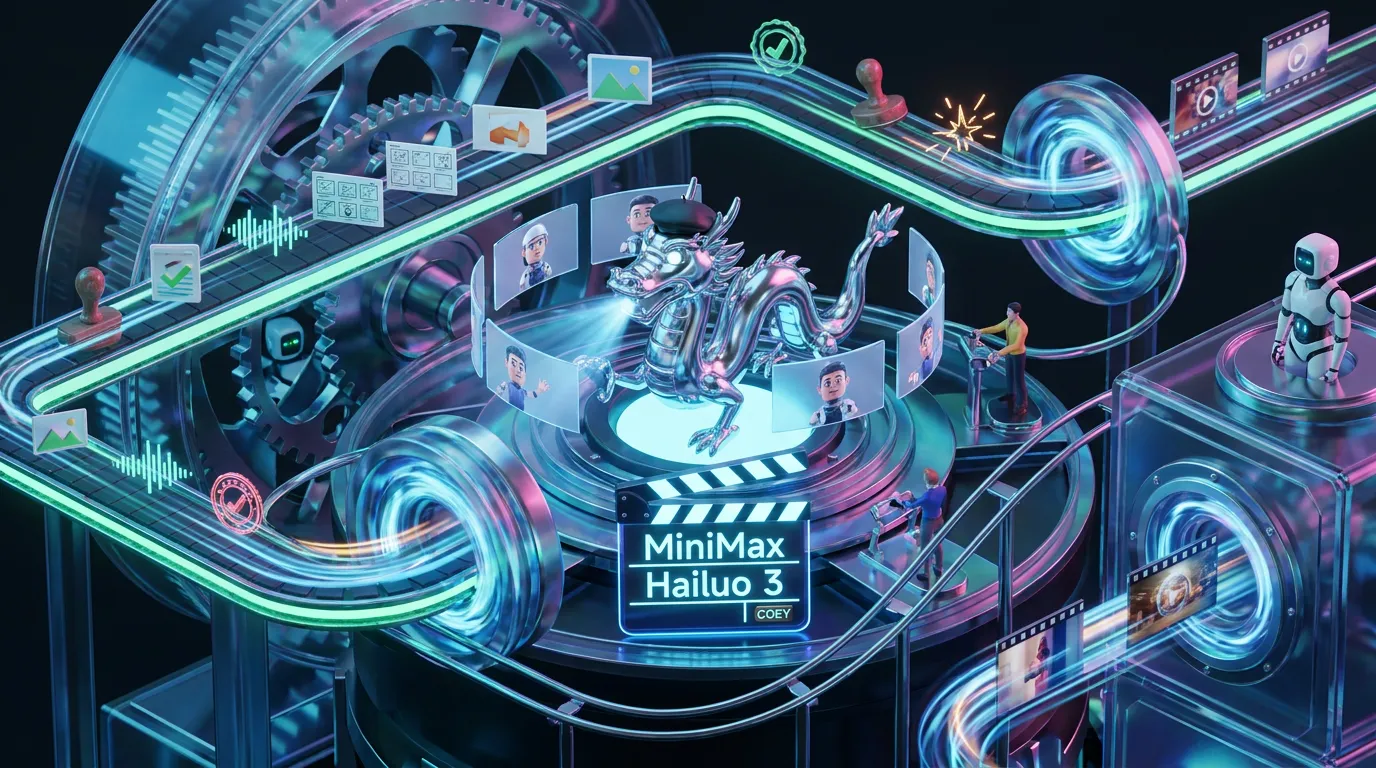
I2V stands for Image-to-Video: AI that takes a single still image (or a small set of reference images) and generates a short video clip from it. If text-to-video is “make something from vibes,” I2V is “make something from assets you already have.” And that’s why it’s showing up everywhere creators and marketing teams actually work.
The reason to care is simple: I2V turns your existing creative library (product photos, key art, thumbnails, brand shoots, even one good frame from a campaign) into motion. Not “Hollywood film” motion, more like scroll-stopping micro-video that fits ads, Reels, Shorts, product loops, app store previews, and pitch decks.

If you want the “tool-first” on-ramp, Runway is a canonical example of a commercial platform that supports image-to-video generation in a production-minded way (Runway).
Translation for execs: I2V is not an art trick. It’s a way to turn static marketing assets into video inventory, fast enough to be testable, and increasingly programmable enough to automate.
Why I2V is popping off now
Teams have been drowning in a weird contradiction: video performs, but video ops is expensive. You need concepting, shooting, editing, versioning, resizing, and then the “oh no we need 14 variants” moment.
I2V changes the unit economics because it starts from a known-good visual. That does three practical things:
- Reduces creative risk: you’re not asking the model to invent the whole world from text; you’re anchoring it to an approved image.
- Improves brand consistency: logos, packaging, color palettes, and “the thing we actually sell” stay closer to reality.
- Speeds iteration: you can generate multiple motion treatments from one asset and let performance data pick winners.
The cultural subtext is also obvious: the internet now expects motion by default. Static is the new “this looks like a slide deck.” I2V is the fastest path from “approved image” to “native-format video.”
How image-to-video works (without the math)
Most modern I2V systems use diffusion or transformer-based video generation under the hood, but the workflow is consistent:
- Input: a reference image (sometimes plus a motion prompt, style prompt, or optional extra keyframes).
- Model inference: the system predicts plausible motion over time (camera movement, subject movement, environmental dynamics) while trying to preserve identity and structure.
- Output: a short clip (commonly 5 to 10 seconds on mainstream commercial generators, and often MP4), with options like aspect ratio and sometimes frame rate.
If you’ve seen “Ken Burns” effects in editors, imagine that, but with the model hallucinating extra motion and detail. Sometimes that’s magic. Sometimes it’s nightmare fuel. The difference is your workflow: do you treat outputs as drafts to curate, or as final deliverables with no checks?
The research side is getting more controllable
A big reason I2V is getting more usable is that research is shifting from “look, it moves!” to “can we control what moves?” NVIDIA’s Motion-I2V is a clean example of that direction, explicitly modeling motion to improve consistency and controllability (Motion-I2V (NVIDIA Research)).
This matters for marketing ops because the main barrier to scaled automation is not peak quality. It’s predictability. If motion control improves, you get:
- Higher “first-pass usable” rates (fewer rerolls)
- More consistent outputs across variants
- Better creative direction without hand-animating
Open tooling: I2V as a modular add-on
On the open ecosystem side, I2V is becoming something you can bolt onto existing pipelines, not a separate “video app.” One widely cited approach is I2V-Adapter, which positions image-to-video as an adapter module compatible with diffusion workflows (I2V-Adapter (GitHub)).
That’s a big deal for teams that already have Stable Diffusion-era infrastructure (custom LoRAs, ControlNet-style controls, internal servers, ComfyUI graphs). The more I2V behaves like a component, the more it can be operationalized.
If I2V is “a button,” it’s a tool. If I2V is “a node,” it becomes infrastructure.
API availability: the line between toy and system
Here’s the COEY reality check: the moment I2V is accessible via API, it stops being a creative novelty and becomes a workflow primitive.
Some commercial platforms are clearly aiming at programmatic usage. Runway has developer documentation that supports common automation patterns (Runway API documentation).
Automation readiness snapshot
| Question | What to look for | Why it matters |
|---|---|---|
| Can we automate it? | REST API, async jobs, polling (and if available, webhooks) | Batch rendering and scheduled output |
| Can it plug into our stack? | Clean inputs and outputs, stable URLs, metadata | DAM, CMS, ad ops, and review routing |
| Is it real-world ready? | Controls plus consistency plus rate limits you can live with | Predictability beats “one perfect demo” |
Even when a platform has an API, “workflow-ready” still depends on your surrounding plumbing: retries, naming conventions, storage, human approvals, and brand safety checks.
Where I2V fits in real creative operations
I2V’s highest-confidence uses are the ones where motion is valuable but doesn’t need to be cinema-perfect:
- Paid social variant factories: animate 10 product stills into 50 hooks across 9:16 and 1:1.
- PDP and ecommerce loops: subtle movement that increases dwell time without requiring a shoot.
- Pitch and pre-viz: turn key art into motion boards so stakeholders stop arguing in hypotheticals.
- Localization lanes: keep visuals stable while swapping text overlays, VO, or region-specific framing downstream.
The compounding effect is simple: humans set intent and pick winners; machines generate breadth. You don’t need I2V to be perfect. You need it to be good enough, consistently enough, that your team spends time selecting, not rescuing.
For adjacent context on how AI video is becoming operational, see our recent post Helios Goes Open: Real-Time AI Video Hits 19.5 FPS (and That Changes Workflows).
Limits you should not ignore
I2V is improving fast, but it still has recurring failure modes:
- Temporal artifacts: flicker, warping, jitter (especially with hands, fine textures, or busy scenes).
- Identity drift: faces and products subtly morph across frames.
- Text fragility: on-screen copy and logos can get weird if the motion stresses the frame.
- Non-determinism: the same input can yield wildly different outputs, great for creativity, annoying for compliance.
Pragmatic rule: if a clip touches regulated claims, precise UI, or legal language, I2V is a draft generator, not an autopublisher.
Bottom line: I2V is “video from your assets”
When someone asks “what is I2V,” the most useful answer isn’t the acronym. It’s the operational implication: I2V turns stills into motion inventory, and as APIs mature, it’s becoming something you can wire into content systems, not just click around in a sandbox.
The teams that win with I2V won’t be the ones chasing the flashiest demo. They’ll be the ones who treat it like a collaborator: human intent plus brand constraints plus automated generation plus ruthless curation. That’s how you scale creativity without scaling grind.
Turn AI News Into Marketing Advantage
COEY turns the latest AI developments into real marketing firepower. We deploy n8n workflows, Claude Cowork agents, and OpenClaw pipelines that keep your channels running and your team focused on strategy. See our automation approach or request a proposal.