
Claude Opus 5 Turns Long Context Into Workflow Muscle
Claude Opus 5 Turns Long Context Into Workflow Muscle
July 27, 2026
Anthropic’s Claude model documentation lists Claude Opus 5 as its newest Opus-class workhorse, bringing a 1 million-token context window, API availability, and flagship-level reasoning into a package priced for serious workflow use rather than one-off demo theater. For creators, marketers, developers, and executives trying to turn AI from "helpful tab" into actual operating system, this is the part that matters: Opus 5 is not just smarter. It is more automatable.
The headline feature is the context window. One million tokens means the model can ingest much larger bodies of text, code, research, campaign history, documentation, transcripts, or customer feedback in a single run. That does not magically make every answer perfect. It does reduce one of the most annoying workflow failure modes in AI: chopping big work into tiny prompt snacks, then asking the model to pretend it remembers the whole buffet.
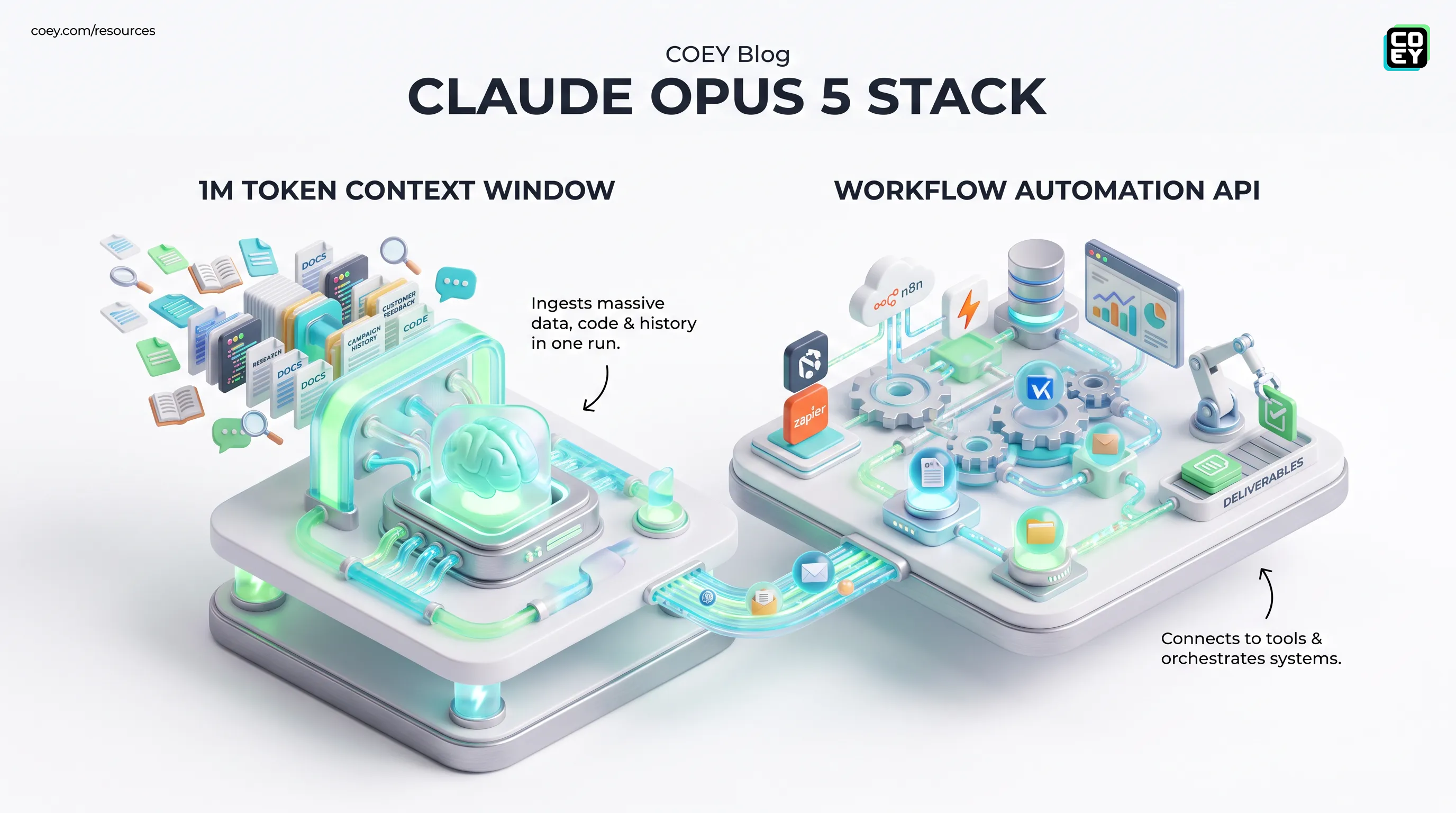
The practical shift: Claude Opus 5 makes whole-project AI work more realistic, especially when connected through APIs into repeatable business systems.
What Anthropic Changed
Opus 5 sits in the premium-but-not-absolute-top lane of Anthropic’s current lineup. It is positioned below the more expensive Fable 5 tier, but close enough on many mainstream reasoning, coding, and knowledge-work tasks that teams will need to ask a very adult question: do we need the most expensive model, or do we need the most efficient model that can reliably do the job?
That distinction is becoming the new center of AI operations. The market has mostly moved past "which model is smartest?" because the answer changes every 11 minutes and someone on X will immediately post a chart with aggressive confidence. The better question is: which model can be wired into our work, governed, budgeted, and trusted enough to scale?
| Capability | What changed | Why it matters |
|---|---|---|
| Context | Up to 1M tokens | Handles larger projects in fewer calls |
| API access | Available through Claude Platform | Can plug into workflows and tools |
| Pricing | $5 input / $25 output per 1M tokens | Premium capability without Fable pricing |
| Output | Up to 128K tokens per request | Supports longer generated reports, drafts, and structured deliverables |
Why Long Context Matters
For non-technical readers, a token is basically a chunk of text. A 1 million-token context window means Claude can "see" vastly more material at once than traditional chatbot-style workflows. That context budget includes input, output, tool results, and thinking tokens, so it is not an unlimited warehouse. Still, it matters because real business work is rarely neat. Campaigns involve briefs, research, customer data, performance reports, brand rules, legal constraints, creative history, sales feedback, and at least one cursed spreadsheet named "FINAL_final_v7_reallyfinal.xlsx."
With more context, Opus 5 can support work that previously required elaborate chunking, summarizing, stitching, and praying. Marketing teams can feed in full campaign histories. Product teams can pass in large documentation sets. Developers can analyze broader codebases. Agencies can synthesize piles of client material without losing the plot halfway through.
The value is not that humans disappear. Please, no. The value is that humans can give the machine more of the surrounding world before asking it to reason. Better inputs, fuller context, fewer weird gaps. That is how AI becomes a collaborator instead of a confident intern with amnesia.
Automation Is The Main Event
Claude Opus 5 is available through Anthropic’s API, which is the real unlock for workflow teams. The Claude API documentation shows how software can send tasks to Claude and receive outputs back that can be routed into tools, databases, documents, dashboards, and approval queues. In plain English: yes, teams can automate with it.
That means Opus 5 can sit inside orchestration platforms like n8n, Make, Zapier, custom internal tools, data pipelines, CMS workflows, CRM processes, reporting systems, and agent frameworks. A form submission can trigger analysis. A folder upload can launch a research summary. A weekly export can become an executive brief. A content archive can be reviewed, clustered, and repurposed without someone manually copying chunks into a chat window like it is still 2023 and we are all living inside prompt cave paintings.
Where It Fits Right Now
- Campaign intelligence: Analyze large volumes of creative, performance data, audience research, and messaging history to surface strategic patterns.
- Executive reporting: Turn messy inputs from analytics, CRM, social, and email platforms into structured summaries for leadership.
- Content operations: Review full content libraries for tone, duplication, gaps, and repurposing opportunities.
- Code and product work: Inspect larger codebases, documentation sets, and release notes with fewer context handoffs.
- Research synthesis: Compare long documents, transcripts, studies, and competitive material in one coherent pass.
Pricing Changes The Routing
Anthropic’s published API pricing places Opus 5 at $5 per million input tokens and $25 per million output tokens. That is not bargain-bin AI. It is still a premium model. But it is meaningfully less expensive than Fable 5’s current public API pricing of $10 per million input tokens and $50 per million output tokens, which COEY recently covered in our look at Claude Fable 5’s credit-metered return.
This is where smart teams should think in routing layers. Opus 5 should not be used for every tiny repetitive task. If you are using a premium long-context model to rename files, format a date, or summarize a three-sentence form response, congratulations, you have built a very expensive toaster.
The better pattern is tiered automation. Use cheaper models for repetitive classification, tagging, formatting, extraction, and first-pass drafts. Escalate to Opus 5 when the work needs deep context, careful reasoning, complex synthesis, or high-value creative judgment. Reserve Fable 5 for the hardest or most sensitive cases where the extra cost earns its keep.
| Task type | Best model lane | Reason |
|---|---|---|
| Bulk tagging | Lower-cost model | High volume, low judgment |
| Campaign synthesis | Opus 5 | Needs context and reasoning |
| Critical strategy | Fable or Opus | Depends on risk and budget |
What Marketers Can Actually Do
For marketing and creative teams, Opus 5 is most interesting as a campaign brain. Not a replacement for strategists, writers, designers, analysts, or brand leads. A brain extension. A system that can hold more of the moving parts while humans decide what matters.
Imagine feeding Opus 5 a product brief, past campaign results, customer objections, sales call transcripts, competitor copy, brand guidelines, audience segments, and landing page history. The model can then summarize positioning gaps, identify reusable themes, draft new message territories, flag inconsistencies, and structure outputs for review. That is not "AI writes some copy." That is AI compressing the messy middle between strategy and production.
This extends the direction Anthropic has been pushing with workflow-oriented releases like Claude Sonnet 5. Sonnet 5 remains a strong candidate for everyday, higher-volume business automation, with promotional API pricing through August 31, 2026 at $2 per million input tokens and $10 per million output tokens before its standard $3 input and $15 output pricing begins. Opus 5 is the heavier reasoning layer for the moments when the system needs to absorb more context and produce a more thoughtful output.
Real-World Readiness
Opus 5 looks ready for serious pilots and selective production deployment, especially where workflows are structured, inputs are known, and humans remain in the approval loop. The API posture is strong. The context window is operationally meaningful. Pricing is high enough to require discipline but not so high that only moonshot workflows make sense.
The caveats are still real. Bigger context does not fix messy data. If your inputs are duplicated, contradictory, outdated, or wildly unstructured, the model can now ingest more chaos at once. Iconic, but not ideal. Teams still need data hygiene, prompt standards, logging, output checks, cost caps, and fallback models.
There is also the reliability question. Long-context reasoning is powerful, but teams should test outputs against source material before trusting automated decisions. Use Opus 5 to draft, summarize, compare, and recommend. Do not let it publish regulated claims, alter budgets, approve contracts, or send brand-sensitive messages without human review. Faster mistakes are still mistakes, just with better typography.
The Bigger Signal
Claude Opus 5 reinforces where AI is heading: away from isolated chat sessions and toward intelligent workflow components. The winning systems will not be built around one giant model doing everything. They will combine model routing, automation platforms, human approvals, cost controls, and reusable prompts into production machines that scale creative output without scaling grind.
That is exactly the human-plus-machine future COEY keeps pointing at. People bring intent, taste, ethics, cultural context, and judgment. Machines handle memory, synthesis, repetition, formatting, and speed. The magic is not in pretending AI replaces the creative team. The magic is in giving the creative team a bigger engine.
Claude Opus 5 is not just shiny model news. It is a credible new layer for long-context automation: powerful enough for complex work, available through APIs, and priced in a way that rewards thoughtful routing. For teams building serious AI operations, that makes it less of a chatbot upgrade and more of a workflow signal. The future is not "ask Claude a question." The future is "connect Claude to the work, give humans control, and let the system carry the grind."