OpenAI’s “Mona-Lisa-1” Image Model Surfaces in Arena
OpenAI’s “Mona-Lisa-1” Image Model Surfaces in Arena
August 9, 2026
OpenAI appears to be testing a new image-generation model under the name “mona-lisa-1” inside Arena, the blind model-comparison platform where users vote on AI outputs without knowing which model produced which result. OpenAI has not formally announced the model, published specs, or added it to public documentation, so this is not a launch. It is, however, the kind of smoke that usually means a model is being evaluated in the wild before broader deployment.
For creative teams, that distinction matters. “mona-lisa-1” is not something you can confidently brief into your production calendar yet. You cannot walk into Monday standup and say, “We’re moving all campaign visuals to Mona Lisa, pack it up Midjourney.” But the early reports are relevant because Arena appearances often reveal where major labs are pushing next: better realism, cleaner prompt execution, fewer weird visual gremlins, and more reliable outputs for high-volume creative workflows.
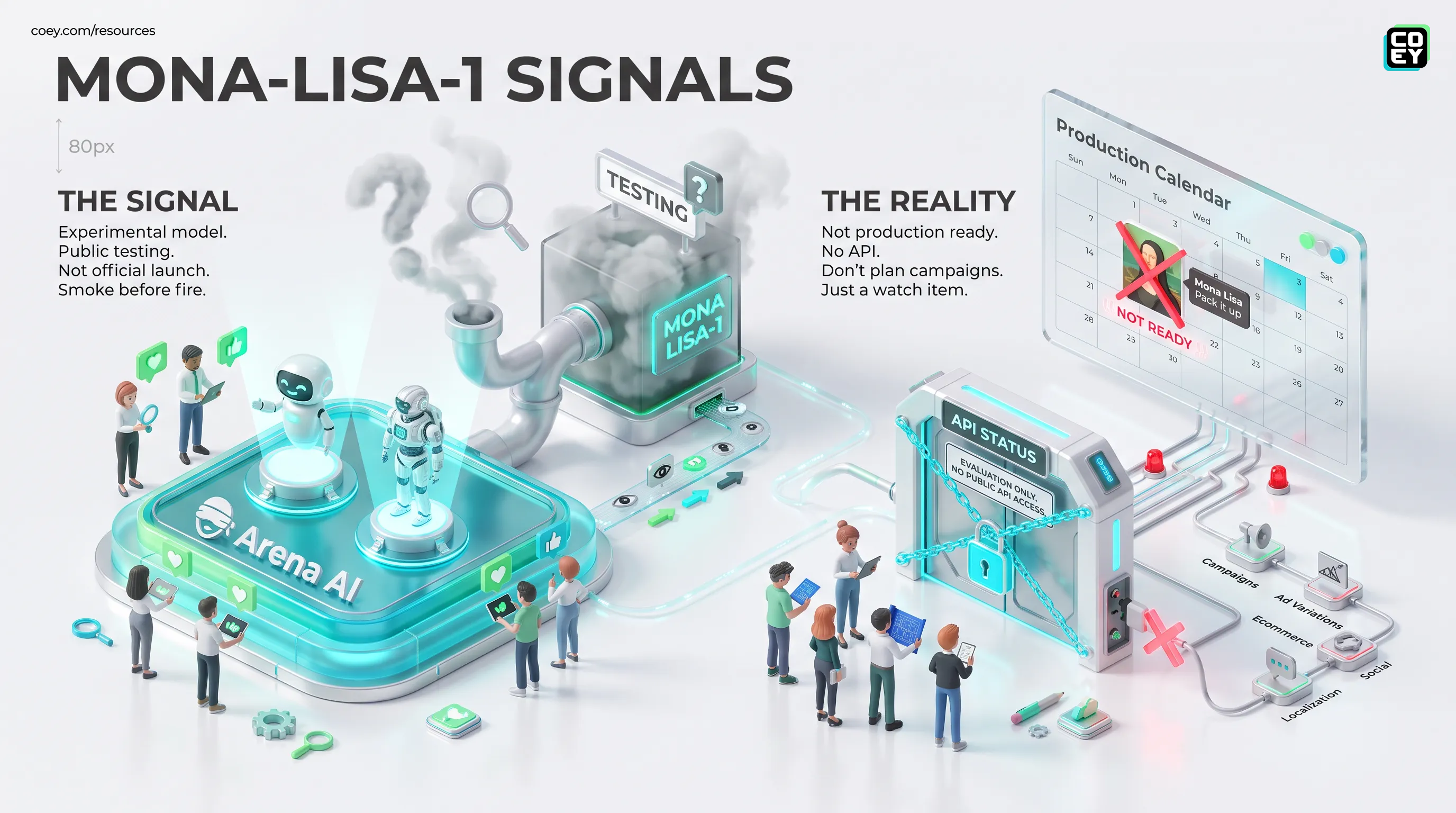
The short version: mona-lisa-1 looks like an experimental OpenAI image model being tested publicly, not an officially released product. The business question is whether its quality gains are meaningful enough to reduce human cleanup time if those improvements eventually reach production tools or APIs.
What Has Actually Surfaced
The model name “mona-lisa-1” has appeared in community reports from Arena users comparing image-generation outputs. Posts on X have described it as a potential new OpenAI image model and a possible successor, checkpoint, or test variant related to GPT Image 2, with testers pointing to improvements in realism and prompt fidelity. Some posts also claim provenance or watermark checks point toward OpenAI attribution, but OpenAI has not confirmed attribution publicly. One widely shared X report called it a potential new GPT-Image model, while another early tester post described it as performing strongly in image battles while still showing some familiar image-model flaws.
That is important, but it is not the same as an OpenAI product announcement. There is no official OpenAI blog post, no model card, no pricing page, no safety document, and no public API reference listing “mona-lisa-1” as a selectable model. In other words: we have a visible testing artifact, not a commercial release.
This is very normal in AI land, where model names can show up as aliases, codenames, checkpoints, A/B tests, or limited evaluation builds before a company decides whether to roll them into a public product. The name may stick. It may disappear. It may become part of GPT Image 2 or a later image model without ever being sold under the Mona Lisa label. AI naming is basically a garage band phase at this point.
Why Arena Matters
Arena is useful because it captures human preference at scale. Instead of relying only on benchmarks that feel like they were invented by someone trapped in a spreadsheet, Arena lets users compare outputs side by side and vote. For image models, that means people are judging the things creative teams actually care about: composition, realism, detail, coherence, style, text handling, and whether the final image looks like something a client would approve or something that escaped a haunted stock-photo folder.
For executives and marketers, Arena is less about leaderboard drama and more about signal. If a model appears there, it may be undergoing preference testing before release. If it performs well, the lab gets evidence that users prefer it over existing options. That can influence whether it becomes part of ChatGPT, the OpenAI API, or an underlying upgrade to an existing image model.
| Signal | What It Means | Business Relevance |
|---|---|---|
| Arena appearance | Public or semi-public evaluation | Possible pre-release testing |
| No OpenAI docs | Not officially available | Not ready for production planning |
| User quality reports | Early preference signal | Worth monitoring for workflow impact |
What Testers Are Seeing
Early community reactions point to incremental image-quality gains rather than a totally new creative paradigm. Reports mention better realism, cleaner surfaces, improved prompt adherence, and stronger handling of complex scene details, though some testers still report artifacts and noise in certain outputs. That is not a “burn the design department down” moment. It is more like: fewer mutant fingers, fewer smudgy backgrounds, fewer images that look perfect until you zoom in and discover the product label is written in cursed alphabet soup.
For marketers, incremental is not boring. Incremental is where ROI often lives. A model that improves first-pass usability by even 10% can matter when a team is generating hundreds of ad concepts, social posts, email headers, ecommerce scenes, or localized campaign variants. The cost is rarely just image generation. The cost is review, rejection, retouching, resizing, legal checks, brand QA, and the sacred ritual of “can we make it pop?”
If mona-lisa-1 reduces the number of unusable generations, that is a real workflow gain. Not because AI replaces creative judgment, but because humans spend less time cleaning up machine weirdness and more time making decisions that actually require taste.
API Status Is The Key
Right now, mona-lisa-1 does not appear to be available as a named model in OpenAI’s public image API documentation. OpenAI’s current image-generation documentation lists supported image models and endpoints through the OpenAI API docs, including GPT Image 2, but “mona-lisa-1” is not presented as a production option.
That makes this a watch item, not a workflow migration. For automation teams, API availability is the line between “cool demo” and “this can run in our stack while we sleep.” If a model is only accessible through an evaluation surface, it cannot be reliably connected to asset pipelines, content calendars, DAM systems, ecommerce tools, or paid media workflows. It is a shiny object behind glass.
If OpenAI eventually exposes mona-lisa-1 through the API, or folds its improvements into GPT Image 2 or a later GPT Image release, then the story changes quickly. Existing automations could generate image variations from structured prompts, store outputs in cloud folders, route them to review queues, push approved assets into campaign tools, and attach metadata for tracking. That is where human-plus-machine collaboration gets practical: humans set the strategy, brand rules, and creative direction; machines handle high-volume execution and variation.
Automation Potential
The most valuable image models are not just the ones that make the prettiest one-off dragon astronaut latte art. They are the ones that behave predictably inside repeatable systems. For brands, predictability beats novelty every time.
If mona-lisa-1 reaches production with stronger realism and cleaner detail, it could improve several automation-heavy workflows:
- Campaign concepting: Generate dozens of visual territories from one brief, then let human creatives select and refine the strongest directions.
- Ad variation: Produce platform-specific images for A/B testing while preserving the same core idea, offer, and audience angle.
- Ecommerce imagery: Create lifestyle scenes, seasonal backgrounds, or contextual product visuals at scale, with humans approving final use.
- Social production: Turn content calendars into prompt batches, generate visuals, and route them into review tools before publishing.
- Localized creative: Adapt visual concepts across markets while keeping brand composition, tone, and product hierarchy intact.
The big unlock is not “AI makes images.” We are past that. The unlock is “AI makes enough usable image options that your team can operate like a creative studio with conveyor-belt throughput and human taste at the controls.” That is the COEY-shaped future: less grind, more judgment, faster iteration.
This is also why model comparisons across visual systems matter. COEY recently covered how Grok Image 2.0 and Aurora are moving toward production-minded marketing workflows, which is the broader competitive context for any OpenAI image upgrade.
Real-World Readiness
For now, mona-lisa-1 is not production-ready in the enterprise sense because it is not officially released. Teams cannot build dependable systems around a model that may be renamed, removed, changed, or absorbed into another product without notice.
That does not mean creative leaders should ignore it. It means they should evaluate it with the right level of curiosity, not panic. The useful question is not, “Should we switch today?” The useful question is, “If OpenAI’s next image model improves reliability, where would that reduce bottlenecks in our current creative process?”
| Readiness Area | Current Status | What To Watch |
|---|---|---|
| Public access | Observed in Arena testing | OpenAI announcement |
| API support | Not confirmed | Named model or backend upgrade |
| Workflow use | Not dependable yet | Integration through existing endpoints |
The smartest teams will not wait until the official launch to think operationally. They will map where generated visuals already slow down: review queues, retouching loops, brand compliance, asset naming, rights management, metadata, resizing, and handoff to media teams. Better image quality only matters if the surrounding workflow can absorb it.
That includes governance. If a future OpenAI image model creates more believable synthetic assets at higher volume, teams will need clearer rules around disclosure, provenance, and approval. COEY’s guide to automating AI disclosure reviews is directly relevant for teams preparing synthetic media workflows before the next model wave arrives.
The Bigger Signal
Mona-lisa-1 is another sign that the image-model race is moving from spectacle to reliability. The early era was about shock: “Look, it made a photorealistic raccoon CEO.” Cute. We clapped. The next era is about operational trust: can it follow a brief, stay on brand, generate clean details, and fit into a repeatable system without creating a QA bonfire?
That is where the creative advantage will compound. Not from replacing designers, art directors, photographers, or marketers, but from giving them faster starting points and more surface area for exploration. Machines can generate the branches. Humans decide which ones deserve sunlight.
Until OpenAI confirms what mona-lisa-1 is and how it will be distributed, treat it as a strong signal rather than a product plan. The model may never ship under this name. But if its reported improvements land inside OpenAI’s broader image stack, the practical impact could be meaningful: faster iteration, cleaner AI drafts, fewer manual fixes, and more scalable creative production.
In other words, not magic pixie dust. Better: potentially useful machinery. And in the AI workflow era, useful machinery is where the magic starts paying invoices.