
NIST’s AI Agent Standards Push Is a Quiet Power Move for Enterprise Automation
NIST’s AI Agent Standards Push Is a Quiet Power Move for Enterprise Automation
February 20, 2026
NIST just stepped into the agent conversation with an AI Agent Standards Initiative under its Center for AI Standards and Innovation (CAISI), and if you’re running marketing ops, creative ops, or any “we-automate-everything” growth stack, this is the kind of news that matters more than the latest shiny model drop. Not because it makes agents smarter. Because it makes agents deployable: interoperable, auditable, and harder to turn into a security incident with a cheerful tone of voice.
The vibe shift is simple: autonomous agents are moving from “cool demo” to “enterprise infrastructure.” And infrastructure comes with grown-up requirements: identity, authorization, logging, and standards that keep your workflow from becoming a vendor-specific escape room.
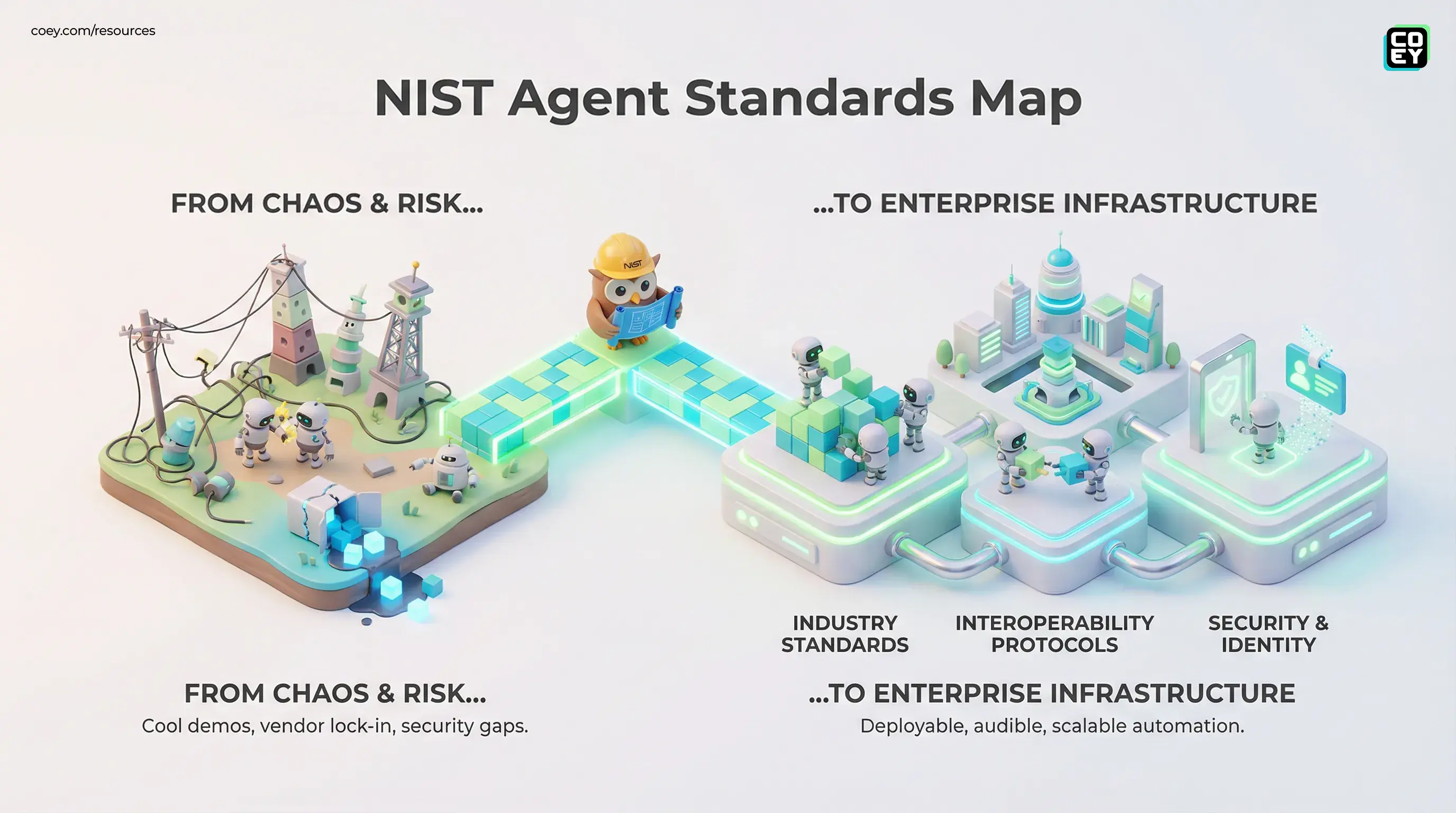
Translation for executives: NIST isn’t launching a product. It’s setting the conditions for what “enterprise-ready agents” will mean when procurement, security, and regulators get involved.
What NIST actually announced
CAISI’s initiative is framed around three tracks: (1) facilitating industry-led standards, (2) fostering community-led interoperability protocols, and (3) investing in research around security, authentication, and identity for agents. It’s also paired with real engagement mechanisms, including a CAISI Request for Information on securing AI agent systems, which signals this isn’t a “we made a PDF” exercise.
NIST’s role in the ecosystem is to turn messy, fast-moving innovation into shared expectations that enterprises can actually bet on. You don’t have to love standards to benefit from them; you just need to enjoy not rebuilding your automation stack every time a vendor changes how tool calls work.
The three pillars in one view
| Pillar | What it targets | Why you should care |
|---|---|---|
| Industry-led standards | Technical convenings, voluntary guidelines, and gap analysis for agent development and deployment | Creates a baseline for “enterprise-ready” and reduces vendor chaos |
| Community-led protocols | Interoperability protocols between agents and tools across platforms | Makes multi-tool, multi-vendor automation less brittle and less locked-in |
| Security and identity research | Authentication, identity infrastructure, and security evaluations for agent systems | Stops agents from becoming privileged, untraceable “ghost users” |
Why this matters for marketing and creative ops
Most marketing teams don’t think they’re “deploying autonomous systems.” They think they’re “speeding up content” or “automating campaign ops.” But modern agent workflows are already doing things that security teams care about:
- Pulling from internal docs, wikis, drive folders, and analytics
- Writing back into CMS, CRM, ad platforms, and support tools
- Running continuously (scheduled, triggered, or event-driven)
- Making decisions across steps (“plan → execute → verify → retry”)
Once an agent can act, the risk profile changes. The problem stops being “it wrote something cringe.” The problem becomes “it changed something real.” That’s why NIST stepping in is timely: it forces the conversation toward permissions, receipts, and interoperability, the boring stuff that makes creativity scalable without becoming chaos.
The uncomfortable truth: the best agent demos rarely show identity, access boundaries, and audit logs, because those don’t look good in a keynote. They look good in incident response.
Interoperability isn’t a nice-to-have anymore
Enterprises aren’t going to standardize on one agent vendor. They’ll have agents embedded in their CRM, their CMS, their analytics, their “AI meeting notes,” their support desk, and whatever their CEO bought because it had a slick landing page. Without shared protocols, you get:
- Custom glue code for every agent-to-tool handshake
- Inconsistent logging formats (aka: forensic nightmare)
- Workflow fragility when vendors update APIs
- Vendor lock-in disguised as “ease of use”
NIST’s initiative explicitly calls out open, community-led protocols as a strategic focus. If that lands, it’s a major productivity unlock for automation teams because it shifts integration from “bespoke per vendor” to “repeatable per protocol.”
It also dovetails with where the industry has already been moving: tool and agent connectivity standards are becoming a competitive battleground. If you want a working example of the broader integration trend, the open-source Model Context Protocol (MCP) ecosystem is one of the most visible signals that “agents should plug into tools the same way” is becoming a default expectation, not an exotic feature.
Security: the agent identity problem arrives
The single most operationally important part of this initiative is the focus on agent identity and authorization. Enterprises already know how to manage people: SSO, role-based access, least privilege, audit trails. Agents break those assumptions because they can look like:
- A shared API key everyone uses (yikes)
- A “service account” with way too many permissions
- A black box where you can’t prove why it did what it did
NIST’s adjacent work through the NCCoE on software and AI agent identity and authorization makes the direction even clearer: agents need standard, auditable identity primitives, not ad-hoc “just give it access” setups. The NCCoE project page is here.
What “agent identity” means in plain English
If you’re not technical, here’s the test: when an agent updates a campaign, a record, or a web page, can your organization answer:
- Who initiated it? (human, system trigger, scheduled job)
- What permissions did it use? (scoped, time-bound, least privilege)
- What exactly changed? (diffs, write receipts)
- Can we roll it back? (reversible operations)
If the answer is “sort of,” you don’t have an agent system. You have a high-speed mystery generator.
API and automation readiness: what’s real now
This is a standards initiative, so you’re not getting a “NIST Agent API” you can call next week. But it still has immediate workflow implications because standards shape what vendors ship, and what enterprise buyers start demanding in RFPs.
Here’s what this initiative signals as the likely “table stakes” trajectory for agent platforms that want enterprise adoption:
| Capability | What it enables | Enterprise reality check |
|---|---|---|
| Standardized logs and receipts | Auditability, debugging, compliance reporting | Without this, you can’t safely scale “agents that act” |
| Portable tool and action contracts | Interoperable agents across vendors | Otherwise every integration becomes bespoke middleware |
| Identity plus authorization primitives | Least privilege, scoped actions, traceable responsibility | If your agents share credentials, you’re one incident away from a reset |
In other words: the “automation potential” isn’t hypothetical. It’s that standards make it easier to plug agents into real stacks (CRM, CMS, DAM, analytics) with fewer custom rules per vendor, and fewer scary unknowns when something goes wrong.
What changes inside enterprises next
Expect the ripple effects to show up in three places first:
- Procurement: vendors will be asked about interoperability, logging, identity, and security evaluation, not just “does it write good.”
- Security and IT: agent permissions will start getting treated like endpoint permissions, not “marketing tooling.”
- Ops teams: the winning implementations will formalize “agent governance” as part of workflow design, not a retroactive cleanup job.
And yes, there will be friction. Standards don’t magically make innovation faster. They make scaling innovation safer. The trade is worth it when agents are touching live systems.
Pragmatic forecast: the agent era doesn’t die under regulation. It grows up under governance, and the teams who can ship with receipts will outpace the teams who can only ship demos.
Bottom line: agents are becoming regulated infrastructure
NIST’s AI Agent Standards Initiative is a signal flare: autonomous agents are no longer a side quest. They’re becoming core operational infrastructure, and infrastructure needs shared standards for interoperability and security.
For marketers and creative automation leaders, the main implication is strategic: if your workflow road map includes multi-agent campaign packaging, automated personalization, always-on content engines, or agent-driven analytics, you’re going to live in a world where identity, authorization, and audit trails matter as much as generation quality.
If your team is already grappling with agent governance in the wild, COEY’s earlier breakdown AI Workflow Firewalls: Marketers’ New Must-Have pairs well with this NIST move, because it translates “standards” into practical boundaries you can enforce inside real workflows.
The upside is big: standards reduce lock-in, integration cost, and operational risk, which is exactly what you need if you’re serious about scaling human creativity through intelligent machine collaboration. The snarky downside: the era of “just give it access and see what happens” is ending. Good. That was never a strategy. That was a phase.
Turn AI News Into Marketing Advantage
COEY turns the latest AI developments into real marketing firepower. We deploy n8n workflows, Claude Cowork agents, and OpenClaw pipelines that keep your channels running and your team focused on strategy. See our automation approach or request a proposal.