
Adobe’s AI Marketing Agents Hit AEP: Orchestrated Automation Moves From Hype to Workflow
Adobe's AI marketing agents hit AEP and orchestrated automation moves from hype to workflow. What it unlocks for AI marketing automation and enterprise ops.
13 September 2025Team COEY
Adobe Rolls Out AI Marketing Agents in Experience Platform
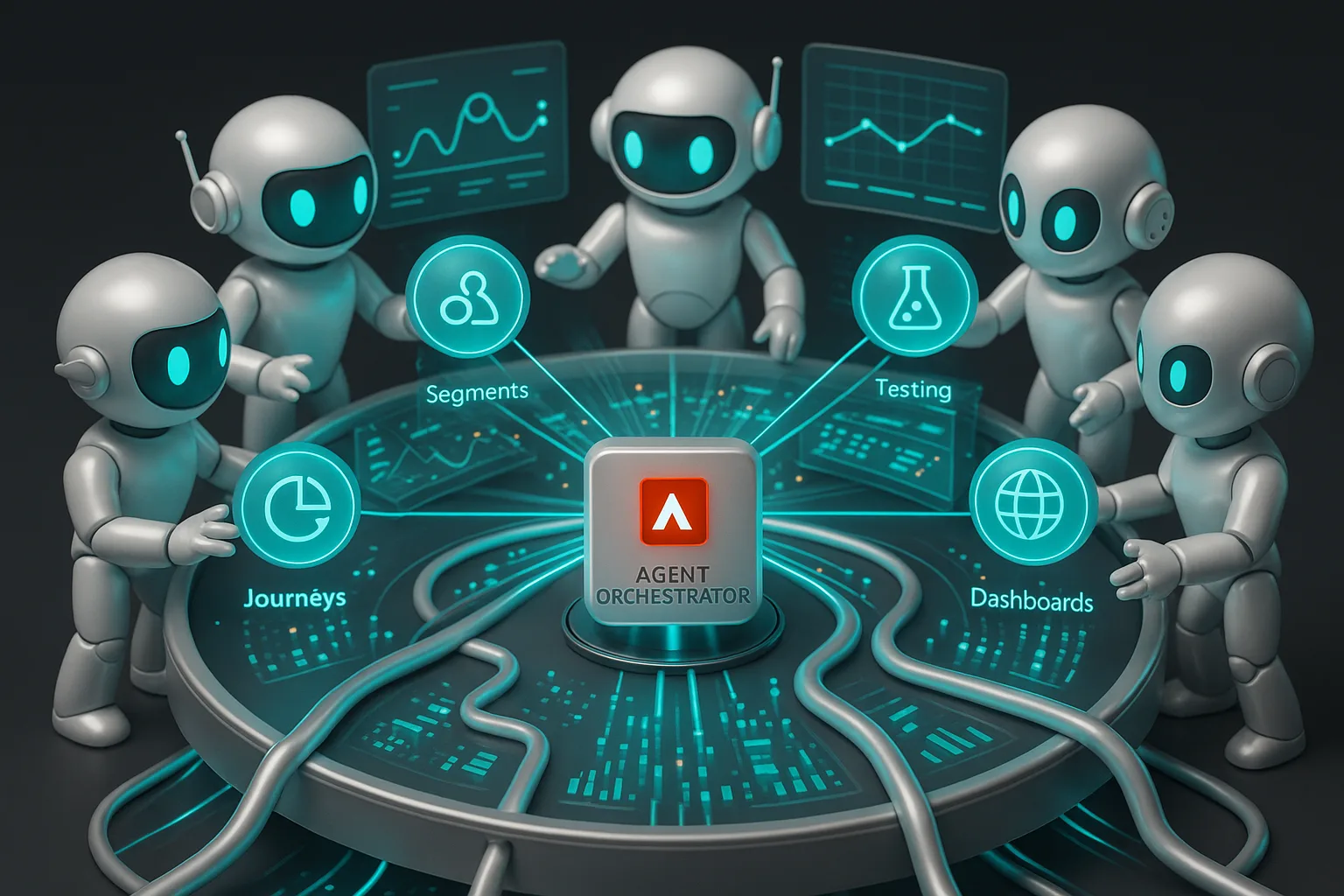
Adobe just put real automation muscle behind its customer experience stack. The company has rolled out a suite of AI agents, coordinated by the new Agent Orchestrator, inside Adobe Experience Platform (AEP), designed to automate segmentation, journey design, experimentation, reporting, and live site optimization. For enterprise marketing and CX teams, this turns AEP from “data lake with dashboards” into “action layer with agents.” Details live on Adobe’s product page (Agent Orchestrator).
Why this matters now
Agentic AI has been long on promise but short on plug‑and‑play delivery. Adobe’s move brings opinionated, prebuilt agents into a platform many brands already use for identity, audiences, and journeys, which means less custom wiring to see value. Coverage and commentary across the industry indicate this is GA, not just a lab demo (Adobe press release; Reuters; CIO).
Agentic AI innovations are redefining customer experience orchestration… enabling businesses to unlock productivity and deliver personalized experiences at scale. Anjul Bhambhri, SVP Engineering, Adobe Experience Cloud, on the AEP agent rollout ( Mi3 )
What’s new: the agent lineup
Adobe’s initial agents cover the high‑friction parts of modern marketing ops:
Audience Agent: builds and refreshes segments from live behavioral and first‑party data for personalization and testing.
Journey Agent: designs and optimizes multi‑touch journeys, spotting drop‑offs and proposing next best actions.
Experimentation Agent: runs and interprets tests, predicting outcomes to guide spend and creative rotation.
Data Insights Agent: turns signals into readable readouts, charts, and forecasts for non‑technical stakeholders.
Site Optimization Agent: monitors web performance, flags UX issues, and can deploy controlled variations.
Product Support Agent: classifies tickets, proposes resolutions, and accelerates support workflows.
Under the hood: Agent Orchestrator
The Agent Orchestrator is the connective tissue. It interprets marketer intent, plans multi‑step actions, and coordinates which agent does what in which system. It is built to use AEP’s existing data models and identity graph, which is critical for real‑time personalization, and to interoperate with external systems where needed.
Automation lens: what you can automate today
Based on Adobe’s materials and coverage, here is the current automation picture.
| Agent | What it does | Automates today | API/Integration status | Real‑world readiness |
|---|---|---|---|---|
| Audience | Dynamic segmentation from live data | Auto‑build and refresh segments; trigger campaigns when thresholds hit | Backed by AEP services and APIs; integrates across Adobe Experience Cloud | Mature if your data already lives in AEP |
| Journey | Designs and tunes multi‑touch flows | Adjusts paths based on behavior; proposes next best action | Operates within journey orchestration; API hooks via AEP | Ready for teams using Adobe journey tools |
| Experimentation | Test design and outcome prediction | Sets variants, monitors lift, suggests reallocations | Reporting and export via AEP; integration to ad channels varies by stack | Strong for insight; activation depends on channel connectors |
| Data Insights | Readable insights, charts, forecasts | On‑demand readouts and scheduled reporting | Exports to BI and warehouses common via AEP data services | Low‑friction quick win for non‑technical teams |
| Site Optimization | Web monitoring and variant deployment | Flags UX issues; rolls out controlled content or layout changes | Works with Adobe web tooling; broader CDP and analytics via AEP | Best if your site stack already uses Adobe |
| Product Support | Ticket triage and suggested resolutions | Auto‑categorization, knowledge retrieval, response drafting | Integrations depend on your support platform | Promising; value grows with knowledge base quality |
APIs and integrations: can you plug this in?
Short answer: yes, if you are already in the Adobe ecosystem; increasingly yes if you are not. The Orchestrator rides on AEP, which exposes REST APIs for data ingestion, identity, segments, decisions, and eventing. Adobe positions the agents to call and be called, so you can sync segments to channels, export insights to BI, and trigger journeys from external events. Industry coverage also points to partnerships with major services firms and clouds to extend reach beyond Adobe‑only stacks.
Translation for builders: you can automate segment refreshes on data updates, pipe agent insights into collaboration tools or your CRM, and roll out web variations under policy guardrails. The sophistication of full‑loop automation, from insight to change to measurement, will depend on your channel connectors and governance.
Current vs. future: what is real today, what is next
Live now: The six prebuilt agents inside AEP, coordinated by Agent Orchestrator, with workflows that span segmentation, journeys, testing, reporting, and web optimization.
Coming next: Experience Platform Agent Composer, the path to build and brand custom agents with your policies and skills, is progressing toward availability.
Multi‑format relevance: text, photo, video, audio
These agents are not generating your YouTube edit or the hero shot yet. They are orchestration layers that decide which creative to show, when, and to whom. The ripple effects across formats are very real:
Text: Rotate headlines and CTAs per audience segment; generate reporting readouts that highlight copy performance by cohort.
Photo and Design: Dynamically serve creative variants that match segment intent; surface underperforming assets for replacement.
Video: Use journey signals to choose cutdowns vs. long‑form; test thumbnails and intros with Experimentation Agent feedback.
Audio and Podcasts: Tie calls to action in audio campaigns to journey states; report lift by episode or channel.
Automation flows across these formats via data. As the agents update segments and journeys, they can trigger the right asset variant without manual trafficking, then score performance and loop improvements back into planning.
What creators and marketers can do today
Turn always‑on segmentation into always‑on personalization. Use Audience plus Journey to keep cohorts fresh and experiences adaptive, not quarterly refreshes.
Shorten the test and learn loop. Let Experimentation plus Data Insights move you from waiting for the weekly deck to near‑real‑time shipping of the winner.
Operationalize web insights. Promote Site Optimization Agent from hall monitor to traffic cop with controlled rollouts and rollback rules.
What is still locked or emerging
Custom agent skills. The real fun, brand‑specific agents with your compliance, tone, and actions, is gated by broader release of Agent Composer.
Deep non‑Adobe activation. You can export and trigger, but the most seamless sense‑decide‑act cycles are inside Adobe’s garden for now. Expect partner connectors to widen that path.
Agent governance. Policies and guardrails are improving, but teams will need clear approval paths and drift detection before enabling fully autonomous changes across channels.
Adoption signal: hype vs. workflow
Industry coverage cites strong enterprise interest, with named brands piloting agents across journeys and support. That puts this in usable‑today territory for teams with data discipline and a defined operating model, less a shiny demo and more a way to compress ops cycles.
COEY take: automation that scales creativity
Marketing is not short on ideas. It is short on time between idea and impact. By delegating the grind, such as segment math, journey tweaks, test monitoring, and reporting, to agents, teams buy back creative and strategic cycles. The human plus AI handshake looks like this: humans set goals, guardrails, and taste; agents keep the machine turning and the insights flowing.
Bottom line: If your customer data foundation lives in AEP, switch these agents on and start measuring cycle time saved and incremental lift. If you are outside Adobe’s stack, watch the Agent Composer and integration roadmap. As custom skills and broader connectors land, this shifts from nice inside Adobe to orchestration layer for the whole funnel. That is when automation stops being a feature and starts being your competitive edge.