Kling 2.5 Turbo: Reliability for AI Video Teams
Kling 2.5 Turbo brings reliability for AI video teams. What it unlocks for AI marketing automation and brand consistent generative video ad workflows today.
25 September 2025Team COEY
What’s new and what’s real in Kling 2.5 Turbo
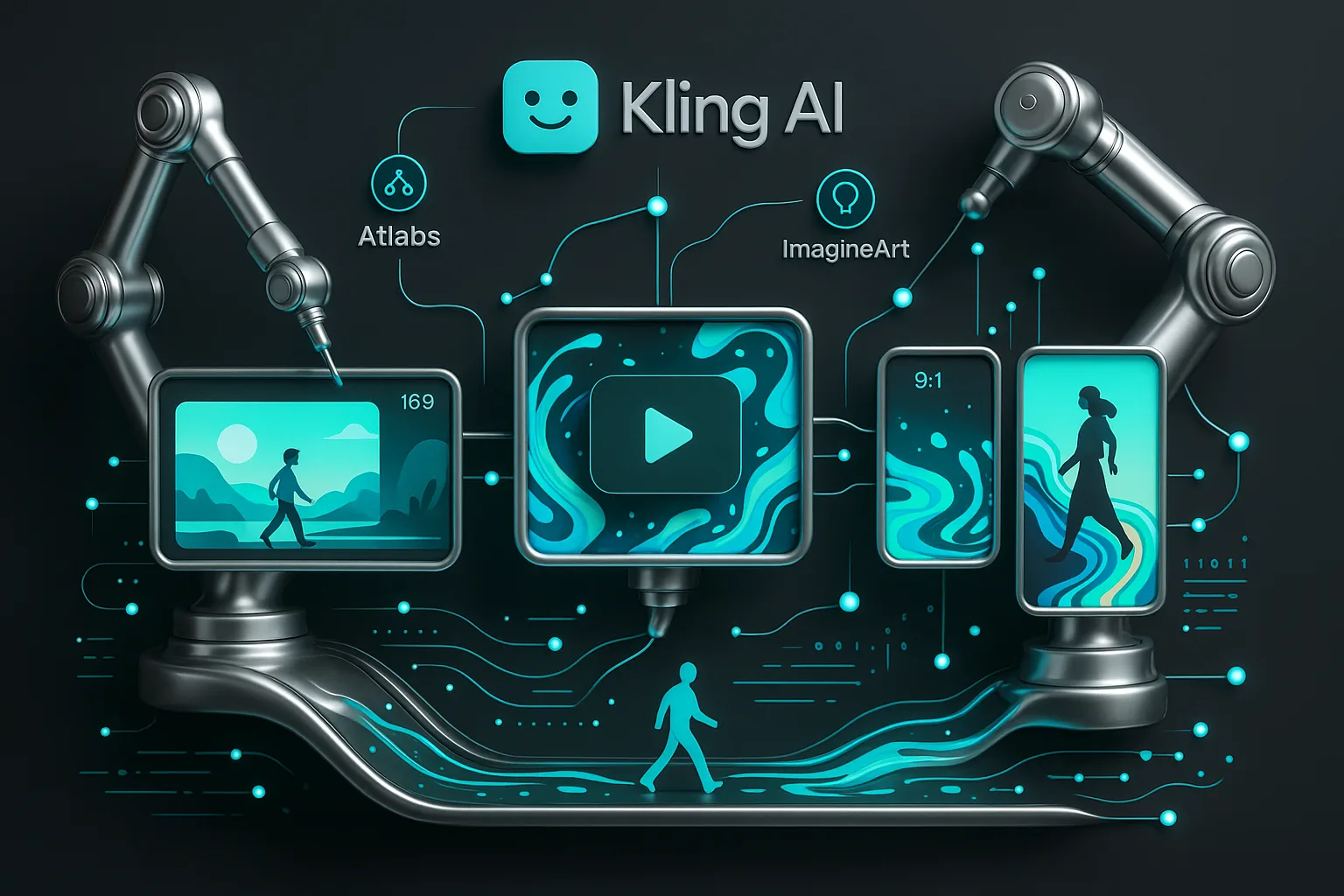
Kling AI is rolling out its 2.5 Turbo video model, with partner platforms already listing access and early demos pointing to clear gains in motion realism, temporal consistency, and prompt fidelity. For teams already betting on AI-native video, this is less about spectacle and more about stability and throughput: cleaner first passes, tighter adherence to style, and fewer post fixes. You can explore Kling’s platform here: klingai.com.
While Kling’s parent company Kuaishou has publicly chronicled its rapid model cadence through 2.0 and 2.1, 2.5 Turbo is emerging through partner ecosystems first, including Atlabs and ImagineArt. That’s typical for fast-moving video models: distribution lands where creators are already shipping content, while official docs catch up.
Smoother motion and camera control: Less jitter, fewer “physics breaks,” and more believable movement , the difference between a passable clip and a usable asset.
Better temporal coherence: Characters and objects persist more reliably across frames, which matters for brand continuity and narrative beats.
Closer prompt and style match: Color, lighting, and texture alignment feel tighter, so your first renders sit closer to the brief.
Cleaner frames, fewer artifacts: Less time rotoscoping, denoising, or patching anomalies in the edit bay.
The headline isn’t a single mind-blowing demo , it’s that 2.5 Turbo raises the floor. That’s what actually scales creative operations.
How we know
Partner listings highlight availability and model positioning: Atlabs has added 2.5 Turbo to its model roster, indicating improved speed and control, and ImagineArt has announced a 2.5 Turbo rollout window for creators on specific plans. Meanwhile, Kuaishou’s IR updates confirm the broader model arc and enterprise focus: 2.0 marked a leap in motion and semantics, with 2.1 sustaining that trajectory.
Atlabs model page: Kling 2.5 Turbo on Atlabs
ImagineArt announcement: Kling 2.5 Turbo on ImagineArt
Kuaishou on the 2.0 era: Kling AI advances to 2.0
Q2 2025 IR overview: Kuaishou 2025 updates
What changed versus 2.1 (and why teams will care)
| Category | 2.5 Turbo (early use) | 2.1 (prior gen) |
|---|---|---|
| Motion & Camera Stability | Smoother pans and tracks; fewer “rubber body” moments | Occasional jitter or drift in complex moves |
| Temporal Coherence | Stronger character/object persistence across shots | Periodic inconsistencies under fast action |
| Prompt & Style Fidelity | Tighter match to color, lighting, art direction | Closer than 2.0, but still variance under heavy styling |
| Artifacts & Cleanup | Fewer visible glitches; less paint-out work | Manual touch-up often required |
| Iteration Speed | Faster concept-to-preview loops on partner platforms | Solid, but slower at higher quality settings |
Call it an upgrade for the boring parts of production , the places where creative energy usually goes to die. If you run paid social, you’ll feel this in fewer reruns. If you manage multi-market assets, you’ll feel it in approvals moving faster because frames are more on-brief. If you’re stitching sequences for a story, you’ll feel it in fewer continuity breaks.
Automation lens: Can this plug into your stack?
Short answer: increasingly yes, but the path depends on where you get access.
APIs and integration status
Kling platform: Enterprise-facing APIs have been part of Kling’s trajectory through 2.0 and 2.1, with broader access typically handled via account dashboards. Expect staged access and usage controls rather than open, public endpoints.
Partner platforms: Atlabs and ImagineArt provide practical on-ramps. If you’re already automating asset generation through these services, 2.5 Turbo can slot into existing flows the moment it appears in their API or no-code modules.
Workflow tools: With API keys (from Kling or partners), teams can wire up batch runs, A/B testing, and scheduled renders via Make, n8n, or custom scripts, often with simple HTTP nodes and webhooks for job completion.
Today: You can automate prompt generation, job submission, status polling, and asset ingestion into your DAM. Tomorrow: You’ll want webhooks, fine-grained scene controls, and stable IDs for characters and props across shots.
Automation readiness scorecard
| Capability | Today | Near-term unlock | What’s missing |
|---|---|---|---|
| High-volume batch generation | Achievable via partner APIs | Rate-limit tuning, priority queues | Transparent quotas, usage SLAs |
| A/B creative testing at scale | Prompt variants + metadata tagging | Webhook callbacks, job IDs | Native experiment analytics |
| Brand-safe style consistency | Improved with 2.5 Turbo | Reference images + presets | Locked style/fingerprint params |
| Multi-shot narratives | Better with temporal gains | Scene-by-scene scripting | Character persistence APIs |
| Full-funnel automation | Connect via Make/n8n | Asset routing to DAM/CMS | Native connectors to ad stacks |
Current vs. future: What you can do now vs. what’s still locked
What creators and marketers can do today
Spin up idea-to-preview loops on partner platforms and route outputs into your asset library automatically.
Run prompt-driven variants for social cuts (9:16, 1:1, 16:9) and push winners into paid campaigns after light editorial polish.
Use image references to maintain on-brand subjects and environments; combine with LUTs or color presets downstream for final grade.
Automate QA passes with simple checks: frame count, duration, and heuristic artifact detection before human sign-off.
What still needs to mature
Official, public API documentation specific to 2.5 Turbo: standardized webhooks, job state schemas, and error codes.
Scene-graph-like control for narrative continuity: stable character IDs, repeatable poses, and deterministic re-renders.
Direct ad-platform integrations (Meta, TikTok, YouTube) for push-button trafficking, with automatic aspect swaps and safe-area checks.
Multi-format relevance: Text, photo, video, audio
Text-to-video: Faster, more faithful drafts improve the throughput of script-driven concepts.
Image-to-video: Better coherence means logo, product, and character references translate more reliably into motion.
Audio alignment: Pair with VO and music tools; use beat detection and subtitle generation to synchronize cuts and captions in bulk.
Photo and key art: Extract hero frames from video passes, up-res in your image stack, and route to thumbnails, ads, and email headers.
Practical impact: For teams that need to scale
Creators: Less time wrestling artifacts, more time dialing style. Treat 2.5 Turbo as your “fast rough cut” engine.
Agencies: Wire up batch concepts for each client vertical, auto-publish previews to review hubs, and cut approval cycles by days, not hours.
Brands: Centralize prompts, references, and presets; lock naming conventions and metadata so performance reporting doesn’t break when volume spikes.
Startups: Use the partner APIs to prototype content factories: daily reels, product explainer variants, and localized edits with automated QC.
Caveats and realities
Official comms lag: 2.5 Turbo is surfacing via partners first; expect staggered access and evolving controls.
Policy and rights: Check usage rights, commercial terms, and platform content policies before campaigns scale.
Latency and costs: Throughput is improving, but budget predictability still hinges on rate limits, retries, and job prioritization.
Human-in-the-loop: Automation doesn’t remove taste , it amplifies it. Keep human review in the loop for brand safety and creative judgment.
The COEY take
2.5 Turbo isn’t a moonshot; it’s a reliability upgrade. That’s exactly what production teams need. With quality and coherence trending up, the door opens wider for automation: batch generation, variant testing, and multi-format routing without grinding your team down in cleanup. The remaining gap is infrastructure: stable, well-documented APIs; webhooks that behave; and a few more levers for continuity.
If your goal is scaling creativity through human + AI collaboration, 2.5 Turbo looks ready to pull weight in the pipeline , especially via partner platforms , while we wait for fuller, public-facing API maturity directly from Kling.