
Tencent Open-Sources HunyuanImage 3.0 for Real Workflows
Tencent open sources HunyuanImage 3.0 for real workflows. What the new weights unlock for AI marketing automation and brand consistent ad creative ops.
3 October 2025Team COEY
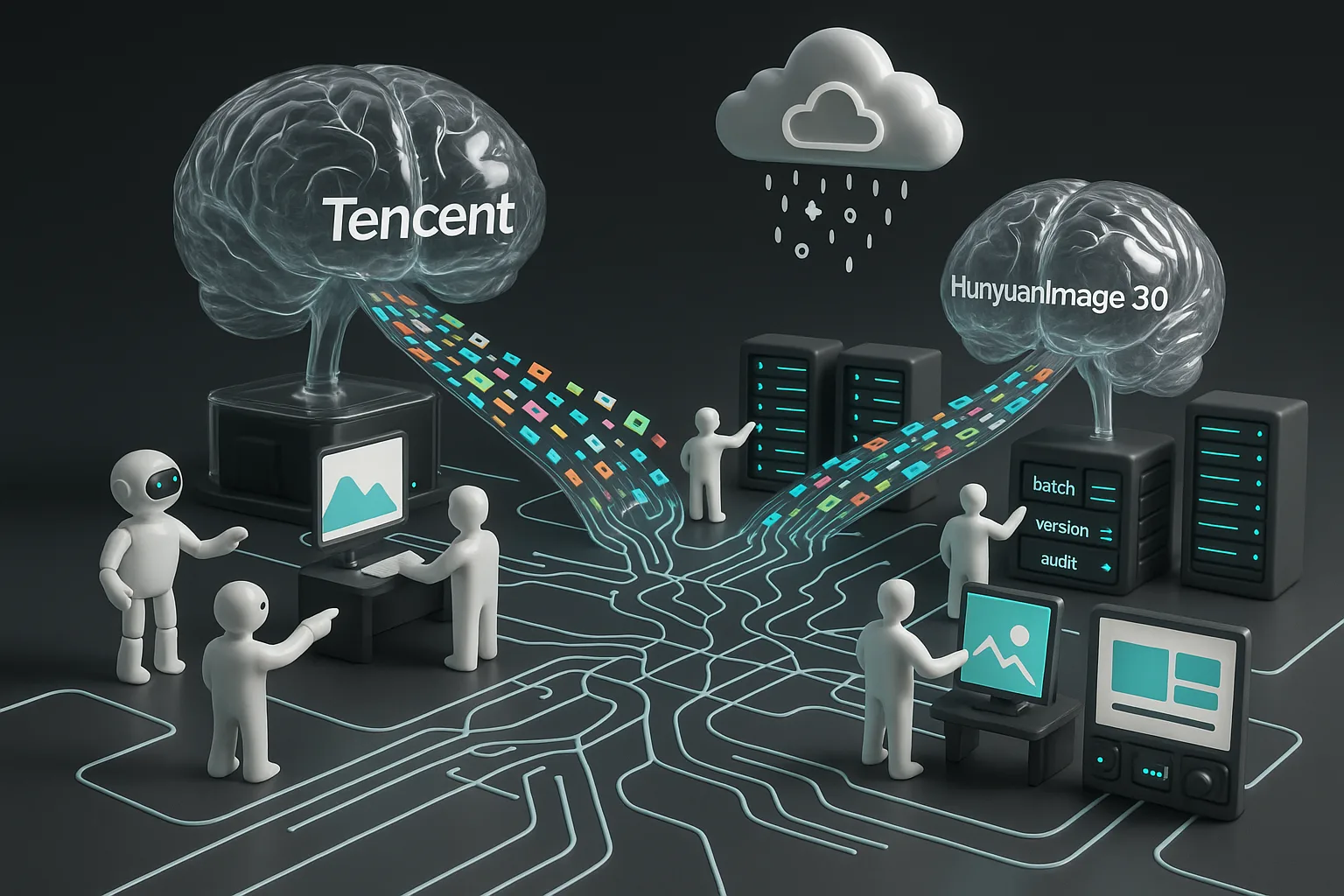
News: Tencent drops HunyuanImage 3 .0 as open weights with pipeline-friendly bones
Tencent has open-sourced HunyuanImage 3.0, an 80‑billion‑parameter, native multimodal text‑to‑image generator, with model weights and inference code now live on Hugging Face and GitHub. Announced in late September 2025 via the team’s technical report, HunyuanImage 3.0 lands as one of the most capable open image models available, and importantly one that is realistic to automate inside production stacks. For creators, agencies, and brand teams hungry for control, it is a compelling counterweight to closed generators.
Open weights do not just mean cheaper images. They mean ownership of your prompts, your outputs, and your automation story.
What dropped and why it matters
HunyuanImage 3.0 is built on a Mixture of Experts architecture: 64 experts totaling 80B parameters, with roughly 13B activated per token at inference. It processes text and image tokens as a single, unified sequence using an autoregressive framework. Translation: stronger alignment between long, specific prompts and what shows up on canvas, which is especially helpful for multi‑subject scenes and brand‑tight art direction. The technical underpinnings are detailed in the team’s technical report on arXiv.
For the COEY crowd, the headline is not just “new SOTA visuals.” It is “new SOTA we can plug into.” Open weights, transparent inference, and a permissive license give builders the green light to script, schedule, batch, and measure. That is the difference between a shiny toy and a creative engine.
Architecture at a glance
80B‑parameter MoE with 64 experts; ~13B active per token at inference
Unified text+image token stream (autoregressive) for tighter prompt adherence
Released with checkpoints and inference code suitable for local and cloud deployment
License: Tencent Hunyuan Community License (commercially usable with conditions)
Target hardware: modern multi‑GPU setups; practical guidance suggests 3×80GB minimum with 4×80GB recommended
For image generation teams, this combo of scale and selective activation is pragmatic: high expressivity without lighting up the entire 80B every step. In practice, it means a shot at premium quality while keeping cloud bills and latency within enterprise reality.
Automation readiness: where does it plug into your stack?
This release is notable because it is not just a model checkpoint. It is a foundation for automation. You get weights, inference code, and clear runtime expectations, with flexibility to expose your own endpoints.
| Capability | Status Today | Automation Impact |
|---|---|---|
| Open weights + inference | Available now (HF + GitHub) | Full control to self‑host, version, and scale batch jobs |
| Official REST API | Not provided | Easy to wrap with your own FastAPI or Flask service for webhooks, queues, and CI |
| SDKs / client libs | Community or DIY | Roll lightweight clients; integrate with workers and orchestration tools |
| License | Hunyuan Community License | Commercial use allowed with conditions; review terms for scale and region |
| Deployment footprint | Multi‑GPU (3×80GB minimum, 4×80GB recommended) | Fits enterprise GPU rigs and cloud nodes; plan around VRAM and throughput |
In short: while there is no one‑click managed API, the open inference path means you can stand up a service layer that fits your pipeline, including job queues for batch generation, asset push or pull to your DAM, and notifications into Slack or your PM tool. If you already orchestrate Stable Diffusion or Llama endpoints, slotting this in is a lateral move with better prompt‑to‑image fidelity for complex briefs.
Quality check: how good is it, really?
Early signals and the team’s report point to high photorealism, clean subject coherence, and improved adherence on long prompts. Lifestyle, product, portrait, and environment shots land in “client‑ready with light art direction polish” territory. Against the very top proprietary models, you should still expect a small gloss gap on hyper‑stylized or bleeding‑edge art directions.
Text inside images is meaningfully improved versus prior open models but remains situational. Short signage, single‑language labels, and simple layouts are increasingly reliable; intricate typography, multilingual copy, and poster‑grade kerning still benefit from a pass in your design tools.
Current limitations to plan around
Typography remains hit or miss at campaign‑grade standards
Multi‑GPU VRAM demand rules out casual desktop deployment
License has conditions, especially for large‑scale or regulated contexts, that merit legal review
No official turnkey API; you will build or adopt a thin service wrapper
Now vs. next: what creators and marketers can do today
What is ready now
Private, compliant image generation for campaigns, moodboards, concepts, and storyboards
Brand‑tuned style via fine‑tuning or adapters to reduce post‑production churn
Pipeline automation: nightly batches, A/B image variants per brief, and automated asset routing to your DAM
Cost control via self‑hosting and predictable GPU scheduling
What is likely next
Community adapters to accelerate brand and style specialization
Stronger layout and text controls through training recipes and tooling
Cleaner, standardized REST and SDK layers from the open‑source community
Tighter integrations with creative suites and MAM or DAM platforms
Multi‑format flows: beyond single images
Text: Long‑prompt adherence supports script‑like scene directions; pair with an LLM to generate structured prompt sets for batch scenes.
Photo: Product and lifestyle synthesis for campaigns, with reference‑guided consistency across SKUs and angles.
Video: Use for storyboards, shot references, and animatics; generate consistent key frames you can hand off to motion teams or video diffusion models.
Audio: Rapid cover art and episode thumbnails, templatized across a season; automate series‑wide visual IDs from a single prompt schema.
The state change here is not only about quality. It is about making cross‑format asset factories realistic. When the generator is yours, you can define schemas, enforce naming, keep logs, and blend human art direction with machine throughput.
The enterprise angle: auditability, privacy, and scale
For enterprise studios and agencies, open weights unlock the governance story. You can log prompts, versions, seeds, safety filters, and reviewers; reproduce outputs; and route sensitive references through private GPUs. That is the difference between “we made a cool image” and “we can prove how this brand asset was created and approved.”
Practical specs that matter
Multi‑GPU setups such as 4×80GB are recommended for smooth inference throughput and headroom
Linux plus recent CUDA stacks are the baseline; plan for fast storage and disciplined caching
Expect larger checkpoints and a need for robust monitoring around memory fragmentation and job queuing
For specifics, see the project materials linked at the top.
Strategy take: ownership beats opacity
Open models do not need to outperform every closed system on subjective “prettiness” to be the smarter choice. If you can fine‑tune on your private data, script repeatable generations per brief, and hit deadlines without API rate limits or surprise policy shifts, the compound returns are obvious. HunyuanImage 3.0 checks those boxes while closing the gap on fidelity.
The win is not one image. It is the machine‑assisted studio you can actually run.
What this means for the COEY community
Creators: Bring brand‑tight looks in‑house. Build mini‑libraries of prompts and styles that stick across scenes.
Founders: Swap per‑image fees for asset factories. Turn creative ops into infrastructure you control.
Marketers: Pre‑visualize campaigns at scale. Batch‑generate variants and route the winners to human polish.
Media builders: Put a service layer over HunyuanImage 3.0 and sell reliability, SLAs, audit logs, and integration, not just “AI magic.”
Bottom line
HunyuanImage 3.0 is a rare open release that is big on paper and practical in production. It brings open weights, a modern multimodal architecture, and a straightforward path to automation, the trifecta for teams scaling human creativity with intelligent machine collaboration. Start with the Hugging Face model card, skim the technical report, and wire the repo into your pipeline. The results will get you 90% of the way there, and the last 10% is where your brand, taste, and team turn automation into advantage.