Leaked: OpenAI Agent Builder Targets Automation Workflows
Leaked: OpenAI's agent builder targets automation workflows. What the new tool hints at for AI marketing automation, agent ops, and content pipelines.
5 October 2025Team COEY
OpenAI Agent Builder Preview: A canvas for agentic automation
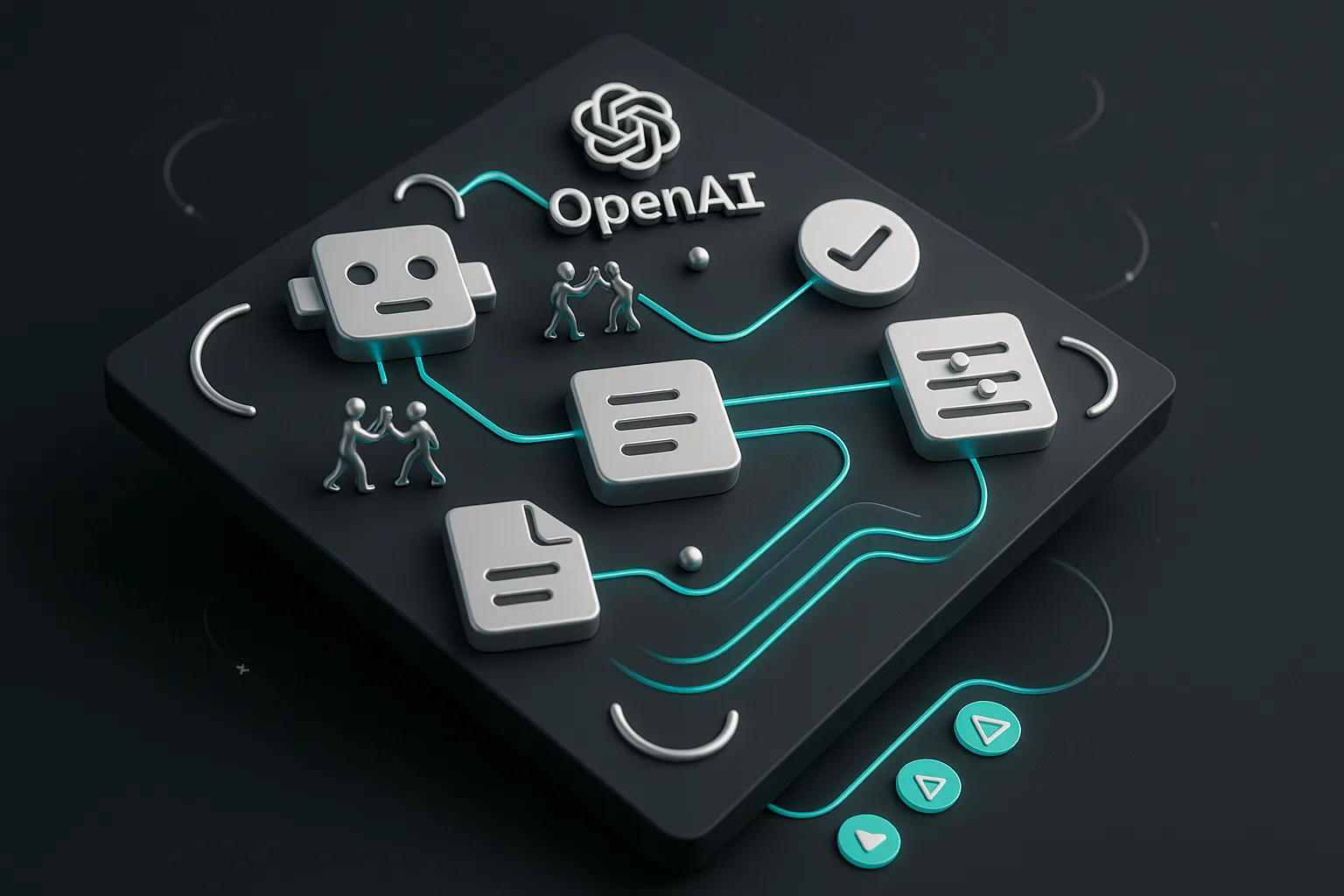
Hours before OpenAI steps on stage at DevDay, a leaked preview via TestingCatalog points to “Agent Builder,” a visual, drag-and-drop platform for designing AI-driven workflows. Think Zapier or Make , but with generative agents, decision logic, and governance on one canvas. If the preview holds, Agent Builder is OpenAI’s most direct move into orchestration and workflow tooling yet. For official details, we’ll be watching the DevDay main event here.
What’s new: Visual flows, logic, and human-in-the-loop
Per the preview, Agent Builder brings a canvas UI where you can compose flows from modular blocks:
Drag-and-drop canvas: Build end-to-end automations visually, no heavy scripting required.
Logic + loops: If/else branches and loops for routing, batching, and non-linear flows.
Connectors (including MCP): Integration points that appear to support the Model Context Protocol for standardized tool and data hookups.
User approvals: Insert manual checkpoints for brand, legal, or creative sign-off.
Guardrails: Policy controls to enforce limits, privacy, and on-brand outputs.
File search + transforms: In-flow retrieval and data shaping for content and reporting.
Templates: Quick-start recipes for common marketing and ops use cases.
The headline: OpenAI isn’t just shipping models , it’s moving up the stack to where workflows live. If Agent Builder ships with real connectors and governance, it becomes the on-ramp for agentic automation in mainstream teams.
The automation lens: Can it plug into your stack?
Short answer: likely yes , with caveats. The preview hints at connector blocks and MCP support. That matters because MCP is fast becoming a lingua franca for AI tools to safely talk to data sources and external systems. For teams already experimenting with MCP via the Agents SDK, this could mean a straighter line from prototype to production. If you’re new to MCP, start with OpenAI’s SDK docs here.
What we still don’t know: depth of third-party integrations at launch, webhooks, scheduling, retries, versioning, environment secrets, and how open the platform will be for bringing your own APIs. That list determines whether Agent Builder is a canvas for demos or a backbone for revenue-critical workflows.
APIs and integrations: “Available today” vs “coming soon”
Because this is a leak, there’s no confirmed API reference yet. But the presence of logic nodes, approvals, and MCP suggests an API-first posture under the hood. Translation for non-devs: if OpenAI exposes these pieces, you’ll be able to trigger flows programmatically, pass context from your CRM/CDP, and push results back into your channels without manual copy-paste gymnastics.
How it compares: Zapier’s Canvas and the agentic twist
Zapier’s Canvas already lets teams sketch, plan, and automate processes across thousands of apps. Agent Builder appears to play in the same stadium, but its differentiator is native generative intelligence: agents that can reason over context, write drafts, summarize, route with nuance, and call tools , in one flow. That’s the shift from “if New row in Airtable, do X” to “interpret goals, evaluate assets, decide next step, then act.”
Open questions: Zapier boasts a massive integration network and hardened ops primitives (schedules, error handling, monitoring). If Agent Builder ships light on connectors or ops controls, expect many teams to pair it with existing automation backbones rather than replace them on day one.
Real-world readiness: What creators and marketers can do now vs next
| Workflow capability | Today (based on preview) | Automation potential | Unknowns / watch-fors |
|---|---|---|---|
| Campaign pipelines (ideate → draft → QC → publish) | Composable with templates, logic, and approvals | High: add MCP tools for CMS, email, analytics | Publishing connectors, scheduling, rollback/versioning |
| Content ops (batch transforms, tagging, SEO briefs) | Loops + file search + transforms are in scope | High: automate briefs, snippets, asset labeling | Throughput limits, cost controls, audit trails |
| Support + UGC moderation | Logic + guardrails + human review steps | Medium-high: triage, summarize, route to agents | PII handling, escalation paths, latency |
| Sales enablement (RFPs, proposals, follow-ups) | Likely via templates and CRM connectors (MCP) | Medium: draft + personalize + log outcomes | Native CRM depth, e-signature, BI write-backs |
| Cross-format creative (text → image/video/audio) | Plausible via connectors to model endpoints | Medium: multi-asset campaigns auto-assembled | Official media tool integrations, rights/brand governance |
Multi-format relevance: text, photo, video, audio
Agentic workflows shine when creative doesn’t live in a single format. Picture a launch flow that drafts a blog post, spins social captions, storyboards a product video, and slices captions for shorts , then waits for approval before pushing to your CMS and scheduler. If Agent Builder exposes stable connectors to your media stack, you can route between text, imagery, video, and audio in one governed pipeline. If not at launch, expect that to be a fast-follow priority: multi-format orchestration is where generative agents drive outsized ROI.
Governance, safety, and trust: not optional
The preview’s nods to guardrails and user approvals are table stakes for enterprise adoption. For teams with compliance needs, look for:
Policy layers: Enforce tone, claims, PII handling, and usage caps.
Observability: Logs, traces, and error surfaces to debug agents.
Secrets management: Store keys and credentials safely across environments.
Human-in-the-loop: Approvals that actually block downstream actions until sign-off.
If those primitives ship in v1, Agent Builder becomes viable for real campaign work. If they’re thin, proceed with pilots, not production.
Current vs future: what’s real today, what needs to land
Real today (preview): Visual builder, logic, loops, approvals, guardrails, file search/transform, and connectors with a likely path to MCP compatibility. Great for prototyping and semi-automated creative ops.
Needs to land (DevDay and beyond): Public API, webhooks, scheduling, retries, versions, environments, role-based access, granular billing, and a credible catalog of third-party integrations (CMS, CRM, ad platforms, storage, DAM).
Bottom line for operators: If OpenAI ships a programmable canvas with MCP and real ops controls, Agent Builder isn’t just another shiny demo , it’s a candidate for your core automation lane.
Why this matters for scaling creativity
COEY’s mission is human + machine collaboration at scale. Agent Builder points to a world where strategy and taste stay human while agents automate the grindy middle: data pulls, drafts, checks, routing, and publishing. The canvas metaphor lowers the ceiling for technical lift and raises the floor for quality, making automation accessible to brand and content teams, not just RevOps and IT.
Practical impact: what creators and marketers should do next
Map your approval gates: Identify where human sign-off protects brand value. Design flows around those gates from day one.
List your agent-able tasks: Drafting, summarizing, tagging, resizing, repackaging , the repetitive, high-volume items that bottleneck output.
Inventory your connectors: CMS, DAM, CRM, email, analytics, storage. Prioritize the must-haves to judge launch readiness.
Decide your backbone: If Agent Builder is light on ops at launch, pair it with your existing automator (Zapier, Make, n8n) and let agents handle the generative bits.
Pilot with constraints: Start with sandbox data, narrow scopes, and tight guardrails; collect metrics on time saved and error rates before scaling.
What to watch at DevDay
APIs and webhooks: Can you trigger flows, pass context, and subscribe to events?
MCP depth: How easy is it to bring your own tools via MCP? Any first-party servers shipping?
Integration catalog: Which CMS/CRM/ad platforms are in day one? Is there a public partner program?
Ops maturity: Scheduling, retries, monitoring, version control, environments.
Enterprise controls: SSO, RBAC, audit logs, data residency, rate/cost limits.
Pricing and quotas: Predictability matters for teams planning to scale volume.
COEY take
This preview reads like OpenAI is meeting the market where work actually happens: cross-app, cross-format, governed, and increasingly agentic. If Agent Builder launches with real connectors and API surfaces , and plays nicely with MCP , creators and marketers will finally have a first-party canvas that blends reasoning, content generation, and orchestration. If not, it’ll be a flashy demo in search of an ops backbone. Either way, the direction is clear: the next wave of scale comes from workflows, not one-off prompts.