
Seed3D 1.0: ByteDance Enters 3D Generation Race
Seed3D 1.0 puts ByteDance in the 3D generation race. What it unlocks for AI marketing automation, 3D ad creative, and generative brand asset workflows.
25 October 2025Team COEY
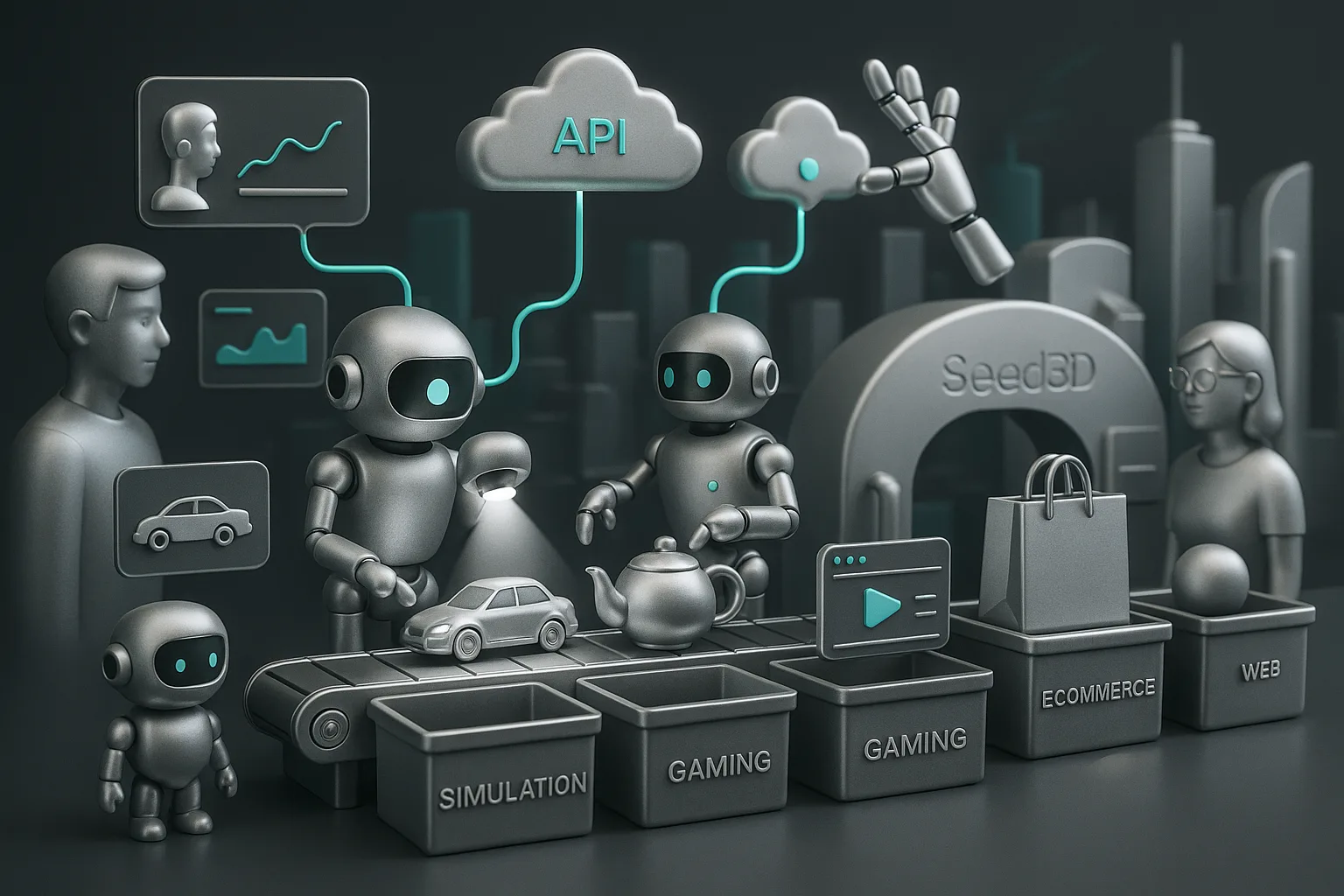
ByteDance’s Seed3D 1.0 enters the 3D arena with a bold promise: simulation-ready, textured assets from a single image, fast enough for real iteration, and packaged to plug into production. The technical report highlights watertight meshes, aligned PBR materials, and compatibility with robotics simulators out of the box, all signals this is aimed at real workflows, not just demos. Read the announcement and paper on the Seed team site here.
What’s new, what’s real
Seed3D 1.0 leverages a Diffusion Transformer backbone to reconstruct 3D geometry and materials from a single RGB image. ByteDance positions it for embodied AI and simulation use: watertight surfaces, UVs, and physically based materials that behave inside physics engines, including robotics simulators. In demos, generation runs in the sub-minute range depending on asset complexity and hardware.
The headline isn’t “image-to-3D”, it’s “image-to-usable 3D.” Moving from cool meshes to simulation-ready assets is the bar that matters for automation.
Access matters as much as architecture. ByteDance is funneling Seed3D via a hosted experience and API endpoints through its cloud stack, with a public demo at seed3d.dev. That means teams can integrate it into pipelines without babysitting a research repo. Code and full weights are not broadly open at this time; think of this as an API-first productization, not an open-source release.
Automation lens: can you wire this into your stack today?
Inputs: Single image. That unlocks product photos, UGC, or catalog shots as feedstock.
Outputs: Textured meshes with PBR maps; watertight and scale-consistent for simulation and game engines.
APIs: Yes. ByteDance offers programmatic access via its cloud. That is the path to auto-ingest images, batch-generate assets, and sync results to storage or downstream tools.
Compute: Hosted. You do not need GPUs; you do need to budget for API usage.
Workflow fit: Strong for ecommerce (turn one hero image into 3D viewers), gaming (rapid blockouts and props), robotics (asset banks for synthetic data), and AR/VR (catalog-to-AR flows).
How it stacks up in the 3D model race
3D generation has matured from “wow, a mesh!” to “will it ship?” Here is where Seed3D 1.0 sits against well-known references:
| Model | Input | Output fidelity | API/Access | Automation readiness | Notes |
|---|---|---|---|---|---|
| Seed3D 1.0 (ByteDance) | Single image | Watertight meshes, UVs, PBR materials | Hosted API | High : batch via API; simulation friendly | Targeted at embodied AI and simulators; demo and paper live |
| DreamFusion (Google) | Text prompt | NeRF-based; mesh extraction possible with extra steps | Research code | Low-Medium : requires engineering wrappers | Score Distillation Sampling; strong research impact site |
| Shap-E (OpenAI) | Text or image | Textured meshes and radiance fields | Open-source code and weights | Medium : scriptable, but not turnkey API | Good flexibility; roll your own service layer repo |
| Luma AI (captures-to-3D) | Multi-view captures | High-fidelity reconstructions via mobile | Closed product; limited API for 3D | Medium : great UX, less programmatic control | Best for creators scanning objects or scenes; not single-image |
Bottom line: Seed3D’s pitch is not “the first to do image-to-3D.” It is “the first to make it production-pragmatic with simulation-ready defaults and an API.” That is the difference between a lab toy and a pipeline tool.
Current vs. future: what you can deploy today
What’s ready now
Catalog-to-3D at scale: Pipe existing product images into Seed3D via API. Auto-generate GLTF/FBX/OBJ, publish to a web viewer, render turntable videos, and drop into AR try-on experiences.
Game and XR prototyping: Block out props and environmental assets from moodboards or reference shots. Route outputs into Unity or Unreal build systems for quick iteration.
Robotics simulation: Expand training worlds with plausible, watertight objects. Generate variants (color, texture, minor geometry) to diversify synthetic datasets without manual modeling.
Marketing and creative ops: Create 3D hero assets for campaigns, then automatically produce 2D renders and short video loops from multiple camera paths for social placements.
What still needs work
Occlusions and hidden geometry: Single-view reconstruction is hard. Expect occasional issues on unseen sides, thin structures, and reflective or translucent materials.
Human subjects and deformables: Characters, cloth, and hair remain tricky. Rigging and cleanup are still human-in-the-loop tasks.
Lighting and material fidelity: PBR maps help, but brand-critical materials such as metallic inks or complex translucency may require touch-ups.
Governance and rights: If you are converting user-submitted images, build consent and IP checks into the pipeline. 3D does not magically fix licensing.
The automation map: how Seed3D plugs into real workflows
Here is a practical flow creators and marketers can deploy without a PhD:
Ingest: Watch a folder or connect an asset manager. When a new image drops, trigger a Seed3D API job.
Validate: Auto-check mesh health (watertight, non-manifold edges, UV coverage). Route failures for artist review.
Package: Convert to GLTF/GLB/FBX, generate LODs, and embed PBR textures. Create thumbnails, turntable MP4s, and WebGL viewers.
Distribute: Push 3D assets to your CMS, ecommerce platform, or engine repository. Attach metadata for SEO, PDP pages, and ads.
Measure: Track which products with 3D increase conversion or watch time; feed learning back into which assets you prioritize.
For teams running robotics or digital twin pipelines, swap the distribution step: export to your simulator’s preferred format and register the asset with your scenario generator. The net effect is the same: less manual modeling, faster iteration, more variety.
Cross-format momentum: text, photo, video, audio
Text-to-3D via research models: With DreamFusion and other text-to-3D approaches, you can concept assets from prompts, then refine with photo reference or hand off to Seed3D for cleaner, simulation-ready output.
Photo-to-3D to video: Once you have a mesh, automated renders become straightforward: turntables, fly-throughs, and vertical social cuts can be scripted per SKU.
Audio: Layer music or VO programmatically to produce shoppable shorts or gameplay teasers at scale. The 3D asset becomes a content multiplier.
The real-world readiness check
Speed: Sub-minute generation is plausible for many assets; your throughput will depend on concurrency limits and asset complexity.
Quality: For hard-surface and many consumer goods, outputs are often ship-ready with light review. Edge cases still need artist time.
Integrations: Hosted API access is the big unlock. You can wire Seed3D into asset pipelines without managing GPUs. If you need on-prem control, broader code or weight release will be required.
Cost: Budget per-asset API costs similar to renders or retouching. For many teams, the trade is favorable: one image in, a suite of 3D, 2D, and video out.
Strategic implications for creators and marketers
Volume beats perfection: When generating hundreds of 3D assets becomes affordable, you can A/B test scenes and interactive product pages like you test headlines.
Personalization finally scales: A base mesh can spin out colorways, materials, and accessories programmatically, paired with personalized renders and videos.
Human + AI collaboration: Artists move up the stack, defining style systems, reviewing edge cases, and handling hero shots, while the machine handles the long tail.
Zooming out: where this is headed
The near future looks like this: text and images generate draft 3D; hosted services return simulation-ready assets; engines and simulators consume them natively; and content systems auto-render videos and stills for every channel. As APIs standardize and more models expose weights, expect tighter CI/CD for 3D: lint your mesh, unit-test your materials, and ship scenes to web, mobile AR, and XR with the same discipline as code.
Seed3D 1.0 is not the only player pushing this vision forward, but it is one of the clearest signs that productionity, not just novelty, is now the yardstick. For researchers and tinkerers, DreamFusion and Shap-E remain excellent playgrounds. For teams who need to ship, API-first 3D is the move.