
Automation Unlocked: Open AI Models Take Center Stage
Automation unlocked as open AI models take center stage. A practical look at what they unlock for AI marketing automation, on prem agents, and content ops.
8 November 2025Team COEY
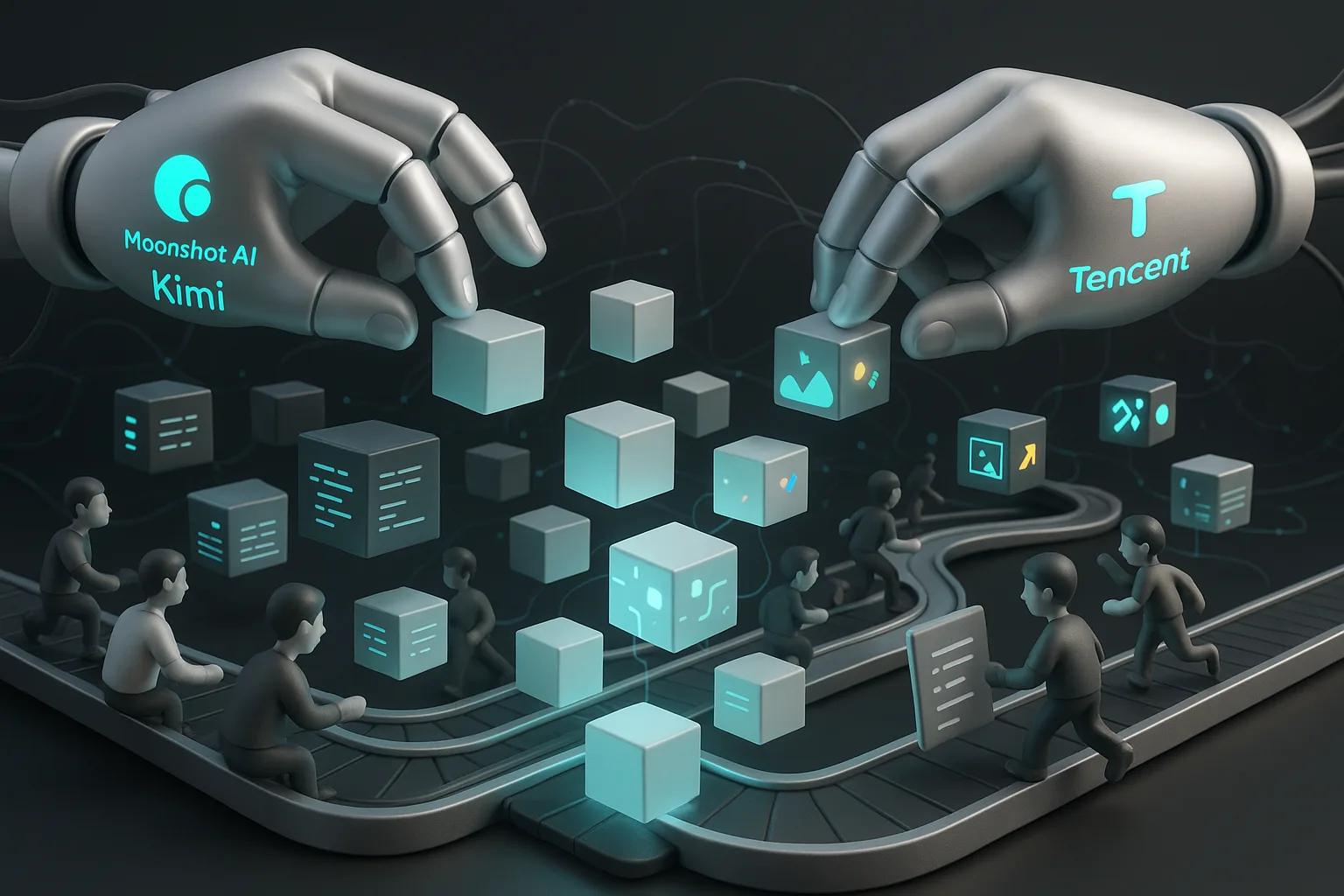
Two Open Releases, One Clear Direction: Automation-Ready AI
China’s AI scene shipped two notable open releases this week: Moonshot AI’s Kimi K2 large language model family and Tencent’s HunyuanWorld‑Mirror for fast 3D scene reconstruction. Both land with credible open-source footprints and immediate experimentation paths that creators and marketers can actually plug into. You can browse Kimi K2 on GitHub here: MoonshotAI/Kimi-K2.
Bottom line: These aren’t just “cool demos.” They edge closer to automation-ready building blocks you can run locally, deploy in the cloud, or connect to your content stack.
Why this matters now
Open, performant models change the economics of creative scale. Instead of paying per-token or locking into opaque vendor roadmaps, teams can fine-tune and orchestrate models on their own terms. Kimi K2 pushes on agentic task-handling for text and code workflows; HunyuanWorld‑Mirror pushes on turning images and video into 3D scenes fast, a foundation for AR/VR, product visualization, and simulation content.
Moonshot AI’s Kimi K2: Open LLMs with Agentic Ambition
Moonshot’s Kimi K2 arrives as an open model family aimed at stronger reasoning, tool use, and long-context tasks, the stuff you actually need for automating research, drafting, code generation, and reporting loops. Moonshot’s update notes point to active performance and API improvements over time: Moonshot platform post.
What Kimi K2 can do today
Multi-step reasoning + tools: Designed to plan tasks, call tools, and work through retrieval → write → format cycles, useful for content calendars, SEO briefs, customer FAQ updates, and code scaffolding.
Long-context workflows: Extended context windows help with working across briefs, transcripts, or long docs without constant chunking.
Developer-friendly deployment: Code and weights are available, enabling local or cloud inference and fine-tuning on domain data.
There’s encouraging momentum on integrations: Kimi K2 is supported in Vercel’s AI Gateway for straightforward API routing (Vercel changelog), which lowers the friction to slot it into existing app backends and agent frameworks.
What creators and marketers can automate right now
Editorial engines: Brief → research → draft → revision loops, with tool calls for search, CMS updates, and analytics pull-ins.
Brand ops: Asset naming, metadata, product copy, and localization, plus QA passes against style guides embedded in long context.
Data-to-narrative: Turn dashboards and CSVs into weekly summaries, stakeholder updates, and client-ready reports, reliably and on schedule.
Reality check: Claims about “beating” top proprietary models vary by benchmark and setup. Treat leaderboard screenshots as directional, not definitive. What’s concrete is the model’s openness, long-context utility, and smoother API paths, enough to power useful automation today.
Tencent’s HunyuanWorld‑Mirror: One‑Pass 3D from Images and Video
Tencent’s Hunyuan team open-sourced a fast 3D reconstruction pipeline that takes multi-view images or a short video and outputs consistent scene geometry in a single feed-forward pass. The official code and docs live under Tencent’s Hunyuan umbrella (HunyuanWorld on GitHub), and reporting indicates the latest WorldMirror 1.1 runs near real-time on a single GPU, accelerating content loops that used to require heavier rigs or iterative pipelines (TechNode).
What HunyuanWorld‑Mirror outputs
Geometry + priors: Point clouds, depth, normals, camera poses, and 3D Gaussian scenes from a modest set of views.
Format-friendly: Exports geared for common photogrammetry and 3D ecosystems (for example, COLMAP workflows), easing handoff into Blender, Unreal, Unity, or Gaussian splatting toolchains.
Sensor‑aware: Can make use of external priors (for example, pose estimates) to stabilize difficult footage.
For creators, that is new speed in turning product photos into shoppable 3D, booth mockups for events, or quick AR try-ons. For robotics and simulation use cases, it is faster environment capture for testing, digital twins, and data generation.
Automation Lens: Can You Plug These into Your Stack?
| Capability | Kimi K2 (Moonshot) | HunyuanWorld‑Mirror (Tencent) |
|---|---|---|
| Primary Modality | Text and code focused LLM (long context, tool use) | Multi-view image or video → 3D scene reconstruction |
| Automation Readiness | High: API support, runs local or cloud, agent friendly | Medium to high: CLI and code first; easy to batch and trigger |
| API/Integrations | Moonshot API; supported in Vercel AI Gateway; self-host via open weights | Open-source repo with Python and CLI; integrate via scripts, Docker, or job runners |
| Multi‑format Relevance | Text → drafts, briefs, code, structured outputs; can orchestrate image and video tools via function calling | Image or video → 3D assets; downstream use in video, interactive web, AR/VR; audio only indirectly (voiceover for 3D tours) |
| Run Cost & Control | Lower if self-hosted; predictable at scale; fine-tune on brand and style | GPU dependent but efficient; batch oriented; predictable per-scene costs |
| What’s Missing | Official turnkey agent frameworks; clear multimodal roadmaps in public docs | Hosted API or SaaS wrappers; native plugins for commercial DCCs (Blender and Unreal) still maturing |
Current vs. Future: Where you can move right away
Do it today:
Kimi K2: Stand up a content and ops agent for weekly reporting, SEO outlines, and code-gen utilities. Route via Vercel’s gateway or self-host to avoid per-token surprises. Add retrieval for brand knowledge and analytics summaries.
HunyuanWorld‑Mirror: Batch-convert product photo sets or short spin videos into 3D; export to your renderer or web viewer. Automate ingestion → reconstruction → export with a storage event (for example, S3 upload) triggering a job runner.
What’s next (near-term):
More OpenAI‑compatible endpoints and SDKs for Kimi K2 from third-party toolmakers, making swap-in easier for marketers using existing AI backends.
HunyuanWorld‑Mirror plugins for Blender, Unreal, and Unity plus packaged Docker images for one‑click deployment on common clouds, shrinking the gap between proof of concept and studio pipeline.
What’s still locked or unclear:
Benchmark bragging rights. Treat “beats X” claims with a grain of salt; your stack, prompts, and datasets matter more than leaderboard deltas.
Enterprise compliance checklists. Open models simplify data control but you still need auditability, PII handling, and vendor risk reviews.
How This Flows Across Text, Photo, Video, and Audio
Text: Kimi K2 handles long-form drafting, code, and structured outputs (JSON, HTML). That makes it a reliable orchestrator for chained tasks (brief → research → copy → QC → publish).
Photo/Video: Feed multi-view images or short video into HunyuanWorld‑Mirror to produce 3D assets. Pair with Kimi K2 to auto-generate titles, descriptions, and landing pages for each asset.
3D: Push reconstructed scenes into Gaussian pipelines or engines for web viewers, AR try-ons, or event prototypes. Automate SKU-by-SKU asset creation on a schedule.
Audio: While neither release targets audio natively, your stack can add TTS and narration to turn 3D tours and product pages into multimodal experiences (voiceover + on-screen text + interactive 3D).
Practical Impact: What This Means for Teams Scaling Creativity
For creators
Lower friction to experiment: You can try Kimi K2 locally or via API without committing to a closed platform. Same for HunyuanWorld‑Mirror on the visual side.
Own your pipeline: Keep brand data and works in progress under your control, tune on your voice, and avoid unpredictable API bills.
For marketers
Agent-driven operations: Use Kimi K2 to automate recurring reports, content calendars, and campaign QA, the unsexy but essential work that eats your week.
3D at campaign speed: Convert product photos into interactive 3D visuals for landing pages and AR placements without heavy photogrammetry overhead.
For media builders and startups
Predictable unit economics: Self-hosted inference makes per‑asset and per‑article costs explicit and controllable.
Composable stacks: Swap in new open models as they improve, keep your orchestration layer steady, and ship faster.
The Signal
With Kimi K2 and HunyuanWorld‑Mirror, open models aren’t just catching up, they’re getting practical. There is enough API exposure, speed, and documentation to build real automations today. Our take: start small but production minded. Wire Kimi K2 into a weekly content and reporting agent. Spin up HunyuanWorld‑Mirror to 3D‑ify one product line. Measure the time saved, harden the pipeline, and scale from there.