
China’s Open-Source AI: K2 Thinking and HunyuanWorld-Mirror
China's open source AI wave: K2 Thinking and HunyuanWorld Mirror. What the new releases unlock for AI marketing automation and generative content ops.
8 November 2025Team COEY
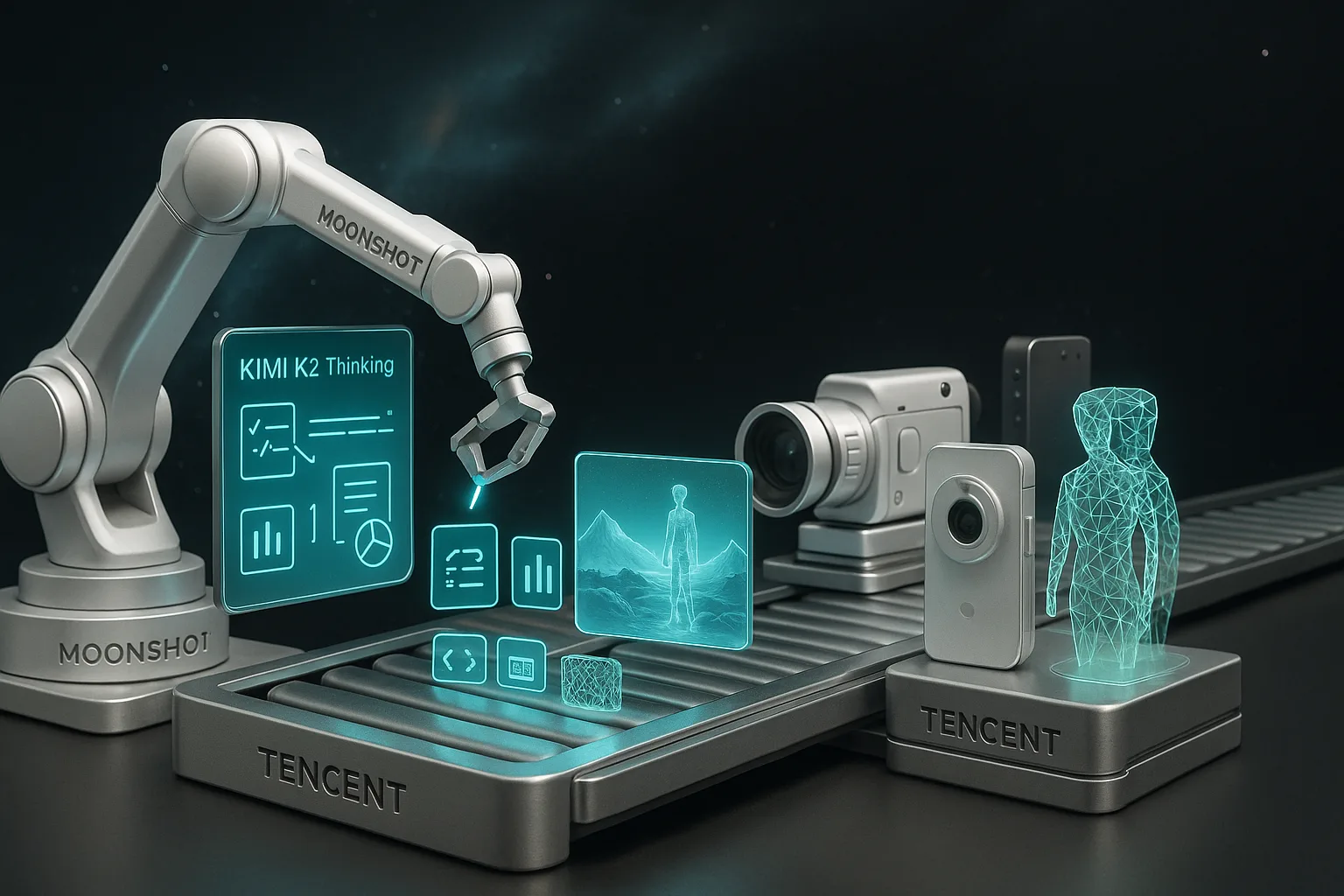
Two releases from China this week push beyond hype into real automation territory: Moonshot AI’s Kimi K2 Thinking, an agentic, open-source-leaning LLM built for tool use and multi-step reasoning, and Tencent’s HunyuanWorld-Mirror, a model that turns short videos or image sets into explorable 3D scenes. Both products target the same thing our readers care about most: can this plug into workflows today, and does it help scale creative output? Kimi K2’s availability via developer-friendly channels makes that answer increasingly “yes.”
Kimi K2 Thinking: Agentic LLM aimed at workflows, not just chat
What’s new: Kimi K2 Thinking is positioned as a reasoning-first model with native tool use. Translation: it does not just write, it can plan, call APIs, browse, and execute multi-step tasks. Third-party coverage and platform partners point to large-context capability and strong coding and planning performance. For creators, that means fewer brittle prompt chains and more out-of-the-box “do the thing” behavior rather than “explain how to do the thing.”
Automation lens: Can it run unsupervised sequences like “research → extract → write → publish”? In early integrations, K2’s tool-calling makes that plausible for semi-automated flows where the model composes queries, hits APIs, and compiles outputs. The usual guardrails still apply (rate limits, content reviews, and audit trails), but the base competency for orchestration is clearly in scope.
APIs and integrations: K2 Thinking is accessible through multiple developer channels today. Cloud providers like Novita AI host K2 for serverless access, a practical on-ramp if you are testing agentic flows without standing up your own infra (model page). For teams wanting deeper control, Moonshot AI maintains a public org with code and resources to watch as the ecosystem evolves (GitHub).
Reality check: Claims about beating the latest Western frontier models on every benchmark should be treated as marketing-adjacent until peer-reviewed. What matters for you: are the model’s tool-use behaviors dependable enough to shrink manual glue work? Early signals from partners suggest yes for well-scoped workflows (research assistants, report generators, analytics bots), and “maybe” for long, open-ended tasks without checkpoints.
K2 Thinking’s practical value is not a leaderboard flex, it is the built-in agentic muscles that reduce hand-rolled scripts between steps. Less duct tape, more throughput.
Tencent’s HunyuanWorld-Mirror: Video-to-3D that wants to be a pipeline, not a demo
What it is: HunyuanWorld-Mirror reconstructs dense 3D assets from short videos or image bursts, outputting scene representations like point clouds, meshes, and camera trajectories. The team’s open-source release cadence for the core HunyuanWorld stack includes code and demos (GitHub).
Automation lens: If you are running content capture at scale, such as product walkarounds, store audits, or event recaps, this is a legit “ingest video, get scene asset” primitive. Hook it to cloud storage triggers and you can push assets straight into Unity or Unreal scenes or web viewers for approval. For robotics and digital twin teams, the export of camera paths and depth maps reduces the manual toil between shoot and sim.
APIs and deployment: With public code and example pipelines, HunyuanWorld-Mirror leans integration-friendly. Expect Docker-friendly inference, standard 3D exports, and hooks for common photogrammetry tools. The headline: it is viable to wire into batch jobs rather than babysit a GUI. On licensing and commercial use, verify repo terms before shipping, since not all open licenses are created equal.
Turning “phone video” into “production-ready scene asset” is the difference between AR as a pitch deck and AR as a weekly content channel.
Quick compare: what you can automate today
| Capability | Kimi K2 Thinking | HunyuanWorld-Mirror |
|---|---|---|
| Primary output | Text, code, plans; multi-step tool calls | 3D assets (meshes, point clouds), camera paths |
| Best-fit automations (today) | Research assistants, report generation, content briefs, analytics summaries, code agents | Product walkarounds to 3D, venue scans, virtual showrooms, robotics sim scenes |
| APIs / Hosting | Available via partner gateways and cloud APIs (including Novita) | Open-source repo with code and examples |
| Integration friction | Low to medium (tool-calling flows still need guardrails) | Medium (media preprocessing, export choices, GPU scheduling) |
| Stack fit | n8n or Make.com, AI gateways, serverless APIs, private inference | Unity or Unreal or WebGL pipelines, asset managers, storage-triggered jobs |
Current vs. Future: where this slots into your stack
What you can do now:
Editorial ops (text or audio): Wire K2 Thinking to your research sources and CMS, then auto-generate drafts, briefs, and multi-language summaries with human checkpoints. Use cloud hosts to pilot without infra overhead (see K2 on Novita ).
Social and lifecycle marketing (text or image or video): Run K2 to parse industry news, produce multi-format post variants, and compile performance recaps daily. Keep humans in the loop for claims and compliance.
3D content capture (video or image to 3D): Batch-convert field footage to assets with HunyuanWorld-Mirror, auto-export to target engines, and stage reviews in a web viewer. Open-source code gives you room to customize ( repo ).
What’s still emerging:
End-to-end, fully autonomous publishing : Even with K2’s tool use, you will want approval gates, fact checks, and brand QA before anything hits production.
Hands-free 3D “perfect meshes” : World-Mirror shortens time-to-asset, but asset cleanup, lighting, and scale consistency still need an eye, especially for consumer-brand polish.
Cross-modal orchestration at scale: Moving fluidly from transcript to blog to video script to 3D scene is doable, but requires glue logic, metadata standards, and observability across tools.
APIs, licensing, and real-world readiness
Kimi K2 Thinking: Developer access is real today through partner gateways and cloud APIs. Moonshot AI maintains a public GitHub org (link). Licensing terms can vary by component, so if you are deploying in production, read the fine print and confirm attribution or scale clauses with your counsel.
HunyuanWorld-Mirror: Tencent’s Hunyuan team has shipped code and examples that make automation feasible now (link). As always, confirm the repo’s license aligns with your commercial needs before you bake it into client workflows.
Why this matters: cost, control, and speed
, Cost: More open, agentic models mean cheaper experimentation and less lock-in. K2’s availability across multiple hosts encourages price pressure and gives you leverage. For 3D, automated reconstruction cuts studio hours from capture to deploy.
, Control: Open repos and containerized inference put you in charge of data residency and tuning. That is a win for regulated verticals and enterprise privacy.
, Speed: The combination of tool-using LLMs and one-pass 3D capture means fewer manual bridges. Your team spends time on concept and QA, not glue code and file wrangling.
COEY POV: How to pilot this month
Start with a narrow agent using K2: a daily industry digest to draft posts to analytics recap loop with human approval. Track error rates and time saved.
Run a 3D sprint : Shoot 10 to 20 short product or venue videos and process them with HunyuanWorld-Mirror. Measure asset usability (mesh quality, edit time) and pipeline fit.
Instrument everything : Log prompts, tool calls, and outputs. Add rollback and audit trails before anything goes near publishing or production apps.
Plan multi-format from day one : Treat every captured asset, text, photo, video, audio, and 3D, as fuel for the others. That is where automation multiplies.
This week’s theme is simple: automation that respects reality. Tool-using LLMs and repeatable video-to-3D are not sci-fi anymore, they are building blocks. Use them to scale your creative system, not to skip taste and judgment.
Scale Your Content With AI Agents That Deliver
COEY helps brands and agencies automate content creation, marketing ops, and campaign execution using n8n, Claude Cowork, OpenClaw, and custom integrations. See how our agentic automation works across every marketing channel, or request a proposal.