Google Gemini 3 Arrives: What’s Real Now?
Google Gemini 3 arrives. What is actually real now and what AI marketing automation teams can ship today with the new reasoning, vision, and agent features.
18 November 2025Team COEY
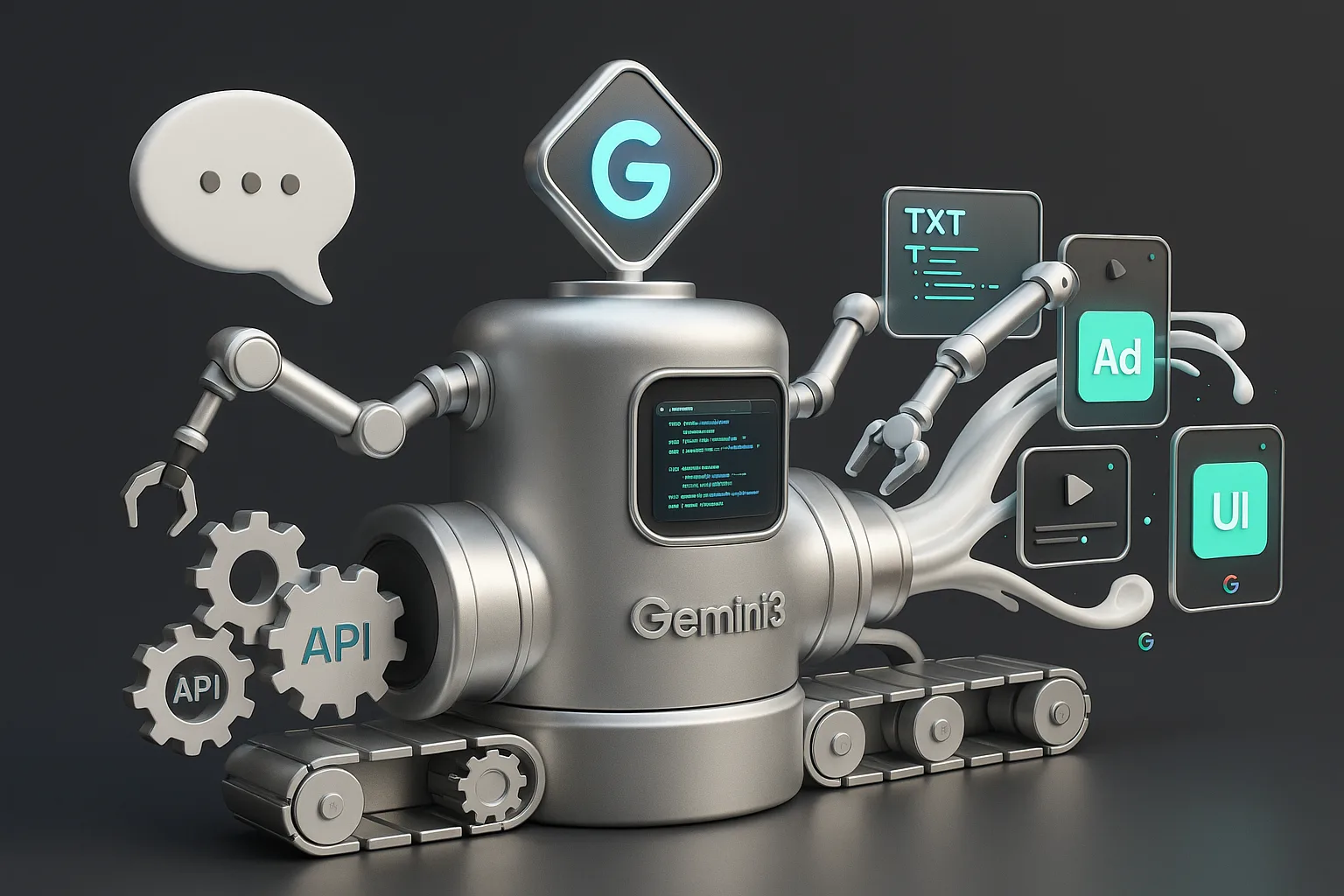
Google’s next big model, Gemini 3, focuses on agentic automation, multimodal reasoning, and a code-first workflow to compress idea-to-ship time. It includes an AI-first developer IDE, Antigravity, designed for moving easily from natural language to deployed apps. The key question: Where does Gemini 3 fit in your workflow today, and what features remain reserved or emerging?
COEY take: Treat this as a step-change, not a magic wand. Look for stable APIs, predictable pricing, and safe agent actions before you scale.
The Headlines, Minus the Hype
Coverage signals three big buckets:
Stronger multimodal reasoning: Process text, images, audio, video, and code together for better cross-format results and tighter instruction-following.
Agentic workflows: Designed to orchestrate multi-step tasks across apps and services , think less “chat,” more “go do it.”
Developer acceleration via Antigravity: An AI-first IDE meant to convert natural language into working code and prototypes. If it ties cleanly to Google’s deployment rails, teams will move faster.
Focus on day-two reliability: prioritize fewer retries, low latency, and seamless integrations with CMS and design tools.
Automation Lens: Can You Plug This In Today?
APIs and Entry Points
Gemini API and Google AI stack: Gemini 3 will integrate into existing Google AI Studio and Vertex AI tools, using REST endpoints and SDKs. Migration from Gemini 1.5 or 2.x is designed to be incremental.
High-quality image generation: Imagen 3 is available through the Gemini API for production-grade images.
Video generation through Veo: Veo 3 Fast delivers quick, synchronized video and audio via Vertex AI , ideal for ad variants and social media clips.
If you currently use Gemini APIs, expect Gemini 3 to be accessible soon. The real unlock is user-friendly agent actions that are safe and scalable.
Where It Already Helps
Text and research: Summarize long documents, extract sources, and enhance assets like briefs and show notes.
Images: Generate consistent, on-brief ad assets thanks to Imagen 3.
Video: Veo 3 delivers short, audio-enhanced clips for creative and social uses.
Code and product: Antigravity supports moving from concept to working prototypes quickly, enabling true cross-functional collaboration.
Current vs. Future: What’s Ready, What’s Still Locked
| Area | What creators and marketers can do today | APIs and integrations | Gaps and watchouts |
|---|---|---|---|
| Text and Docs | Research, summarize, draft, and refine long documents; generate briefs and copy. | Gemini API via AI Studio and Vertex AI. | Hallucinations still possible; maintain strong citation and QA. |
| Images | Generate assets and variants with watermarking and guardrails. | Imagen 3 through the Gemini API. | Style consistency requires prompt management and review. |
| Video | Create short clips with audio for social and creative experimentation. | Veo 3 Fast via Vertex AI. | Control over sequence length and details is still limited. |
| Agents | Initial action capabilities in Google apps; expanded actions coming. | Platform updates extend features gradually. | Enterprise-scale controls like permissions and error handling still evolving. |
| Code | Prototype apps and dashboards faster with model support. | SDKs and REST endpoints across Google’s AI suite. | Production quality still requires thorough testing and oversight. |
Context: How This Fits Google’s Broader Play
Google is working to unify multimodal reasoning, deploy safe creative tools, and deliver practical models. The Gemma family targets open, developer-friendly options. Gemma 3 emphasizes portability and efficiency. Recent platform updates push for longer context and practical agent steps in daily work.
About those benchmarks
Leaderboards offer signals, but success is measured by fewer retries, stable latency, and smooth integration with design and content tools. Use benchmarks as an indicator, not a guarantee.
Practical Impact: Workflows You Can Upgrade Now
Research-to-asset pipelines: Process transcripts, PDFs, and images to create structured briefs, initial copy, and draft visuals. Human review still essential for brand and legal checks.
Campaign experimentation at scale: Generate creative assets and ads faster , use Imagen for images, Veo for video, and Gemini for copywriting.
Prototype-to-production: Use Antigravity for rapid scaffolding. Final tests and analytics remain key.
Cross-format repurposing: Transform a webinar into a blog, social content, and emails from one prompt chain.
What’s Still Missing
Agent APIs with granular permission: Enterprise needs audit trails and detailed control.
Transparent availability: Watch for staggered releases, limits, and pricing differences.
Greater creative video control: Veo is progressing, but more nuanced direction for video is still needed industry-wide.
Rule of thumb: if you can call it via API and verify outputs with a human in the loop, you can scale it. If it is only available inside a closed UI, treat it as a pilot, not a pipeline.
The Bottom Line for Builders
Gemini 3 points toward collaborative models that cover text, image, video, and code for more seamless workflows. The main value: fewer handoffs across formats and new reliability for creative and code outputs. Move quickly where APIs are stable, experiment cautiously with agentic features, and maintain human review for anything user-facing. When agent APIs become robust, shift from assistive to more autonomous use cases. Build now with what is ready so you can scale fast as new features unlock.
For visual work, use Veo 3 Fast for concise, audio-rich video, and Imagen 3 for consistent image output. If lightweight models matter, track Gemma 3’s progress. Leverage today’s tools, so you are prepared for tomorrow’s expansions.